1557
Published on December 6, 2025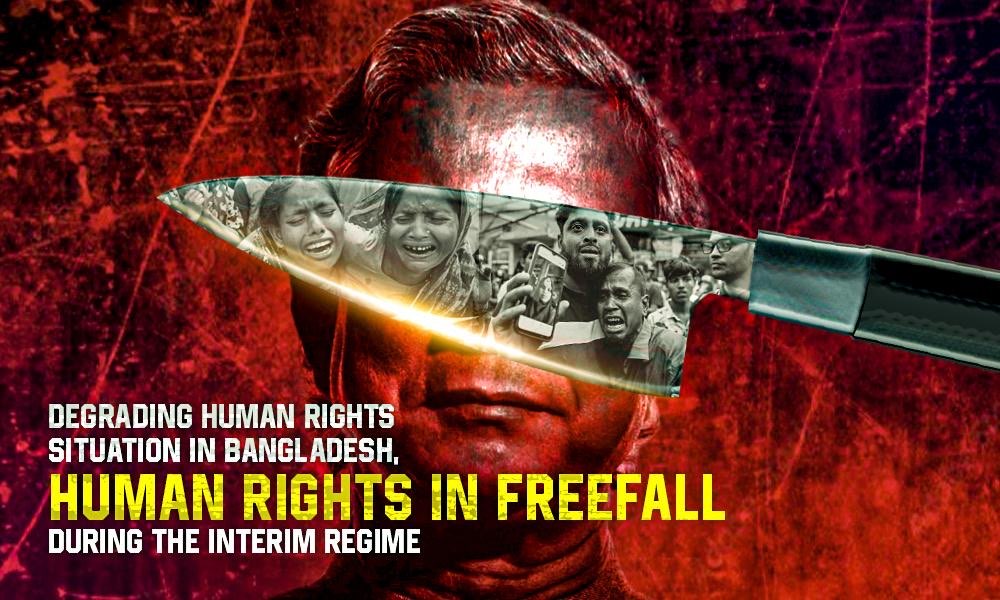
November 2025 has exposed a stark truth: human rights in Bangladesh are rapidly eroding under the interim government led by Muhammad Yunus. Ordinary citizens - students, journalists, and political activists - now live under constant fear. Speaking out, participating in protests, or even expressing opinions online can lead to arrests, harassment, or worse. The interim government has turned state institutions, from the police to intelligence agencies, into tools of control, often operating with complete impunity.
Concerns Over Human Rights Violations in Post-Hasina Bangladesh
These violations are not random incidents. They are part of a deliberate and systematic effort to silence dissent and consolidate power. Evidence suggests that lethal force has been authorized against protesters, showing a government willing to put power above the safety and rights of its citizens.
In this climate, human dignity is ignored, due process is routinely sidelined, and the institutions meant to protect justice fail to act. November serves as a grim reminder: when the interim government enforces fear instead of protecting rights, the very foundations of democracy and civic life are at risk.
Throughout November, the interim government’s approach to dissent became unmistakably clear: speech itself is now treated as a crime. Ordinary people were detained for something as simple as reacting to a political post online. In several districts, individuals were picked up for old Facebook activity or for being suspected of supporting the “wrong” political side. These aren’t isolated cases; they reflect a broader attempt to police everyday expression.
Much of this repression is being carried out through the National Cyber Security Ordinance 2025, which has turned online spaces into something citizens fear rather than use freely. Under this law, criticism of the interim government is often labeled as harmful or destabilizing. In November alone, an estimated 40 to 50 people were questioned, detained, or charged under cyber provisions, many without prior notice or proper legal access. The message is simple: even digital conversations are being watched.
The pressure extends to those who shape public thought. Journalists, students, and academics who speak critically about the interim regime have faced intimidation, surveillance, or threats of arrest. University classrooms and newsrooms feel unusually restrained, with people choosing silence over the risk of drawing unwanted attention. What used to be spaces for open discussion are now marked by caution and self-censorship.
Taken together, these actions show a clear pattern. The arrests, the misuse of cyber laws, and the targeting of critical voices are all part of a deliberate effort to stifle debate and consolidate authority. By shrinking the space for dissent at every level, the interim government is attempting to control not just politics, but the national conversation itself.
The month of November brought a fresh wave of politically-rooted violence across Bangladesh, underscoring how deeply insecurity and fear have become embedded under the interim government. According to recent human-rights monitoring, November saw 96 reported incidents of political violence, in which 12 people killed, and hundreds more were wounded.
12 people killed in political violence across Bangladesh in November 2025, says HRSS report
Beyond politically-linked confrontations, November also witnessed a surge in mob violence: in at least 20 separate mob-attack incidents, 16 people were killed, and 11 others were wounded. The number of bodies found under suspicious circumstances, dumped in rivers, canals, or remote areas, rose sharply, adding to the climate of dread that now hangs over many communities.
Alarming rise in mob attacks in the country: 16 killed in 20 incidents in November
These aren’t merely random crimes or interpersonal disputes. The patterns are chillingly consistent: political affiliation or perceived opposition seems to be enough to mark someone for violence, while oversight and accountability appear dangerously absent. Weapons reportedly looted from hundreds of police stations and outposts over the past year are now being used freely, fueling killings and enabling perpetrators who clearly act with confidence, not fear.
By any measure, November maps as a month of intensified repression and lethal force aimed at suppressing dissent. The deaths, the mob attacks, the anonymous corpses, they’re not accidents or byproducts of chaos. They are symptoms of a state-sponsored strategy of intimidation, deployed to silence opposition, eliminate threats, and reinforce absolute control.
Under this interim regime, violence has become more than a tool; it has become a message.
November revealed a deeper crisis than street-level violence; it exposed how completely the state’s institutions have stopped functioning. Instead of protecting citizens, the machinery of justice and law enforcement has turned inward, operating as an extension of political control under the interim regime.
Throughout November, rights groups documented over 300 house-to-house raids, many conducted without warrants and accompanied by intimidation, property damage, and arbitrary detentions. Victims attempting to file complaints found police stations either refusing cases or redirecting them endlessly. At the same time, the judiciary’s silence has grown louder: politically sensitive petitions stalled, hearings delayed, and case backlogs expanded significantly, signaling a system deliberately slowing down when justice is most urgently needed.
This collapse has reshaped daily life. Teachers avoid discussions, activists scrub their online history, and community events shrink as fear becomes the default social condition. Monitors estimate that self-censorship surged by 40% in November, reflecting a population forced to retreat from public expression.
These aren’t bureaucratic failures; they are outcomes. The interim government has created an environment where fear replaces law, and compliance replaces citizenship, ensuring that dissent is impossible and accountability nonexistent.


This work is copyrighted and authorized by the Bangladesh Awami League. You may download, display, print and re-produce this material in unaltered form only (retaining this notice)for your personal, non-commercial use or use within your organization.
