2932
Published on December 20, 2025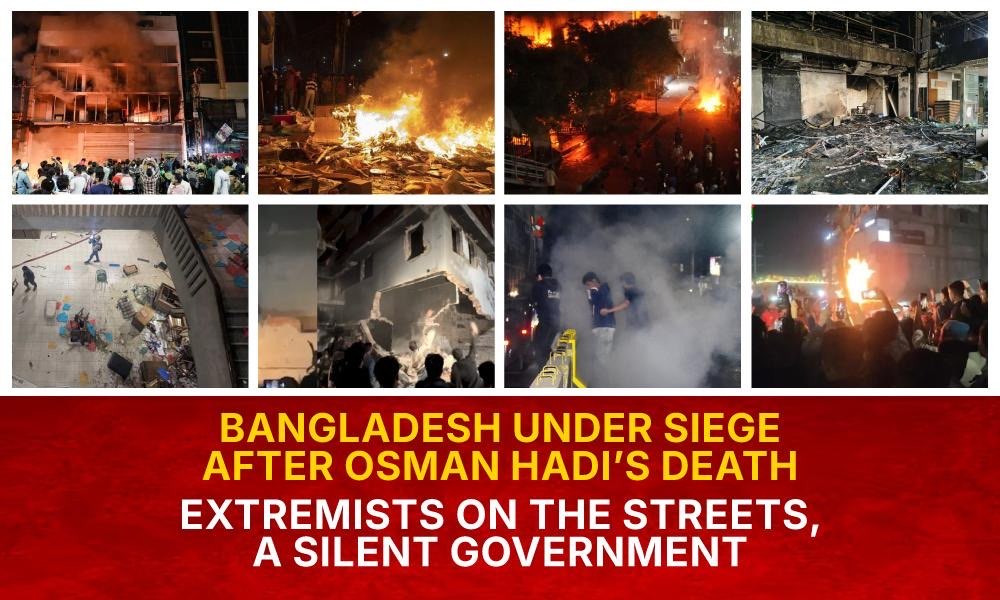
A coordinated wave of attacks on media, minorities, cultural institutions, and diplomatic sites exposes the rise of organized Islamist violence and the interim government’s refusal to confront it.
Osman Hadi did not die on the streets of Dhaka. He died abroad, in Singapore, far from the political theater that would later be built around his body. More importantly, the Singaporean authorities refused permission for his janaza, citing suspected links to extremist activity. This was not a rumor, not an opposition claim, but a decision taken by a state known for its zero tolerance toward militancy. Yet the moment Hadi’s death entered Bangladesh’s political bloodstream, this fact was systematically erased.
Violence continues in Bangladesh after youth protest leader's death
What followed was not collective mourning; it was deliberate narrative laundering. A figure flagged internationally for security concerns was rapidly repackaged at home as a “martyr.” Complexity was stripped away, context buried, and inconvenient facts silenced. In its place emerged a simplified, emotionally charged story, one designed not to inform the public, but to mobilize it.
Hadi’s body became a political instrument. It was placed at the center of street agitation, invoked to justify rage, and used as moral cover for actions that had nothing to do with justice or grief. This was not about honoring the dead. It was about activating the living, directing anger outward, toward carefully chosen targets, at a carefully chosen moment.
Nationwide Vandalism and Arson Erupt After Osman Hadi’s Death
The speed with which this transformation occurred matters. So does the coordination. Narratives do not shift this cleanly, this quickly, without guidance. The reframing of Osman Hadi, from a controversial figure denied burial abroad to a sanctified symbol at home, was not organic. It was engineered.
The real question, therefore, is not why people were emotional. The real question is far more uncomfortable: who decided to weaponize that emotion, who benefited from it, and why the state allowed a foreign death to be converted into a domestic crisis. Grief does not automatically lead to nationwide chaos. Someone has to pull the switch.
The violence that followed Osman Hadi’s death was neither accidental nor uncontrolled. It was structured, targeted, and executed with remarkable consistency across the country. Institutions were attacked in parallel, symbols were chosen with care, and fear was deployed as a political tool. This was not outrage escaping the streets; it was unrest being activated, guided, and allowed to spread.
Attack on Indian Assistant High Commissioner’s Residence in Chattogram
Prothom Alo, The Daily Star offices vandalised, set on fire
New Age Editor Nurul Kabir harassed by protesters near Daily Star office
Youth Killed Over Blasphemy Allegations, Body Set on Fire After Being Tied to a Tree
Taken together, these incidents form a map, and that map tells a single story.
These targets are not random, and the sequence is not accidental. This is ideological violence with a coherent logic, aimed at reshaping the public sphere through fear and destruction. What Bangladesh witnessed was not public outrage, but the street-level execution of an extremist agenda, carried out in plain sight.
With Osman Hadi’s body placed at the center of events, a central question emerges: who is creating chaos and paralysis in Bangladesh, and why is the state acting only as a spectator?
As events unfolded, it became clear that Islamist extremist networks, particularly those linked to Jamaat-e-Islami, were not harmed by the unrest; they were strengthened by it.
A Group Is Deliberately Pushing the Country Toward Chaos
For Jamaat, instability is politically useful. A return to normal civic life, especially one moving toward an election, requires law and order, public confidence, and institutional control. Those conditions do not favor a party with limited public support. Chaos, however, does. By keeping the streets tense and institutions under pressure, the possibility of a functional political process steadily recedes.
The ideological signals during this period were hard to ignore. Al-Qaeda flags were raised openly in parts of Dhaka, not in hiding or fear, but with confidence. Such actions usually happen only when those involved believe there will be little or no consequence. That sense of safety was strengthened by slow, uneven, or missing responses from law enforcement, even as violence unfolded in full public view.
At the same time, familiar political positions resurfaced. Jamaat-e-Islami’s hostility toward India appeared again in both language and targets, while its long-standing political closeness to Pakistan, a country historically aligned with Islamist forces opposed to Bangladesh’s secular roots, remained unchanged. These are not sudden reactions to recent events, but part of an established ideological outlook.
Most striking of all was the government’s response, or more accurately, its absence. At a moment when the country required clear authority and decisive leadership, there was no firm condemnation of the violence, no public identification of the forces driving it, and no visible move toward accountability. This vacuum was not merely symbolic; it had real consequences on the ground.
In times of unrest, the state’s language matters as much as its actions. Silence from the top does not calm situations; it signals boundaries, and in this case, it signaled that those boundaries were weak or negotiable. Violent actors test limits. When those limits are not enforced early and publicly, confidence shifts away from institutions and toward the streets.
By choosing restraint without clarity, the government allowed extremist networks to interpret inaction as tolerance. Law enforcement hesitated, political authority blurred, and responsibility was quietly deferred. What emerged was not neutrality, but a passive posture that emboldened those already pushing the country toward disorder.
When organized extremism advances and the state restricts itself to observation, neutrality stops being a safeguard. It becomes complicity by omission, enabling violence not through intent, but through refusal to act.




This work is copyrighted and authorized by the Bangladesh Awami League. You may download, display, print and re-produce this material in unaltered form only (retaining this notice)for your personal, non-commercial use or use within your organization.
