2912
Published on February 3, 2026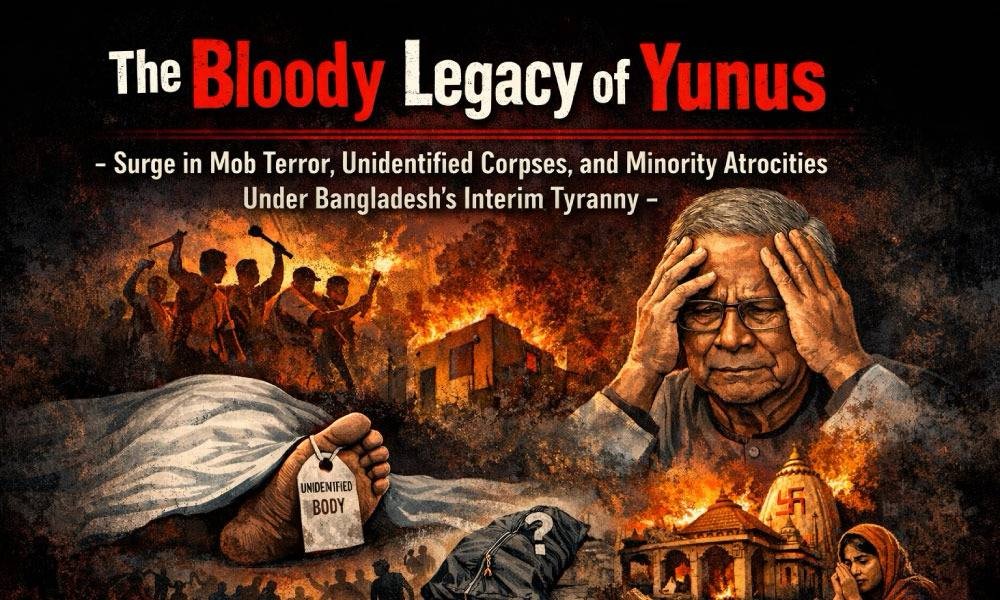
In the shadow of Nobel laureate Muhammad Yunus's interim rule, Bangladesh has descended into a lawless abyss where mobs dictate justice, corpses pile up unidentified, and minorities, particularly Hindus, face systematic extermination. Since Yunus seized power in August 2024 following a chaotic student-led uprising that ousted Prime Minister Sheikh Hasina, the nation has witnessed an unprecedented explosion of violence.
Yunus Democracy Failure and Bangladesh’s Growing Security Crisis
But it's in January 2026 where the horror peaked, with mob killings doubling, unidentified bodies surging, and targeted attacks on minorities reaching feverish levels. Yunus, once hailed as a poverty-fighting hero, now stands accused of enabling this carnage through sheer incompetence, deliberate neglect, or worse, complicity in a regime that prioritizes political vendettas over human lives. His administration's denials and whitewashing of these atrocities only expose the rot at the core of his so-called "reform" government.
This is not governance; it's a betrayal that has turned Bangladesh into a graveyard for the vulnerable.
Mob violence has replaced the rule of law under Yunus. The Manabadhikar Shongskriti Foundation (MSF) documented 28 mob-beating incidents in January 2026 alone, resulting in 21 deaths, more than double the 10 fatalities recorded in December 2025. MSF bluntly calls these “extrajudicial killings by the public,” enabled by the total collapse of institutional justice during Yunus’s tenure.
MSF Report: 21 Killed in Mob Justice in January; Unidentified Bodies and Minority Abuses Rise
The surge reflects a chilling escalation in grassroots terror, often fueled by rumors, false accusations, and impunity:
Victims accused of theft, mugging, robbery, extramarital affairs, drug dealing, extortion, or political ties (e.g., perceived Awami League affiliates) were beaten to death, with 17 injured survivors handed over to police only after near-fatal assaults, proving mobs now serve as judge, jury, and executioner while law enforcement stands aside.
High-profile cases spilling into or near January highlight the pattern: A Hindu businessman in Shariatpur attacked on December 31, 2025, doused in petrol and set ablaze, died January 3, 2026, amid rising minority-targeted brutality.
Earlier December horrors, like the December 18, 2025, lynching of a Hindu factory worker in Mymensingh over alleged blasphemy (beaten, hanged, burned), set the tone for unchecked mob rage that carried forward, emboldening perpetrators into the new year.
Since August 2024, over 650 people have been beaten to death by mobs. Yunus has nurtured a “culture of impunity” that Human Rights Watch compares to the worst days of authoritarian rule. His administration bans opposition student wings, purges institutions, and ignores digital incitement on Facebook and TikTok that turns rumors into lynchings. The Rights and Risks Analysis Group (RRAG) labels it “mobocracy”, and Yunus is its enabler-in-chief.
Bangladesh: Mob lynching and arson killings expose escalating breakdown of law and order
January’s doubling of deaths is no coincidence. It is the predictable result of a government obsessed with prosecuting political enemies while letting grassroots terror run wild, leaving the vulnerable to face barbarism without protection.
The mounting pile of unidentified bodies across Bangladesh serves as one of the starkest indictments of Muhammad Yunus’s interim rule, a grim testament to collapsed law enforcement, unchecked violence, and a regime that has prioritized political purges over basic public safety. Under Yunus, the recovery of these nameless corpses has surged, reflecting widespread fear, disappearances, torture, and extrajudicial killings that his administration refuses to confront head-on.
According to the Manabadhikar Shongskriti Foundation (MSF)'s January 2026 monitoring report, 57 unidentified bodies were recovered nationwide in January alone, an alarming increase from 48 in December 2025. MSF explicitly ties this rise to escalating “violence, enforced disappearances, and extrajudicial killings” during the interim period, with many bodies bearing clear evidence of brutality: torture marks, blunt-force trauma, execution-style wounds, and signs of being dumped post-mortem.
The trend has worsened progressively under Yunus:
October 2025: A sharp initial spike in recoveries, signaling “growing insecurity in public life” and public distrust in law enforcement.
Late 2025 into January 2026: Acceleration of discoveries in rivers, ditches, urban dumpsites, highways, and abandoned areas, locations that scream deliberate concealment.
Chattogram region: At least 12 murders reported in just 26 days during early 2026, with many victims ending up as unidentified remains while suspects openly threaten police online, highlighting the near-total breakdown of authority.
Since Yunus assumed power in August 2024, unidentified corpse recoveries have roughly doubled compared to pre-interim periods, with MSF and other rights groups noting patterns linked to mob lynchings, political vendettas, ransom-related crimes, and possible state-linked disappearances. Armed groups operate brazen ransom camps in areas like Teknaf, while the police, understaffed, demoralized, and systematically purged of experienced officers, fail to investigate or deter.
Bangladesh Slipping into Fear Under Yunus’ Interim Regime
Yunus’s press team routinely dismisses the crisis as “no cause for panic,” offering hollow reassurances amid a human rights situation MSF describes as “alarmingly violent and complex.” Yet every unidentified body pulled from a river, or roadside is a silent, rotting accusation against a leader who promised reform after the 2024 upheaval but delivered only chaos, impunity, and fear. These nameless dead are not statistics; they are the forgotten victims of a government that has let Bangladesh descend into a lawless void.
The relentless assault on minorities, especially Hindus, under Muhammad Yunus’s interim rule stands as one of the most disgraceful failures of his tenure. His government’s systematic denial and reclassification of targeted violence as “ordinary crime” has granted near-total impunity to perpetrators, leaving entire communities in terror.
Minority Forum Raises Alarm Over Increasing Communal Violence in Bangladesh
Key documented horrors since mid-2025:
At least 116 minority deaths(June 2025–January 2026), including lynchings, targeted murders, and suspicious killings.
522 communal attacks in 2025 alone (per Bangladesh Hindu Buddhist Christian Unity Council), resulting in 66 deaths, 28 cases of violence against women (including rapes), 95 attacks on places of worship, and 102 assaults on homes/businesses.
India’s Ministry of External Affairs recordsover 2,900 incidentssince Yunus took power, encompassing killings, rapes, looting, temple vandalism, and land grabs.
January 2026 marked a savage escalation:
42 communal incidents by January 27 (BHBCOP data), including 11 murders, 1 rape, 9 temple/church attacks, and 21 home/business/land-grab assaults.
Rights groups documented at least 15 Hindu murders in the 45 days from December 1, 2025, to January 15, 2026, roughly one every three days.
Sharp rise in temple and idol vandalism (21 cases in January vs. 6 in December, per MSF).
These follow a chilling pattern: false blasphemy claims → mob mobilization → murder and destruction with zero accountability. Yunus’s regime insists that of 645 recorded incidents in 2025, only 71 were “communal,” dismissing the rest as neighbor disputes or theft, an absurd whitewash that excludes most killings and arsons.
Why Bangladeshi minorities are scared ahead of elections
Yunus brands credible reports “fake news” or “exaggeration,” even as HRW, Amnesty International, and the UN condemn the surge and the failure to prosecute. His inaction, or complicity, has emboldened fundamentalists, creating a climate of existential fear for minorities ahead of elections. This is ethnic cleansing by attrition, enabled by a leader who promised reform but delivered terror.
Yunus promised a new Bangladesh. Instead, he has presided over:
Custodial deaths doubled in January 2026 (15 vs. 9 in December).
Misuse of anti-terror laws to silence journalists (e.g., Monjurul Alam Panna) and critics.
272,000 people were implicated in politically motivated cases within his first 100 days.
Indigenous killings and injuries in Bandarban are left unaddressed.
Systematic purging of police and bureaucracy, creating a security vacuum that mobs and criminals exploit.
Amnesty International’s open letter to Yunus demanded basic rights guarantees ahead of elections, guarantees he has failed to deliver. RRAG and Transparency International point to rampant corruption, rising radicalisation, and a “jungle law” environment where kidnappings have doubled, and citizens sell assets to pay ransoms.
Yunus threatens resignation when criticised, yet clings to power, delays elections, and bans opposition voices. The man who won a Nobel for fighting poverty now fights only to protect his own failing regime, at the cost of hundreds of lives.
Muhammad Yunus's interim rule has been a catastrophe, transforming Bangladesh from a flawed democracy into a failed state riddled with mob terror, unidentified graves, and minority genocide. January 2026's horrors,21 mob deaths, 57 unidentified bodies, and a spree of Hindu killings, encapsulate his abject failure. His denials, whitewashing, and inaction have enabled this nightmare, betraying the Nobel ideals he once embodied. The world must hold Yunus accountable; his regime isn't reforming Bangladesh, it's destroying it. Without immediate intervention, the death toll will only rise, and Yunus's legacy will be etched in blood.


This work is copyrighted and authorized by the Bangladesh Awami League. You may download, display, print and re-produce this material in unaltered form only (retaining this notice)for your personal, non-commercial use or use within your organization.
