12991
Published on February 15, 2026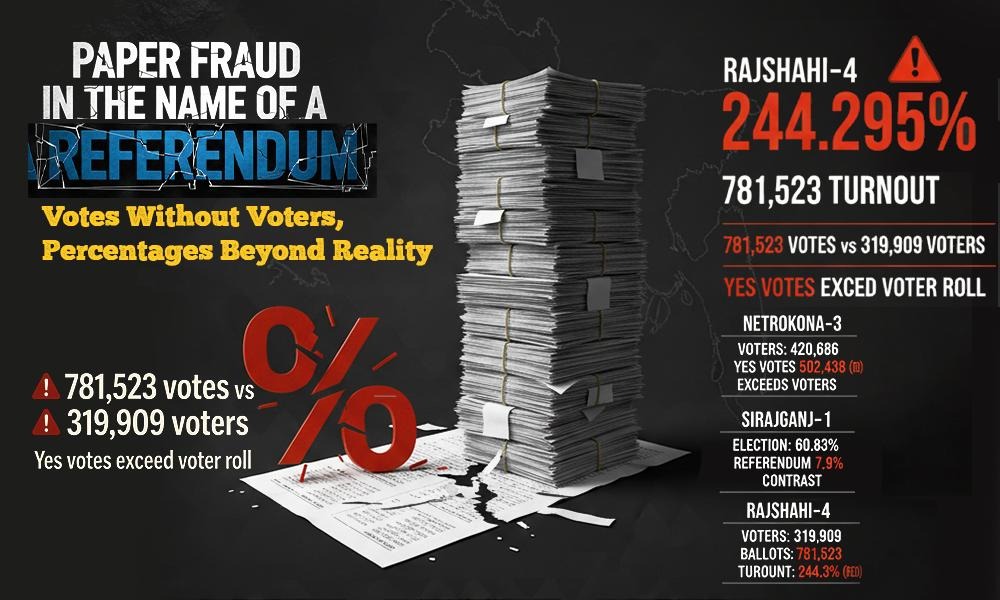
What has been presented as a referendum is being described by critics as a paper exercise designed to manufacture legitimacy under the patronage of the “illegal” Yunus government. They argue that no matter how figures are arranged, falsehood remains false. An analysis of the Election Commission’s declared results, they claim, reveals numbers in several constituencies that defy mathematics, reality, and common sense.
Rajshahi–4: More Than Double the Voters?
Total registered voters: 319,909
Referendum votes reportedly cast: 781,523 (244.295%)
‘No’ votes: 612,229
‘Yes’ votes: 145,382
Critics point out that the total ballots exceed the number of registered voters. In this constituency, Jamaat-e-Islami candidate Abdul Bari Sardar was elected to parliament.
Sirajganj–1: 60% in the Election, 7% in the Referendum?
In the parliamentary election, turnout was reported at 60.83%.
Yet on the same day, referendum turnout was declared at just 7.899%.
The seat was won by BNP candidate Selim Reza. Observers question how turnout among the same voters, at the same polling centres, could vary so sharply.
Netrokona–3, –4, –5: ‘Yes’ Votes Exceed Voter Rolls
In Netrokona–3:
Total voters: 420,686
‘Yes’ votes reported: 502,438 — exceeding the total number of voters.
Total votes cast: 238,358
Casting rate: 56.659%
Similar statistical inconsistencies are alleged in Netrokona–4 and –5.
Opponents describe these figures as evidence of a “set result” and a fabricated election — pointing to turnout exceeding 200% in some cases, missing votes in others, and results they say were predetermined. They argue that attempts to revise or defend the outcome will not address what they call a fundamental crisis of credibility.
According to critics, the boycott by large sections of the electorate underscores their claim: that this was not a genuine democratic exercise, but a deeply contested one.










This work is copyrighted and authorized by the Bangladesh Awami League. You may download, display, print and re-produce this material in unaltered form only (retaining this notice)for your personal, non-commercial use or use within your organization.
