4784
Published on February 26, 2026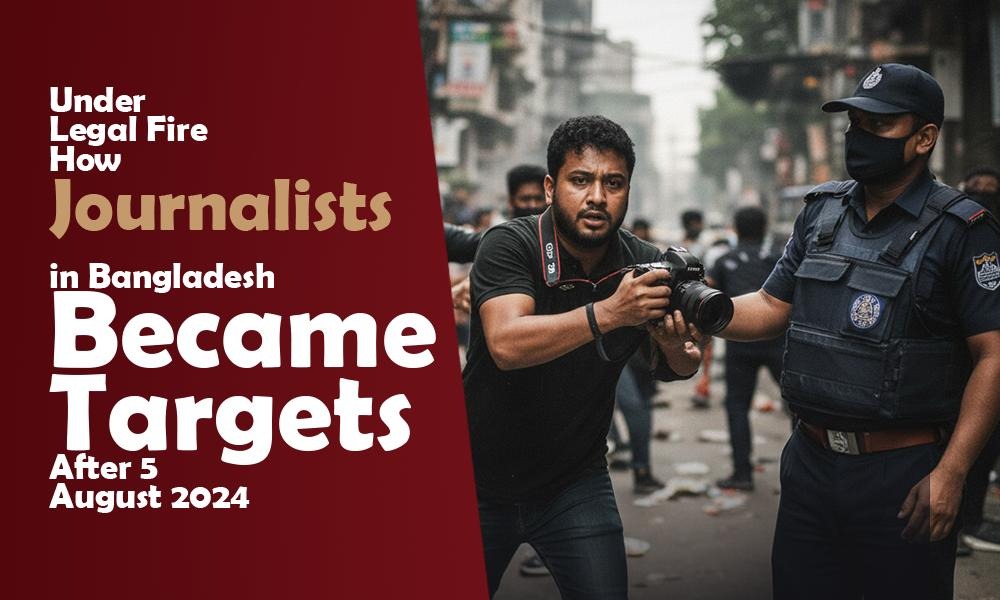
When Bangladesh underwent political transition on 5 August 2024, journalists were on the streets documenting protests, clashes and uncertainty. Months later, many found themselves not just reporting the news - but becoming part of it.
Since that date, a sharp rise in criminal cases, arrests, intimidation and physical attacks against journalists has been documented by domestic and international watchdogs. Media leaders warn the trend risks eroding press freedom at a critical political juncture.
According to research published by Transparency International Bangladesh (TIB), between 5 August 2024 and 1 November 2025, at least 1,073 journalists and media workers were affected by attacks, threats, detention, legal action or harassment across 476 documented incidents.
International reporting by The New Humanitarian found that over 140 journalists faced criminal cases, including serious charges such as murder linked to protest-related coverage - a significant rise compared to previous years.
Press watchdog Reporters Without Borders (RSF) condemned charges brought against at least 25 journalists in August 2024, calling them disproportionate and raising concerns about judicial harassment.
TIMELINE: How Journalists Were Targeted on False Cases in Bangladesh
5 AUG 2024
Political transition begins.
Journalists cover protests and clashes nationwide.
AUG–SEP 2024
First wave of criminal cases filed.
Journalists named in murder and protest-related charges.
RSF condemns cases against at least 25 reporters.
OCT–DEC 2024
Multiple journalists detained or facing repeated court appearances.
Rights groups report spike in intimidation and threats.
Press accreditation concerns raised.
EARLY 2025
Demonstrations by journalists in Gazipur demanding withdrawal of “false cases.”
Reports emerge of travel restrictions and summons linked to reporting.
MID–LATE 2025
TIB documents 1,073 journalists affected in 15 months.
Ain o Salish Kendra reports hundreds facing abuse or legal pressure.
Mob attacks reported on media offices, including major newspapers.
25 FEB 2026
Editors’ Council formally calls for withdrawal of
“false and harassing cases” filed since August 2024.
Legal Pressure and Arrests
Monitoring groups report that criminal complaints often include journalists among large lists of accused individuals in protest-related cases. Critics argue such filings blur the distinction between reporting on unrest and participating in it.
The International Federation of Journalists (IFJ) documented arrests in August 2024 of broadcast journalists attempting to travel abroad, alleging “incitement to violence.” Their representatives described the accusations as unsubstantiated.
Local rights group Ain o Salish Kendra (ASK) reported that in 2025 alone, 381 journalists faced abuse or harassment, with dozens subjected to legal action directly connected to their reporting or commentary.
Attacks Beyond the Courtroom
Legal cases represent only part of the picture.
Journalists have reported physical assaults, threats, and pressure from political actors. In late 2025, Reuters reported that mobs attacked offices of major newspapers including Prothom Alo and The Daily Star, temporarily halting printing operations and raising alarm about press safety.
Editors say such incidents, combined with criminal litigation, have created an environment where journalists increasingly weigh legal consequences before publishing sensitive stories.
The Editors’ Council Intervention
On 25 February 2026, the Editors’ Council issued a public statement urging the government to withdraw what it called “false and harassing cases” against journalists filed since August 2024.
The Council stated that while credible allegations should be addressed through transparent legal processes, politically motivated or intimidation-driven cases undermine the constitutional commitment to press freedom.
A Climate of Caution
Inside newsrooms, editors describe heightened self-censorship and caution. Journalists report frequent court appearances, financial strain from legal defence, and uncertainty about professional security.
Media analysts warn that the cumulative effect may be long-lasting - not only affecting reporters but narrowing public access to independent information.
As Bangladesh continues navigating its post-transition political landscape, observers say the handling of these cases will remain a defining test of democratic accountability and media freedom.

This work is copyrighted and authorized by the Bangladesh Awami League. You may download, display, print and re-produce this material in unaltered form only (retaining this notice)for your personal, non-commercial use or use within your organization.
