1320
Published on September 21, 2026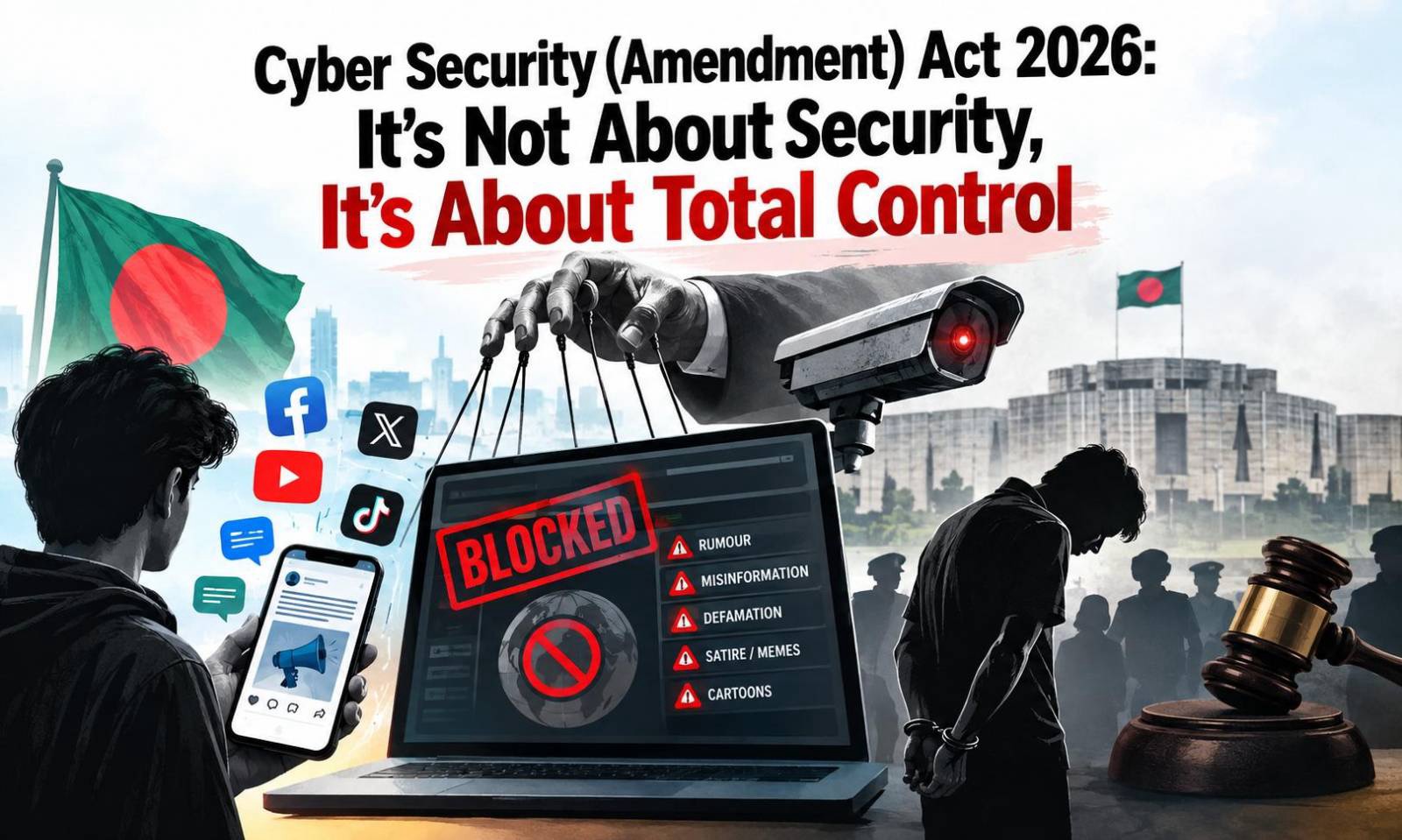
Bangladesh’s newly elected BNP government is moving fast to pass the Cyber Security (Amendment) Act 2026. This is not a technical update on digital safety. It is a law that turns everyday online speech into a potential crime. Spreading what the government calls a “rumour” could land you in prison for up to 10 years. Sharing “misinformation” online could cost you a fine of BDT 40 lakh. Online defamation carries up to five years. Satire, memes, and cartoons are not safe either.
Draft Cyber Security Amendment Act a threat to freedom of expression
Vague words like “demeaning,” “humiliation,” and “insulting to the state” are left wide open. There is no clear standard for intent or actual harm. That is exactly how laws become tools for selective enforcement.
Gathering clouds darken sky over media landscape
Transparency International Bangladesh has been blunt about the danger. The draft throws cybercrime, cybersecurity, and freedom of expression into one law, creating “scope for risky and deliberate misinterpretation and misuse.” TIB Executive Director Dr. Iftekharuzzaman warned that if it passes as written, Bangladesh’s cyberspace risks becoming “an environment of unchecked surveillance, impunity and repression.” Other rights groups, including the Human Rights Support Society, have raised the same red flags: treating “unverified” information as a criminal offence will hit journalists and public-interest reporting hardest.
TIB warns draft cyber law could enable unchecked surveillance and repression

These are not the penalties of a confident democracy. They are the penalties of a government that wants people to think twice before they speak.
The draft also hands the state sweeping new powers. Content can be blocked without prior court approval. The grounds for blocking are broader than before. Public disclosure of what has been taken down is no longer required. A 28-member National Cyber Security Council, stacked with the Prime Minister and government nominees, would hold the real authority. Only two private-sector experts would sit on it, and both would be chosen by the government. Officials acting under the law receive immunity from legal action. That is not checks and balances. That is a system designed for control.
Won’t accept cyber law that silences people
These expanded powers, combined with the vague speech offences, raise a basic question: do democratic governments write laws like this? Most do not. Healthy democracies define offences tightly, demand proof of harm, and keep independent courts between the state and the citizen. Authoritarian systems do the opposite; they keep the language vague so the powerful decide what counts as speech. The BNP draft follows the second model.
When the Awami League government passed its Cyber Security Act in 2023, the law faced intense domestic and international criticism. Yet that framework still operated under continuous public scrutiny and left some room for civil society consultation, judicial process, and ongoing dialogue on human rights safeguards. The interim government that followed later removed several of the most contested provisions. The current BNP proposal does not build on those limited gains. In important ways, it reverses them, raising maximum sentences for “rumours” and “misinformation,” widening content-blocking authority, and folding speech controls more explicitly into a security statute. A party that campaigned on restoring democratic space is now advancing a tighter legal instrument than the one it once criticised.

If this law passes, how much freedom of speech will actually remain? The right to speak, to question authority, to publish a cartoon, or to report facts that inconvenience those in power will shrink under the threat of long prison terms and heavy fines. A government that came to office promising democratic recovery is building a more efficient tool to manage public conversation.
The BNP leadership should withdraw this draft and start over with genuine consultation. Vague speech crimes and unchecked executive power do not protect citizens. They protect power. International observers and Bangladeshis who fought for open space should treat this proposal for what it is: a clear warning that the language of freedom was easier to campaign on than to practise.




This work is copyrighted and authorized by the Bangladesh Awami League. You may download, display, print and re-produce this material in unaltered form only (retaining this notice)for your personal, non-commercial use or use within your organization.
