9886
Published on January 15, 2026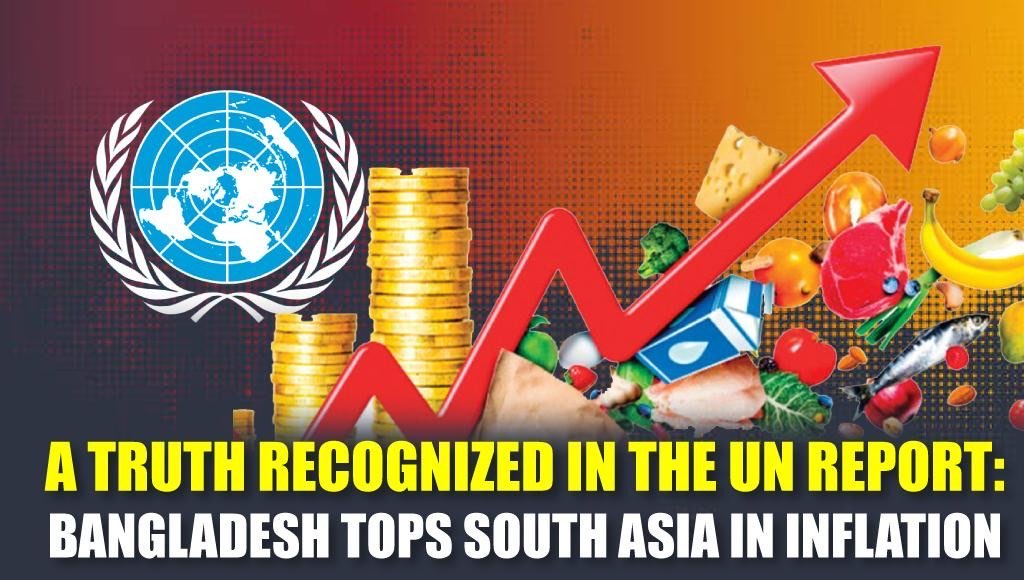
The latest United Nations report on inflation leaves no room for ambiguity: Bangladesh is experiencing the most severe inflation crisis in South Asia. Among seven regional countries, Bangladesh now stands at the bottom of the list, with inflation at 8.9 percent in 2025, far higher than its neighbors. By comparison, inflation remains at 2.7 percent in India and 0.6 percent in Sri Lanka.
Even more troubling, the situation shows no sign of meaningful improvement. According to the UN’s forecast, inflation in Bangladesh will remain at 7.1 percent in 2026, still higher than every other country in the region. While neighboring economies stabilize, Bangladesh continues to drift deeper into a cost-of-living crisis.
These figures represent more than macroeconomic indicators—they reflect daily hardship for millions of Bangladeshi families. A household that spent 10,000 taka on monthly groceries a year ago now needs at least 15,000 taka to purchase the same items.
Teachers, salaried employees, day laborers, rickshaw pullers, and small traders are all struggling to cope with rising prices. Middle-class families are steadily lowering their living standards, while low-income households are barely managing to secure three meals a day. Inflation has become an invisible but relentless tax on survival.
What makes Bangladesh’s inflation crisis particularly alarming is the regional contrast. Sri Lanka and Pakistan, both of which endured devastating inflationary shocks in recent years, have now managed to regain control. Sri Lanka reduced inflation from 49 percent in 2021 to 0.6 percent, while Pakistan brought it down from 30 percent to around 4 percent.
Bangladesh, by contrast, has remained stuck above 8 percent for more than eighteen months. A country once known for relative economic stability now finds its population disoriented and economically exhausted.
Responsibility for this paralysis has become increasingly clear since the overthrow of the elected government in July 2024. Under the current interim administration, policy responses have failed to address the structural causes of inflation.
While interest rates were raised and tariffs on selected goods were reduced, these steps did not translate into sustained relief. Instead, inflation has started rising again over the past two months, signaling policy inconsistency and weak execution. This trend reflects not external shocks, but administrative failure and economic mismanagement.
The UN’s assessment effectively places Bangladesh in an embarrassing regional position. While India, Nepal, Bhutan, Pakistan, and Sri Lanka have all managed to bring inflation below 5 percent, Bangladesh remains isolated above 8 percent.
This divergence highlights not just economic weakness, but institutional incapacity. The inability to stabilize prices has become a defining feature of the current governance structure.
Economists emphasize that without controlling food inflation, public suffering will not ease. Food inflation stood close to 11 percent at the beginning of last year, dropped to 7.36 percent by December, and has since begun rising again.
These fluctuations expose the absence of a coherent strategy. Policies are introduced without sufficient evaluation, then altered before their impact is measured. This lack of continuity ensures that inflation remains entrenched rather than contained.
There is also no visible effort to dismantle market syndicates operating at the wholesale level. Certain trader groups continue to manipulate prices, while consumers absorb the shock. Farmers are forced to sell produce at low rates, only to see the same goods sold at inflated prices in urban markets.
These middlemen profit from systemic failure, draining household incomes daily, while enforcement remains weak or nonexistent.
With incomes stagnant, every price increase erodes purchasing power. Salaried workers and teachers do not receive monthly pay raises, yet are compelled to spend more each week. In real terms, household income is shrinking.
Many families now rely on loans to survive. Some are withdrawing children from school; others are delaying or abandoning medical treatment. Inflation has become a silent engine of impoverishment.
The UN report functions as a report card on economic governance, and the verdict is unmistakable. Bangladesh has failed to control inflation, and the outlook for 2026 offers no meaningful hope. While neighboring countries continue to improve, Bangladesh remains trapped in stagnation.
Despite access to high-profile advisers and even Nobel Prize–winning economists, those in power have failed to address the most basic economic concern of ordinary citizens: the ability to afford food. The UN has now documented this failure with evidence.
If this is not a national embarrassment, it is difficult to imagine what is.








This work is copyrighted and authorized by the Bangladesh Awami League. You may download, display, print and re-produce this material in unaltered form only (retaining this notice)for your personal, non-commercial use or use within your organization.
