3905
Published on January 23, 2026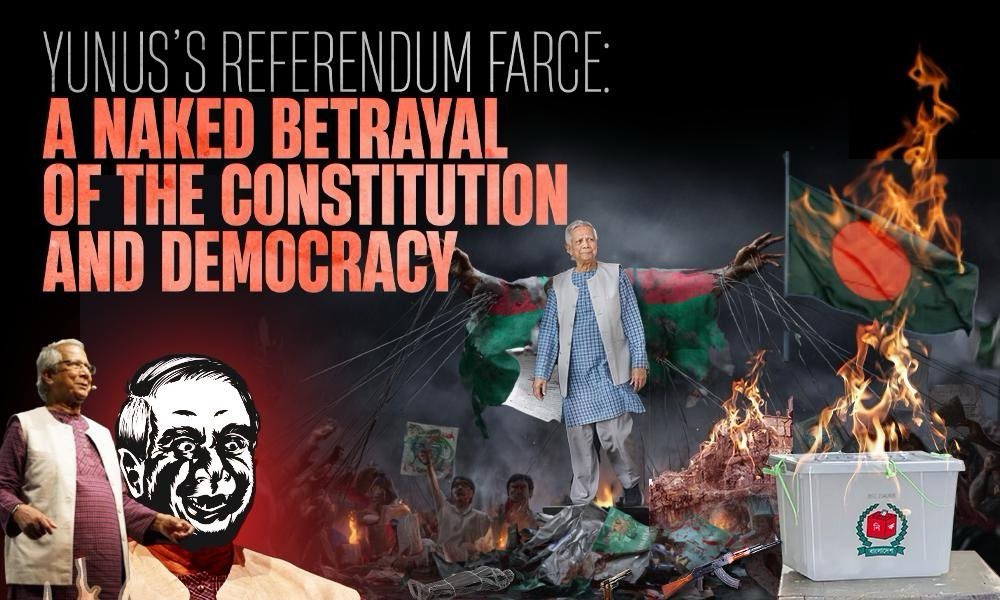
Since orchestrating planned riots across the country in July 2024 to overthrow an elected government, the way Muhammad Yunus and his so-called advisory council have clung to power has become a disgraceful chapter in Bangladesh’s constitutional history. This foreign-funded coup, carried out with the active support of Islamist militant groups and enabled by the silent backing of a section of the military, succeeded through betrayal rather than consent. Now, in January 2026, the illegal government’s attempt to stage a so-called referendum is not merely a gross violation of constitutional norms. It is a carefully designed deception of the people.
Article 7 of the Constitution clearly declares that all powers of the Republic belong to the people. On this fundamental principle rests the constitutional mechanism of a referendum, where citizens directly express their will. Yet the Yunus government’s audacity in proposing a referendum while keeping the contents of thirty so-called reform proposals secret directly collides with the spirit of the Constitution. In a democratic state, asking for public opinion while keeping citizens in the dark is not a referendum. It is nothing more than a sham.
The obvious question is this: how can public opinion be sought without disclosing the substance of the proposed reforms? When a voter stands before the ballot box, will they be expected to vote yes or no without knowing what they are voting on? This is not just undemocratic. It is a profound insult to the intelligence and rights of the people. The constitutionally guaranteed right to information, the principle of transparency, and the basic conditions of democratic participation are all being trampled.
If the relevant reform proposals are not made public before the referendum, the people cannot make an informed and conscious decision under any circumstances. The transparency and legitimacy of such a vote will inevitably be questioned. In reality, this is nothing but a deliberate deception of the public. An illegal government with no popular mandate of its own is now organizing a vote while keeping citizens deliberately uninformed. What kind of democracy is this? What kind of constitutional process is this supposed to be?
This entire process is not only politically unacceptable. It is legally unlawful and unconstitutional in every sense. This so-called referendum can be challenged in any constitutional court, and it will not withstand judicial scrutiny. Where the Constitution mandates transparency, accountability, and the people’s right to know, this enforced secrecy is a direct violation of those principles.
The role of the Election Commission is also deeply concerning. Under Article 66(2) of the Constitution, a person holding dual citizenship is not eligible to contest a parliamentary election. If the Election Commission validates the nomination of an ineligible candidate, such as a dual citizen, that act is clearly illegal. Section 67 of the Representation of the People Order 2008 requires candidates to meet all eligibility criteria. If an ineligible candidate is allowed to contest and participate in voting, the election results can be challenged in court.
A writ petition can be filed in the High Court seeking cancellation of such illegal nominations. Under Articles 101 to 105 of the Constitution, if constitutional provisions are violated or if an administrative authority such as the Election Commission takes unlawful action, a writ may be sought from the High Court. Through such a writ, cancellation of nominations and, if necessary, suspension of the election can be requested. Even after election results are declared, if it is proven that a candidate was ineligible, those results can be challenged before the higher courts. Section 69 of the Representation of the People Order 2008 clearly states that an election can be annulled if an ineligible candidate takes part.
The question of the Election Commission’s accountability is therefore critical. If the Commission knowingly validates an ineligible candidate, it constitutes a breach of its administrative duties and constitutional obligations. The High Court may caution the Commission, direct the cancellation of nominations, and take necessary constitutional measures. While courts generally refrain from directly punishing commissioners except in exceptional circumstances, they do have the authority to invalidate illegal nominations and elections.
This entire charade by Sudhi Mahajan Yunus and his illegal advisory council is nothing more than an attempt to blindfold the public. When a government born of a coup launches a new farce in the name of a referendum, it becomes clear that the real objective is to legitimize its illegal rule. But no process built on the violation of constitutional principles can ever gain legitimacy.
Every action of this government pushes the country further toward the erosion of the people’s constitutional rights. Acting on the instructions of foreign patrons, with the backing of Islamist militants and shielded by elements within the military, this illegal structure is now bent on the complete destruction of the Constitution and democracy. Organizing a referendum while concealing the contents of thirty reform proposals is not only unconstitutional. It is a direct act of deception against the people.
This referendum farce by the Yunus government will remain a black stain on Bangladesh’s constitutional history. An illegal government with no popular mandate is attempting to decide the nation’s future while keeping its people in the dark. What greater arrogance can there be? What greater constitutional violation can there be? To protect the rights of the people, the dignity of the Constitution, and the foundations of democracy, a legal battle against this farce is not optional. It is essential.













This work is copyrighted and authorized by the Bangladesh Awami League. You may download, display, print and re-produce this material in unaltered form only (retaining this notice)for your personal, non-commercial use or use within your organization.
