3747
Published on March 2, 2026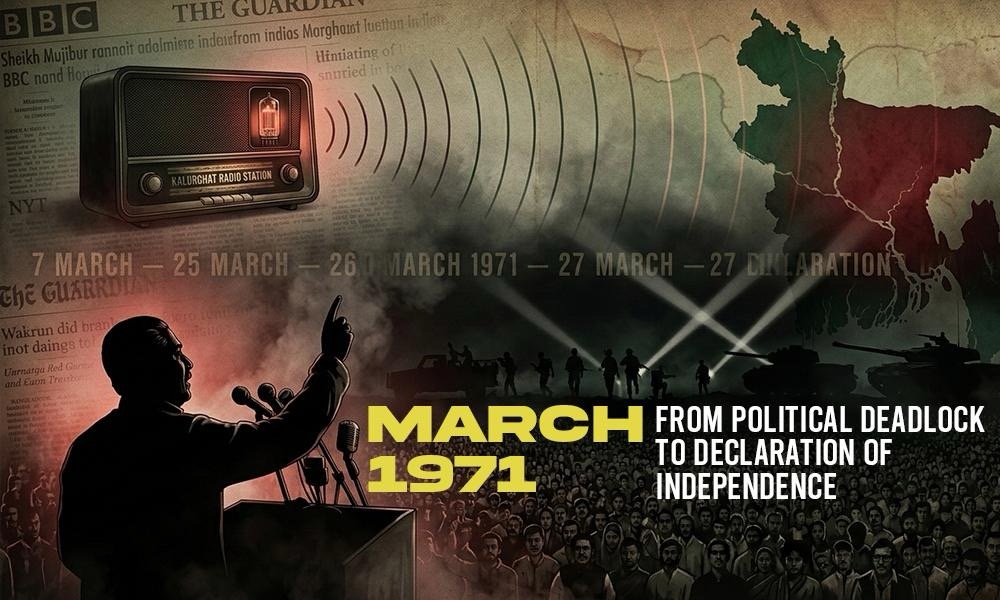
In the aftermath of the 1970 general election, won decisively by the Sheikh Mujibur Rahman-led Awami League, political tensions in what was then East Pakistan deepened rapidly. A nationwide non-cooperation movement, called by Sheikh Mujibur Rahman, brought civil administration to a near standstill. By early March 1971, the streets of Dhaka had become the centre of mass mobilisation.
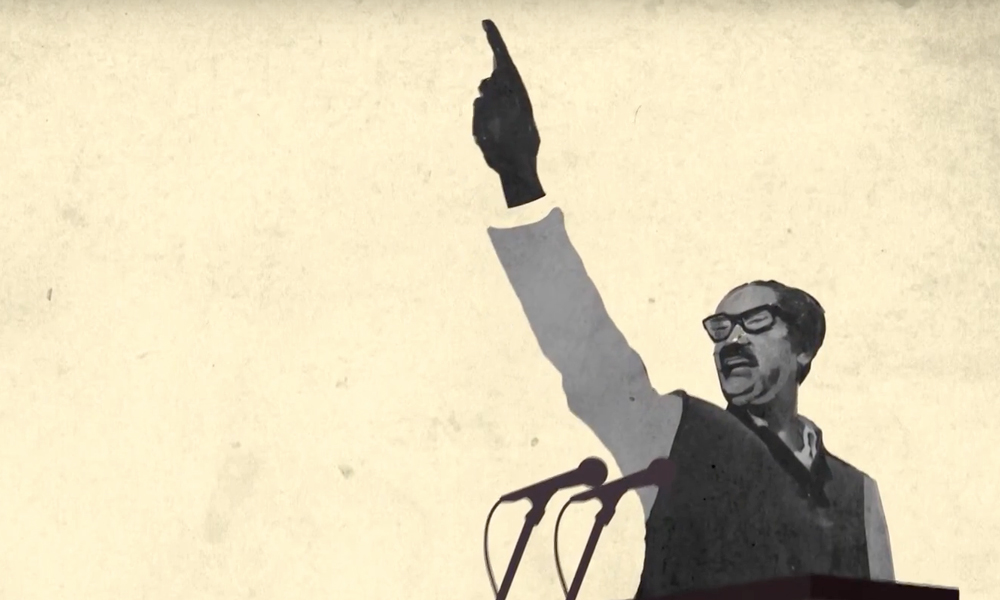
On 7 March 1971, at the Racecourse Ground — now Suhrawardy Udyan — Sheikh Mujibur Rahman delivered a historic address that many historians regard as a de facto declaration of intent. While stopping short of a formal proclamation of independence, the speech called for preparedness and resistance, signalling that the crisis had entered a decisive phase.
Amid mounting unrest, Pakistan’s military ruler, President Yahya Khan, arrived in Dhaka in mid-March for talks with Sheikh Mujibur Rahman. Discussions continued until 24 March but failed to produce a political settlement. At the same time, reports circulated that additional troops and arms were being transported from West Pakistan to reinforce military positions in the east.
Later accounts, including those in Witness to Surrender by Pakistani military officer Siddiq Salik, suggest that preparations for a crackdown were underway even as negotiations continued. According to these sources, senior military officials finalised plans for an operation that would begin late on 25 March.
Shortly before midnight on 25 March 1971, the Pakistan Army launched what it termed “Operation Searchlight.” The stated objective was to restore state authority; in practice, the operation targeted political activists, students, members of the security forces, and civilians in Dhaka and other major cities.
Attacks were carried out at Rajarbagh Police Lines, the East Pakistan Rifles headquarters in Pilkhana, and on the campus of Dhaka University, including Jagannath Hall. Tanks and heavy weaponry were deployed against largely unarmed populations. Estimates vary, but thousands are believed to have been killed in the initial phase of the operation.
In the early hours of 26 March, Sheikh Mujibur Rahman was arrested at his residence in Dhanmondi and flown to West Pakistan. Before his arrest, however, a message declaring the independence of Bangladesh was transmitted.
The declaration of independence, issued in the name of Sheikh Mujibur Rahman, was first relayed from Chittagong. Activists associated with the Swadhin Bangla Betar Kendra (Independent Bengal Radio Station) broadcast the message on 26 March. Awami League leader M A Hannan is widely reported to have read the declaration publicly.
On 27 March, Major Ziaur Rahman, speaking from Kalurghat Radio Station in Chittagong, broadcast the declaration again on behalf of Sheikh Mujibur Rahman. These transmissions played a significant role in informing both domestic and international audiences that a new phase of resistance had begun.
News of the crackdown and the declaration of independence spread globally within days. International media outlets reported on the military action in Dhaka and the arrest of Sheikh Mujibur Rahman. The BBC, Voice of America, The Daily Telegraph, The Guardian, The New York Times, and newspapers across Asia, Europe and the Americas carried accounts of escalating violence and political rupture in East Pakistan.
Headlines referred to civil war, a declaration of independence, and the imposition of martial law. While communications were limited and verification was difficult, it was clear that the crisis had moved beyond political negotiation.
Following the events of 25–26 March, resistance emerged in several regions. Elements of the East Pakistan Rifles and Bengali members of the armed forces began organising opposition to Pakistani military control. What began as scattered resistance soon evolved into a coordinated liberation struggle.
The declaration of independence marked the beginning of a nine-month war that would culminate in December 1971 with the emergence of Bangladesh as a sovereign state.
The night of 25 March remains one of the most consequential and traumatic moments in the country’s history — a turning point when political impasse gave way to armed conflict, and a movement for autonomy transformed into a war for independence.






This work is copyrighted and authorized by the Bangladesh Awami League. You may download, display, print and re-produce this material in unaltered form only (retaining this notice)for your personal, non-commercial use or use within your organization.
