3420
Published on April 27, 2026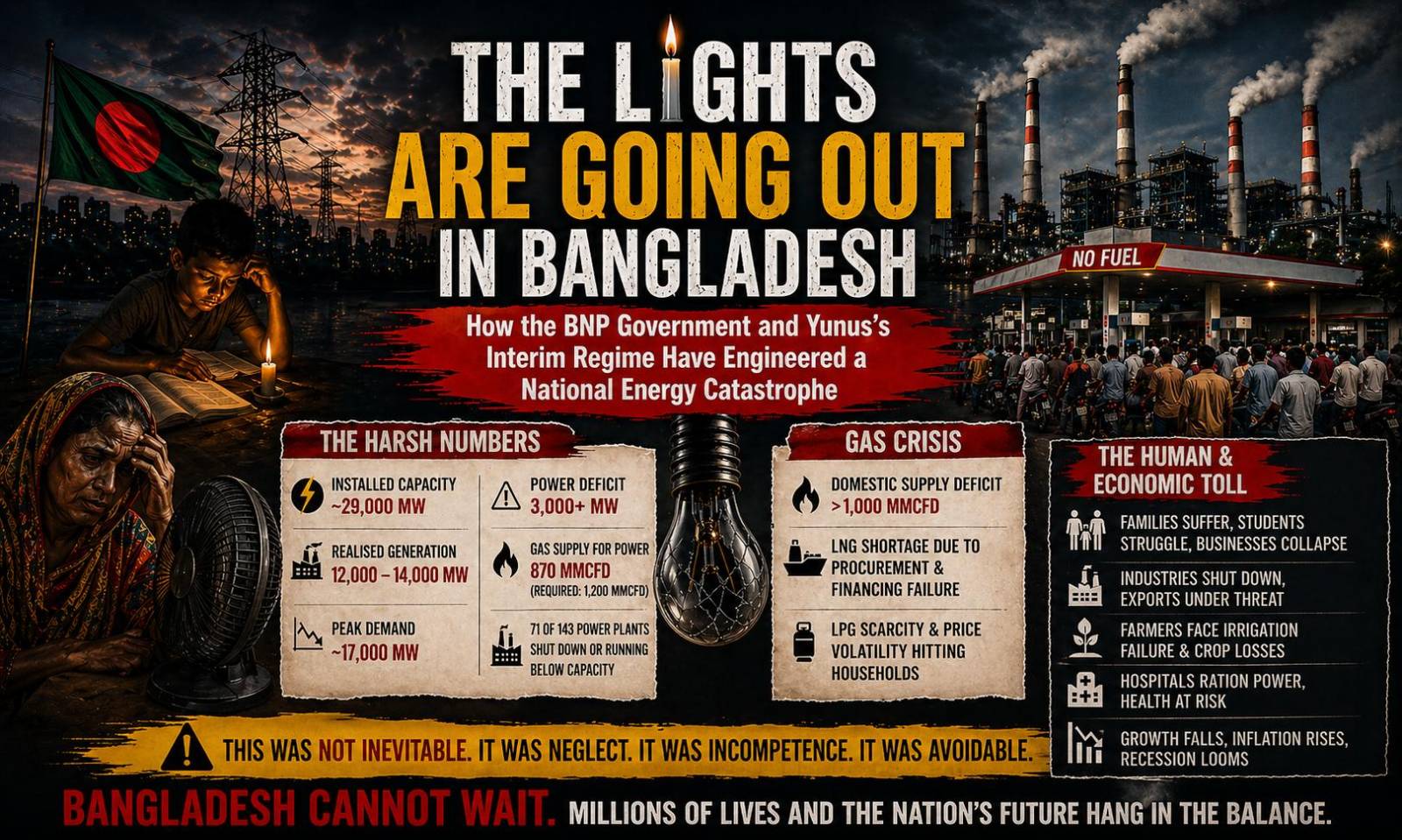
For over a decade, Bangladesh was heralded as an "Asian Tiger," a burgeoning economic miracle powered by a robust energy infrastructure and a vision of a "Digital Bangladesh." Today, that tiger is whimpering in the dark. As the scorching summer heat of April 2026 takes hold, the nation is gripped by a catastrophic power, fuel, and gas crisis that is no longer just a "disruption"; it is a full-scale systemic collapse.
Energy crisis: Global problem, local failure
While the current administration, led by the Bangladesh Nationalist Party (BNP) and its acting chairman, Tarique Rahman, desperately points to global market volatility and regional conflicts, the truth is far more damning. It is a manufactured disaster, seeded by the criminal neglect of Muhammad Yunus’s unelected interim regime and perfected by the paralysis of the current BNP-aligned government.
The power and fuel crisis did not erupt overnight under the current government. The roots of today’s problems go back to the 18-month interim government led by Muhammad Yunus, which took over after the political shift of 2024. When Yunus assumed office, the country still benefited from expanded power plants and fuel reserves built during Sheikh Hasina's era. Generation capacity had grown significantly, and the system was largely keeping up with demand.
USD 4.1 Billion Power Crisis: Yunus Leaves Energy Sector in Financial Freefall
Yet during that period, there was little serious effort to secure new fuel supplies or sign long-term contracts. Investment in exploration and new infrastructure slowed. Maintenance of existing plants was largely overlooked. Instead of rebuilding buffers, the interim administration essentially ran on the reserves and infrastructure it had inherited. By the time it handed over power in early 2026, fuel stocks had noticeably declined, and the country was left more exposed than before. The much-discussed reforms often felt more like political exercises than practical steps to strengthen energy security. In hindsight, it was a missed opportunity that left Bangladesh vulnerable when global shocks arrived.
The figures tell a troubling story of this inherited decay. Bangladesh has an installed power generation capacity of around 29,000 MW, yet on many days in April 2026, the system struggles to produce even 12,000 to 14,000 MW. Peak summer demand is pushing toward 17,000 MW, leaving a catastrophic shortfall of 3,000 MW or more.
Energy crisis 'beyond tolerable level' as country faces 3,000MW power deficit
Power cuts worsen amid searing heat
Of the country’s 143 power plants, as many as 71 are either completely shut down or running far below capacity because of shortages of gas, coal, and furnace oil. Specifically:
Gas Famine: Gas supply for electricity generation has dropped to about 870 million cubic feet per day (mmcfd), well short of the 1,200 mmcfd needed to keep the turbines spinning.
Coal Collapse: Major hubs like the Adani, SS Power, and RPCL plants are operating at a fraction of their capacity due to "technical faults" and unpaid dues, leaving a 2,500 MW gap from these sources alone.
Fuel Depletion: Diesel reserves have at times fallen to levels that would last only around nine days.
Fuel supply disrupted amid surge in demand
Long queues now form at petrol stations, and the government has resorted to desperate measures: rationing, early shop closures, shortened office hours, and even accelerating university holidays to save energy. These measures manage the symptoms, but they don’t fix the underlying failure to secure reliable fuel and maintain the infrastructure.
Not just in industries, there's also a shortage in domestic gas production and supply. The crisis has moved beyond short-term disruption and entered a phase of systemic failure.
Systemic Supply Failure: Domestic gas production remains flat at approximately 2,300–2,400 mmcfd, while effective demand exceeds 3,500 mmcfd, leaving a structural deficit of over 1,000 mmcfd. Domestic pipeline gas supply has become erratic, with prolonged and unannounced outages across urban areas, particularly in Dhaka.
The LNG Deadlock: LNG, once the primary balancing mechanism, is now severely constrained. In 2024, LNG accounted for nearly 30% of supply, but volumes have plummeted in 2026 due to procurement delays and financing shortfalls. Each cargo requires $60–80 million upfront, and with usable foreign exchange reserves under strain, the government has failed to secure regular spot cargoes.
Market Chaos: LPG availability is unstable despite ongoing imports. LPG cylinders, vital for households, vanish from markets or experience sharp price volatility due to weak regulatory oversight. This has enabled hoarding and speculative pricing, turning a basic utility into a luxury for the average citizen.
This was not an unavoidable global crisis; it was pure governance failure. The previous administration had managed worse shocks with subsidies, diversified contracts from Qatar and Oman, and decisive intervention. Yunus replaced action with reform slogans. The BNP government inherited this broken system and has failed to fix it. Today, the gas crisis fuels the power blackout, locking the country in a vicious cycle of darkness and economic decline.
The situation has deteriorated further under the BNP-aligned government that took office after the February 2026 elections. Elected with promises of stability, the administration, with Tarique Rahman playing a central role, has instead relied on drastic austerity.
Bangladesh cuts working hours to save energy
The response has been a series of bureaucratic band-aids: fuel purchase limits, mandatory early shop closures at 6:00 PM, and shortened office hours. While these steps aim to stretch limited supplies, they highlight a deeper problem: a total lack of long-term planning. Power plants that could be producing electricity remain idle simply because there is no fuel to burn.
Families swelter through sleepless, humid nights. Students abandon books by candlelight. Small businesses watch perishables rot as customers vanish. Farmers’ irrigation pumps fall silent, threatening crops and food shortages. Hospitals ration power for life-saving equipment while mobile networks flicker. The daily scramble for scarce LPG cylinders piles fresh misery on millions.
Power crisis fears cloud Bangladesh RMG orders, says BCI chief
Economically, the damage is brutal. The garment sector, Bangladesh’s export lifeline, has slashed production sharply due to erratic power and gas. Industrial zones face repeated shutdowns. Foreign buyers are fleeing. Capacity charges bleed public funds while generation collapses. Growth forecasts tumble, inflation surges, and recession looms. Decades of economic progress are cracking under sheer governmental incompetence.
Economic outlook fragile as country faces three-pronged crisis: PRI
This crisis was entirely foreseeable and avoidable. The Yunus interim allowed vital reserves to erode through neglect. The BNP government inherited the wreckage and responded with austerity, rationing, and empty committees instead of urgent fuel procurement, plant repairs, or new exploration.
Bangladesh now teeters on the brink of mass factory closures, agricultural collapse, health emergencies, and social unrest. The poor and rural masses suffer most while leaders issue hollow statements from comfort.
Time is running out. The people deserve leaders who treat power, fuel, and gas as basic duties, not excuses after the lights go out.
Bangladesh cannot wait. Millions of lives and the nation’s future hang in the balance.










This work is copyrighted and authorized by the Bangladesh Awami League. You may download, display, print and re-produce this material in unaltered form only (retaining this notice)for your personal, non-commercial use or use within your organization.
