15687
Published on May 8, 2026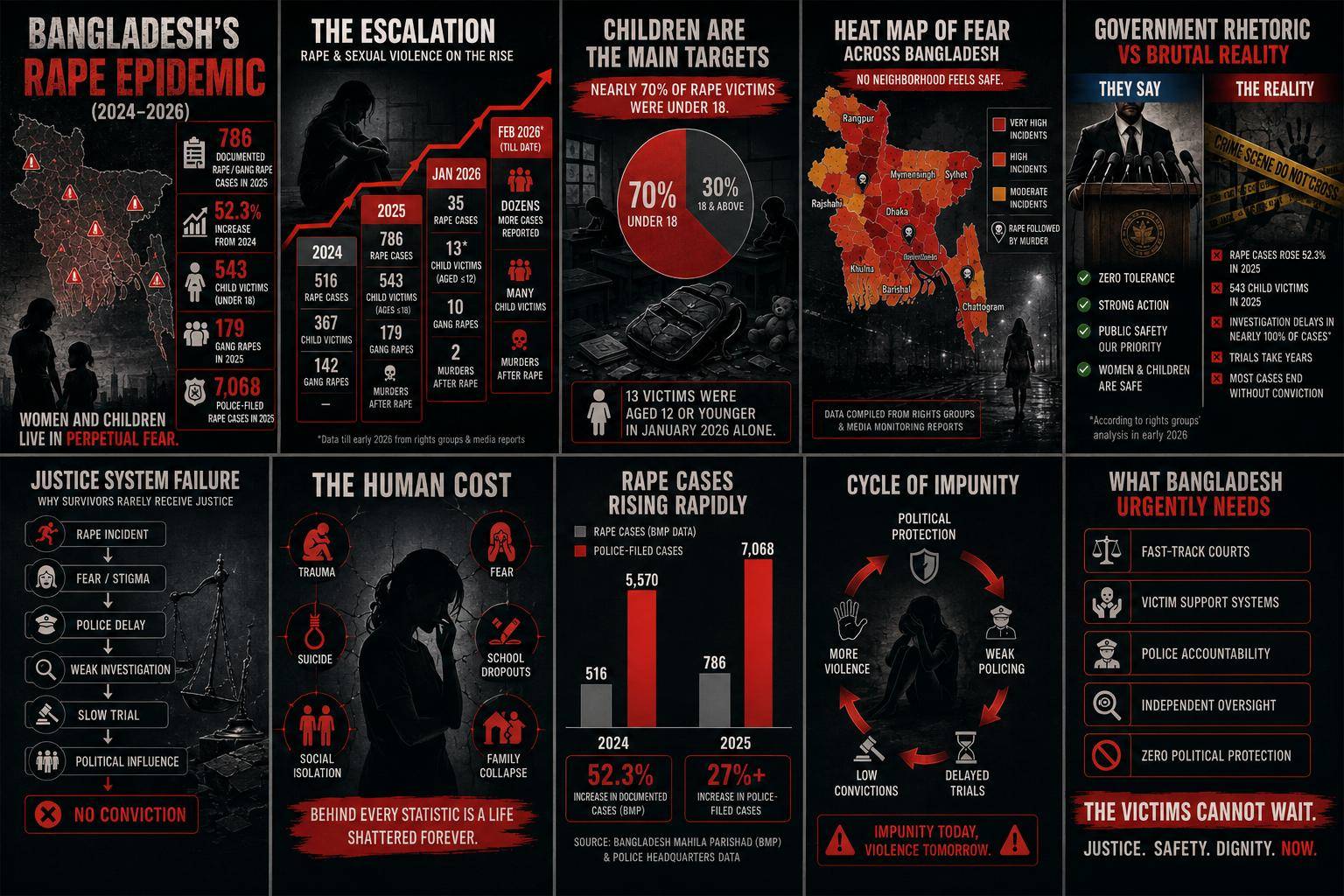
In the streets, villages, and even homes of Bangladesh in 2026, women and children live in perpetual fear. No neighborhood feels safe. No hour of the day guarantees security. Almost daily, reports emerge of rape, gang rape, sexual assault, and murders following these violations. This is not a sporadic crisis; it is a national emergency that exposes the hollow promises of governance under the current BNP-led administration.
Rising Rapes And Murders Across the Country Sound Alarm for the New Government
The current government continues to issue stern warnings and "zero tolerance" rhetoric. But for the grieving mothers and traumatized children of this nation, these words have lost all meaning.
If the state’s primary function is the protection of its most vulnerable citizens, then the BNP government is not just failing; it is presiding over a collapse of social order. We must ask: If a government cannot ensure that a child is safe walking to school, what is it truly governing?
Fix the systemic loopholes to curb gender-based violence
The numbers do not lie, and they tell a story of a nation in freefall. Data compiled from human rights watchdogs like the Bangladesh Mahila Parishad (BMP) and media monitoring reports paint a grim picture. In 2025, the country saw 786 documented cases of rape and gang rape, a
staggering 52.3% increase from the previous year. Of these, 543 were girls under 18, reflecting a nearly 48% rise in child victims. Gang rapes alone accounted for 179 incidents. Far from being a temporary spike, the early months of 2026 show that this blood-soaked trend is accelerating.
Bangladesh sees sharp rise in rape cases, with girls most at risk
Police headquarters data corroborates the alarm: 7,068 rape cases filed in 2025, up from 5,570 in 2024, a more than 27% increase. Overall, violence against women and children cases surged under the Women and Children Repression Prevention Act.
Rape cases rise 27pc in one year
The trend has accelerated into 2026. Ain o Salish Kendra (ASK) reported 35 rape cases in January 2026 alone (25 single rapes and 10 gang rapes), with 13 victims aged 12 or younger. Bangladesh Mahila Parishad logged 31 cases that month. By early 2026, ASK data showed 776 rape cases over roughly 13 months, nearly half involving minors. In the first two months of 2026, dozens more incidents emerged, including fatal cases.
Violence Against Women Has Increased Alarmingly
Summary of Sexual Violence in Bangladesh (Key Figures):
|
Period |
Total Rape/Gang Rape Cases |
Child Victims (Under 18) |
Gang Rapes |
Notes/Source |
|
2024 |
516 (BMP) / 5,570 (Police) |
367 |
142 |
Baseline year |
|
2025 (Full Year) |
786 (BMP) / 7,068 (Police) |
543 |
179 |
52.3% increase (BMP); 27%+ (Police) |
|
Jan 2026 |
35 (ASK) / 31 (BMP) |
13 (aged ≤12) |
10 |
2 murders post-rape |
|
~13 months to Feb 2026 |
776 (ASK) |
~366 |
- |
Nearly half minors |
These figures represent only reported cases. Activists consistently note massive underreporting due to stigma, fear of reprisal, weak policing, and societal pressure. True numbers likely run far higher.
The most sickening aspect of this surge is the targeting of children. In 2025, nearly 70% of all rape victims were girls under the age of 18. This is not a mere crime wave; it is a fundamental
breakdown of the moral and legal fabric of society. In January 2026 alone, 13 of the 35 reported
rape cases involved children aged 12 or younger. These are not statistics; these are lives shattered before they have even begun.
Sexual abuse of Bangladeshi street-connected children
Madrasa teacher accused in rape of 11‑year‑old
Boys are not spared, though their cases receive even less attention. Educational institutions, including madrasas, have become sites of horror rather than safety.
Rights groups note that nearly 75% more child rape cases were recorded in early 2026 compared to the same period in 2024. The predators are becoming bolder because the consequences are non-existent.
Call for Urgent Action to Prevent Child Abuse in Bangladesh
Why is this happening? The answer lies in the culture of impunity nurtured by a government that seems more focused on political survival than public safety. The "National Crisis," as recently termed by roundtables in Dhaka, is exacerbated by a judicial system that moves at a glacial pace.
Reports indicate that nearly 100% of sexual violence cases analyzed in early 2026 faced significant delays in investigation or trial. When the law does not act, the criminal is empowered.
Bangladesh Failing to Protect Women and Children Despite Tough Laws
The government’s response has been reactive at best. Strong statements from ministries are issued only after an incident gains enough social media traction to threaten the administration's image. This is "governance by optics," not "governance by law." The citizens of Bangladesh are beginning to realize that the current administration is either unable or unwilling to dismantle the patronage networks that often protect local perpetrators.
464 murder, 666 rape cases filed since govt takes office
Behind every statistic lies devastation: shattered childhoods, traumatized families, suicides, and lifelong scars. Survivors face ostracism, inadequate support, and further harassment. The economic and social toll, reduced female participation, eroded trust, and a generation growing up in fear, threaten Bangladesh's future.
This is no longer a "women's issue." It is a crisis of governance, justice, and national character. International observers and media must amplify these voices. Donors, partners, and global institutions should tie support to measurable improvements in protection and accountability.
From election to eruption Bangladesh’s Human Rights violence on the rise
Bangladesh urgently needs: independent oversight of cases, fast-track courts with high conviction targets, robust victim support systems, police sensitization and accountability, and a zero-tolerance stance on political protection for criminals. Cultural campaigns against impunity must accompany enforcement.
The time for polite discourse has passed. Women and children in Bangladesh are screaming for safety. The BNP government must deliver, now, or stand exposed as incapable of fulfilling the most basic duty of any administration. The world is watching. The victims cannot wait.




This work is copyrighted and authorized by the Bangladesh Awami League. You may download, display, print and re-produce this material in unaltered form only (retaining this notice)for your personal, non-commercial use or use within your organization.
