72
Published on October 4, 2026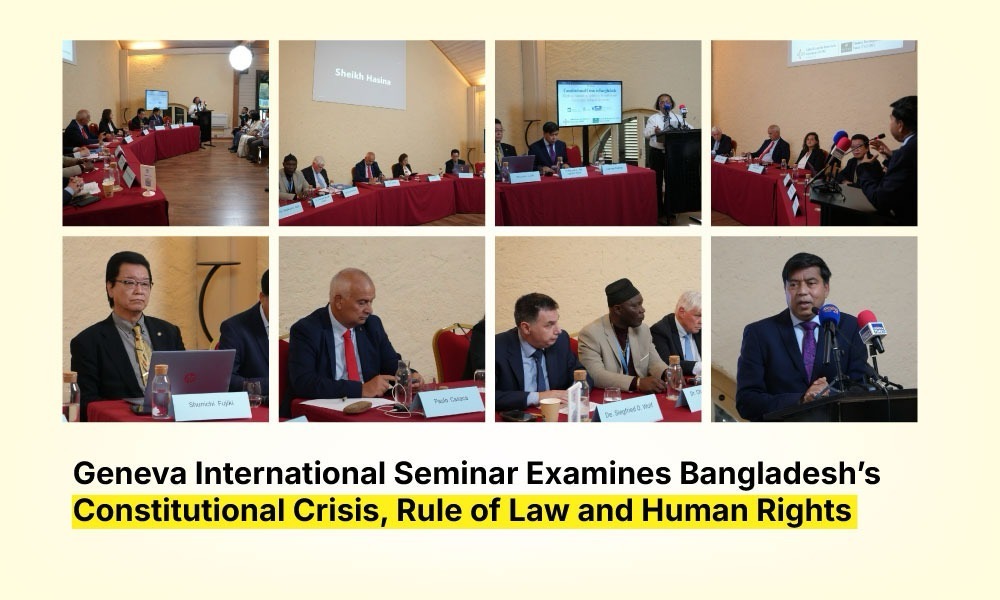
Bangladesh’s constitutional order, rule of law, human rights, political participation, judicial independence and the future of its democratic institutions came under extensive discussion at an international seminar held Friday at the Geneva Press Club.
The seminar, titled “Bangladesh’s Constitutional Crisis: Right to Education, Arbitrary Detention and Fabricated Tribunal Verdicts,” brought together former political leaders, lawyers, human-rights advocates, researchers and international experts from Europe, Asia and Africa.
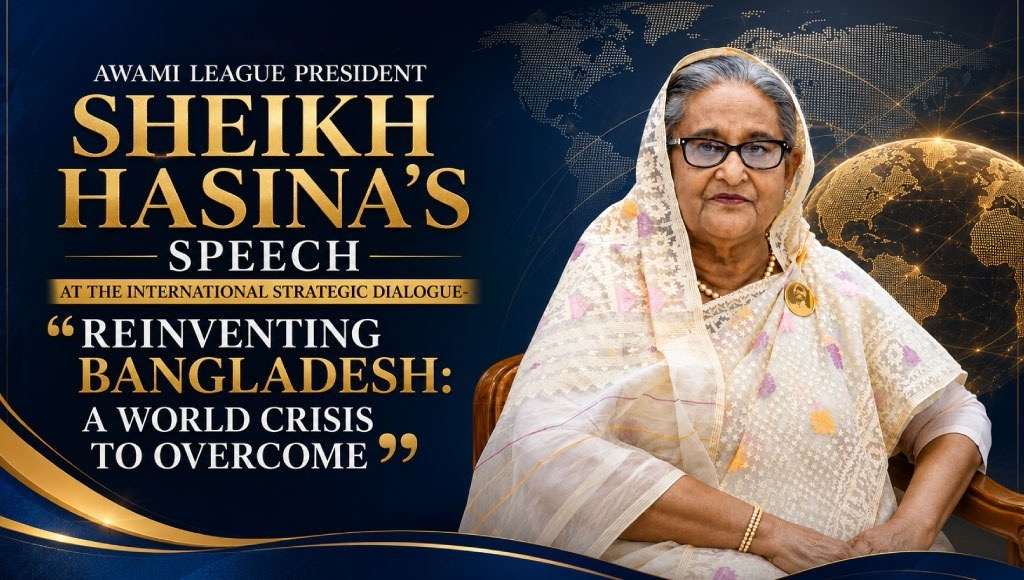
Former Bangladesh Prime Minister and Awami League President Sheikh Hasina delivered the keynote address. Other speakers included Professor Dr. Md. Habibe Millat, Paolo Casaca, Dr. Siegfried O. Wolf, Shinichi Fujiki, Carl Gustav Bjartnes, Professor Alfred de Zayas, Dr. Chonsi Ayach Joseph and Swedish attorney Mona Hago Strindberg.
The event was jointly organized by the Global Center for Democratic Governments and Tumuku Development and Cultural Union, with the participation of international human-rights and democracy advocates. The program began at 5:00 p.m. Geneva time, or 9:00 p.m. Bangladesh time.
Former Prime Minister Sheikh Hasina said Bangladesh is passing through what she described as a serious constitutional crisis and argued that the country’s future must be determined through the free and informed will of its people.
In her keynote address, she said the events of July and August 2024 had not brought peace or prosperity to Bangladesh. She accused the current authorities of political retaliation, arbitrary detention, politically influenced legal proceedings and actions that, in her view, are damaging the educational and professional futures of students and citizens because of their political identities.
Sheikh Hasina argued that a constitution is more than a legal document: it is a commitment to protect citizens from arbitrary power, guarantee equality before the law and ensure that political disagreements are resolved through democratic institutions rather than intimidation, imprisonment or retaliation. She said these principles are now under severe pressure.
She cited a series of incidents involving alleged violence, killings, arrests and insecurity in different parts of Bangladesh and said many incidents never reach the media. She argued that the situation should no longer be viewed solely as political instability but as a crisis involving law, public security and the responsibilities of the state.
She also raised concerns over universities and educational institutions, alleging that students had lost their studentship or certificates and that young professionals had been suspended from employment because of political affiliation. She said political identity should never be treated as collective criminal liability and argued that anyone accused of a crime should be held individually accountable through due process.
On detention and the justice system, Sheikh Hasina said thousands of Awami League leaders, activists and supporters had been detained, prosecuted or forced into hiding. She questioned the use of criminal and anti-terrorism laws in circumstances where, she alleged, due process, equal treatment and judicial independence were under pressure.
She also criticized what she described as attempts to remove the Awami League from political life through judicial and tribunal processes. She warned that if judicial institutions are used for political retaliation, public confidence in the justice system will suffer. Referring to capital punishment, she said the state should not exercise the power to take a person’s life where the fairness and independence of the judicial process itself are in question.
She further argued that an election cannot be genuinely representative if a major political force and its supporters are excluded from political participation. “Bangladesh’s future must be determined by the people of Bangladesh,” she said, emphasizing that this should happen through free and informed public choice rather than fear, force or administrative orders.
Sheikh Hasina called on the United Nations, democratic governments, human-rights organizations, the legal community and Bangladesh’s international partners to closely monitor the country’s situation. She urged an end to arbitrary detention and politically motivated persecution, restoration of judicial independence and due process, protection for students and professionals, adequate medical care for people in state custody, and guarantees for freedom of expression, association and peaceful political activity.
Reflecting on the assassination of her family members in 1975, including her father Bangabandhu Sheikh Mujibur Rahman, she said her personal experience had taught her that no nation can build its future on retaliation. She described her father’s vision of a Bangladesh where people live with dignity, the law protects both the weak and the powerful, and the state belongs to its citizens.
Sheikh Hasina concluded by saying she wants to see a Bangladesh where citizens can approach courts without fear, vulnerable people receive protection before tragedy occurs, perpetrators are held accountable, students do not lose their futures because of political identity, prisoners receive appropriate medical care and every citizen can rely on equal protection under the law.
Professor Dr. Md. Habibe Millat, President of the Global Center for Democratic Governments, said Bangladesh is facing a broad crisis involving what he described as the erosion of rule of law, judicial protection, democratic rights and citizen security.
In his opening remarks, Millat said the organizers had brought together human-rights advocates from Asia, Europe and Africa to hear their views while drawing international attention to developments in Bangladesh. He claimed that millions of people had been internally displaced, thousands had been killed and more than 200,000 students were outside educational institutions because of political affiliation.
Millat also alleged that the Awami League, which he described as Bangladesh’s largest and oldest political party, had been banned indefinitely. He said political violence and insecurity had affected professionals, journalists and minority communities. He claimed that more than 200 journalists had lost their jobs and that hundreds had faced murder cases.
He also alleged attacks, vandalism and changes in ownership involving media organizations, as well as pressure on doctors and other professionals. Referring to prison conditions, he cited figures that he said indicated severe overcrowding and claimed that many political detainees had been denied adequate legal and medical protection.
Millat argued that Bangladesh’s people had lost important freedoms of expression, political participation and voting rights. He called on the international human-rights community, particularly those attending United Nations forums in Geneva, to examine the situation and support the restoration of democratic and civic rights.
“We do not want anyone’s favour. We want justice. We want our rights back. We want Bangladesh to become a democratic country again,” he said.
Former European Parliament member Paolo Casaca said Bangladesh’s present situation should not be treated merely as a constitutional dispute or ordinary political crisis. He described what he regarded as a broader democratic crisis accompanied by serious human-rights concerns.
Casaca argued that reports of political opponents being excluded, restrictions on freedom of expression, pressure on journalists and imprisonment of dissenters represented patterns associated with authoritarian systems. He also raised concerns about developments in the education sector, saying political and ideological pressures could undermine academic pluralism and independence.
He referred to historical examples including Nazi Germany, Maoist China, Stalin-era systems and post-revolutionary Iran to illustrate how political repression, ideological restructuring and the use of law as an instrument of control can contribute to broader systems of social control.
Casaca said political participation, freedom of expression, judicial independence and the rule of law should remain central to any assessment of Bangladesh’s constitutional debate. He argued that technical discussions about constitutional structures, parliamentary arrangements or electoral mechanisms should not obscure the fundamental question of whether citizens can freely express political views and journalists can work without fear of imprisonment.
Dr. Siegfried O. Wolf, Research Director of the South Asia Democratic Forum in Germany, expressed concern about what he described as shrinking political pluralism on Bangladeshi university campuses.
Wolf said Bangladesh had a personal and professional significance for him, noting that he had taught South Asian politics at Heidelberg University, conducted research in Bangladesh and worked with Bangladeshi media. He said recent developments on university campuses presented a troubling picture involving political labeling, intimidation and pressure on students, teachers and administrators.
According to Wolf, individuals are increasingly being identified by political labels such as “fascist collaborator” or “pro-Awami League,” which he alleged could be used to justify harassment, expulsion or physical attacks. He also raised concerns about the independence of university administrations and claimed that teachers and officials had been forced to resign under pressure.
Wolf further alleged that ideological polarization and religious conservatism were increasing on campuses, affecting cultural activities, women’s freedom and the ability of secular and minority students to express themselves freely. He said academic freedom requires institutional neutrality, physical security and protection from political intimidation.
Japanese human-rights advocate Shinichi Fujiki said fundamental rights in Bangladesh remain under serious pressure following the country’s political transition. Speaking on behalf of the Japan International Career Support Association, an organization he said is accredited by the UN Economic and Social Council, he called for greater scrutiny of arbitrary detention, politically motivated cases, media restrictions and judicial proceedings.
Fujiki referred to what he described as an urgent appeal submitted to United Nations mechanisms concerning Bangladesh. Citing Human Rights Watch and Reporters Without Borders, he raised concerns about large-scale arrests and legal proceedings against journalists and political opponents.
He focused particularly on capital punishment, arguing that where the death penalty is imposed, international fair-trial guarantees must be fully respected because execution is irreversible. He referred to Article 14 of the International Covenant on Civil and Political Rights and said trials in absentia, inadequate disclosure of evidence, insufficient preparation time and weak appeal mechanisms could raise serious fair-trial concerns.
Fujiki proposed five priorities: review of arbitrary detention and politically motivated cases; protection of media freedom; strict application of international fair-trial standards; protection of minorities and vulnerable communities; and stronger independent monitoring by the UN human-rights office.
Carl Gustav Bjartnes, President of SEEDS-Africa, argued that Bangladesh’s development should not be assessed solely through economic growth. He said development should also be measured by whether ordinary citizens have security, dignity, fair treatment, access to education and opportunities for decent livelihoods.
Bjartnes discussed the relationship between economic conditions and access to justice, arguing that poorer citizens often face greater difficulty understanding charges, obtaining legal representation and maintaining employment during lengthy proceedings. He said poverty should never be treated as equivalent to criminality and that vulnerable people require protection from exploitation while those responsible for genuine crimes should remain accountable.
He also highlighted prison overcrowding, saying the number of detainees was more than twice the official capacity and that a large proportion were awaiting trial. He argued that the causes of prolonged detention and delays in judicial proceedings should be examined alongside prison infrastructure.
Bjartnes proposed an independently financed assessment mission to review detention procedures, prison conditions, health care, security, rehabilitation and oversight. He said reform should combine judicial and administrative changes with targeted investment and measurable outcomes.
Professor Alfred de Zayas, a professor at the Geneva School of Diplomacy, former UN Independent Expert on the promotion of a democratic and equitable international order and retired senior lawyer at the Office of the UN High Commissioner for Human Rights, urged greater international attention to Bangladesh’s constitutional and human-rights situation.
De Zayas said he initially attended the seminar to listen and learn but concluded that more information about Bangladesh needed to reach the international community. He argued that Bangladeshis have rights to human rights, rule of law and democracy and called for wider use of existing UN human-rights mechanisms.
He referred to mechanisms concerning torture, arbitrary detention, enforced disappearances and the independence of judges and lawyers, as well as international treaties to which Bangladesh is a party. He said individuals and organizations could submit relevant information to UN human-rights mechanisms and urged participants in Geneva to engage with upcoming UN meetings.
De Zayas also discussed the possibility of interstate procedures under international human-rights instruments and said the international community should ensure that developments in Bangladesh receive appropriate scrutiny.
Dr. Chonsi Ayach Joseph, President and Chief Executive of Cameroon’s Center for Human Rights and Peace Advocacy, said a constitutional crisis emerges when the rule of law becomes weak and argued that the rule of law should therefore be central to any discussion of Bangladesh’s current situation.
He explained that a state is founded on fundamental elements including territory, people, history and language and that constitutional government must ultimately serve its people. He emphasized that laws should be clear, consistent and applied equally rather than differently according to a person’s identity or status.
Joseph stressed the importance of independent executive, legislative and judicial institutions, particularly an independent judiciary capable of holding even senior state officials accountable. Drawing on historical examples from the United States, including racial discrimination and the civil-rights struggles associated with Martin Luther King Jr. and Rosa Parks, he argued that legal systems can change when societies confront discriminatory rules.
He also referred to international human-rights obligations and said governments have a responsibility to respect, protect and fulfil citizens’ rights. He linked the right of citizens to change their government to international human-rights instruments, including the Universal Declaration of Human Rights and the ICCPR.
Swedish attorney Mona Hago Strindberg said accountability for serious crimes committed during periods of political upheaval is legitimate and necessary, but criminal justice must never be turned into an instrument of political transition.
Strindberg said the developments surrounding Bangladesh provide an important case study for international law because political transitions can simultaneously increase the need for accountability and the risk that criminal justice will be used for political purposes.
She said alleged serious human-rights violations during the July-August 2024 unrest should be investigated and addressed, but any accountability process must comply with international human-rights law, judicial independence, due process and the rule of law. Political identity, broad allegations or public pressure, she argued, cannot substitute for individualized evidence of criminal responsibility.
Referring to Article 9 of the ICCPR, Strindberg emphasized that detention must not be arbitrary and that legality under domestic law alone does not necessarily make detention lawful under international standards. She called for regular and effective judicial review of detention.
She also discussed the case of human-rights advocate, journalist and filmmaker Shahriar Kabir, whom she identified as her client, and referred to a 2025 opinion by the UN Working Group on Arbitrary Detention. According to her account, the Working Group identified multiple categories of concern in his detention.
Strindberg said the case illustrates the need to examine the legal basis for detention, the reasons for continued detention, access to judicial review and the relationship between detention and freedom of expression.
She concluded that governments may investigate and prosecute serious crimes committed under previous administrations, but individuals must be held accountable on the basis of evidence rather than collective political identity. She warned that ignoring these safeguards could turn legitimate accountability into selective justice and damage confidence in the judiciary.
The seminar brought together participants from Europe, Asia and Africa and focused on constitutional governance, democratic participation, education, judicial independence, detention, media freedom and human rights in Bangladesh.
In addition to the principal speakers, the event was attended and moderated by human-rights advocate and Geneva Press Club member Rahman Mamun.
The organizers said the seminar was intended to create an international platform for discussion of Bangladesh’s constitutional and human-rights situation and to encourage engagement with international institutions, legal experts and civil-society organizations.
The organizers emphasized the need for continued international attention to the rule of law, due process, democratic participation, human rights and the protection of citizens regardless of political identity.





This work is copyrighted and authorized by the Bangladesh Awami League. You may download, display, print and re-produce this material in unaltered form only (retaining this notice)for your personal, non-commercial use or use within your organization.
