2077
Published on June 4, 2026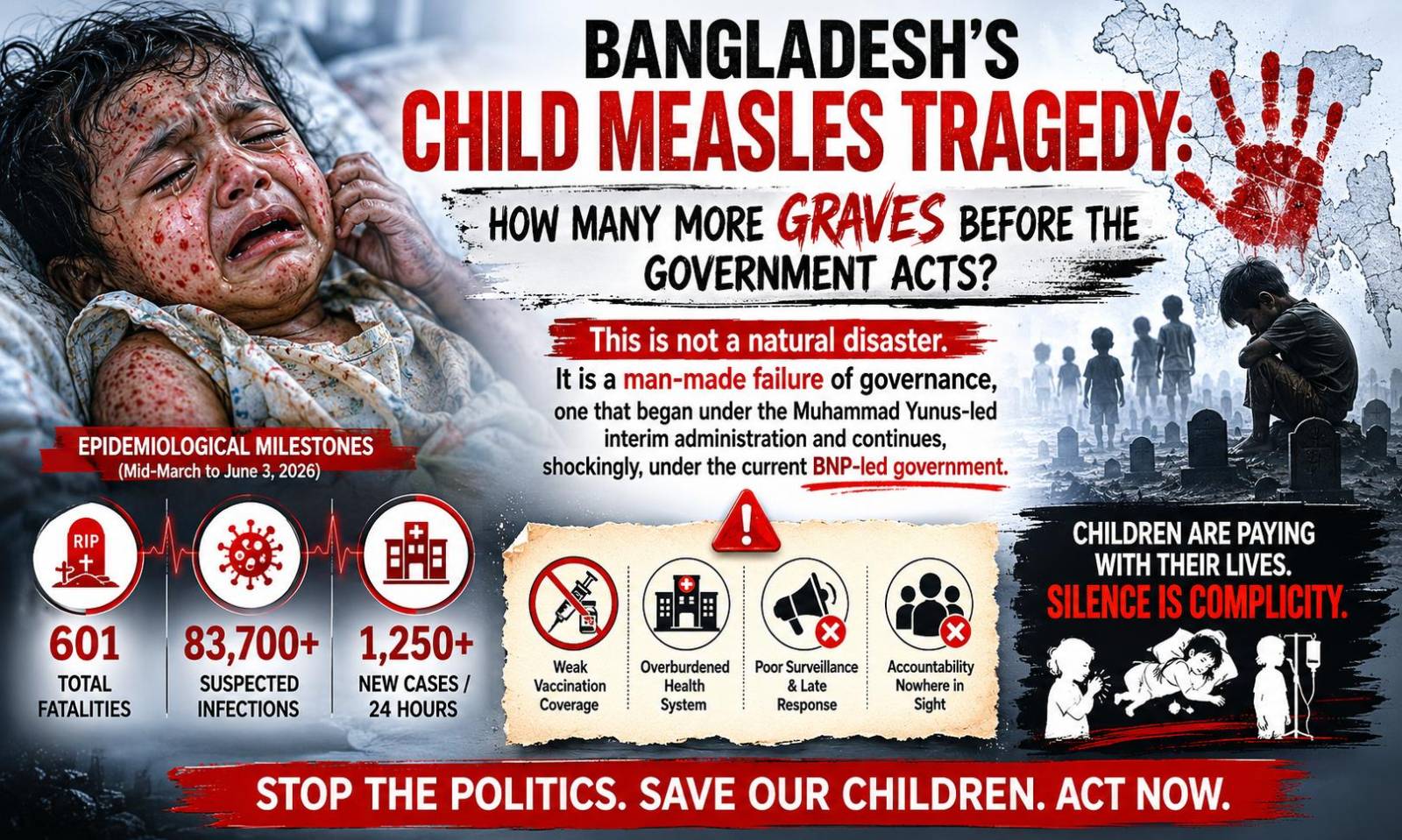
With hundreds of children dead and tens of thousands infected, the Tarique Rahman administration’s cold indifference transforms a preventable outbreak into an institutional crime.
With hundreds of children dead and tens of thousands infected, the Tarique Rahman administration’s cold indifference is transforming a preventable outbreak into an institutional crime.
Every single day, the death toll climbs. As of June 3, 2026, over 600 children have died from measles and measles-like symptoms since mid-March, 90 confirmed measles deaths and 504 suspected. Over 83,700 suspected cases have been recorded, with hospitals overwhelmed and mothers watching their children die from a disease that modern medicine conquered decades ago.
Bangladesh measles death toll rises above 600 as outbreak continues
This is not a natural disaster. It is a man-made failure of governance, one that began under the Muhammad Yunus-led interim administration and continues, shockingly, under the current BNP-led government.

The roots of this tragedy lie in catastrophic decisions taken during the Yunus interim government. In September 2025, despite repeated warnings from UNICEF, including multiple formal letters and high-level meetings, officials abandoned the reliable vaccine procurement system through UNICEF and switched to a cumbersome open tender process. Vaccines sat idle in warehouses while critical supply chains collapsed. Routine immunization programs stalled. Vitamin A supplementation, essential for reducing measles severity, was neglected.
Interim govt’s missteps behind measles crisis
The outcome was predictable and devastating: a massive immunity gap among millions of children, particularly those under five, who now constitute the vast majority of victims. Independent investigations have rightly described this as a "man-made massacre" rooted in administrative arrogance and incompetence.
Prime Minister Tarique Rahman and the BNP government assumed office in February 2026, fully aware of the unfolding crisis. Yet nearly four months later, with the death toll still rising, the response remains disturbingly inadequate.
While some vaccination drives have been initiated and probes announced, fresh deaths continue to be reported daily, six more children in a single 24-hour period as recently as June 2. There has been no declaration of a full national public health emergency. Accountability for those responsible under the interim government appears slow or stalled. Critical interventions, intensified nationwide campaigns, transparent procurement reforms, hospital surge capacity, and nutritional support feel reactive and insufficient.
Bangladesh’s measles outbreak lays bare governance failures
Why has the government failed to treat this as a pandemic-level crisis? Why the apparent reluctance to confront the scale of suffering with honesty and force? How many more mothers must bury their children before Tarique Rahman’s administration matches the urgency this horror demands?
Bangladesh was once a global success story in child immunization. That proud legacy now lies buried in small graves scattered across the country. The current government cannot continue blaming its predecessors while children keep dying on its watch. True governance requires ownership, not just of inherited failures, but of resolving them decisively.
Hundreds of children die within months as measles cases soar in Bangladesh
The world is watching. International organizations, global media, and public opinion will judge Bangladesh not merely by how this outbreak began, but by whether its elected leaders finally show the courage and competence to end it.
The Urgent Call to Action
This tragedy must end now. The Tarique Rahman government should immediately:
Declare a national public health emergency with clear timelines, targets, and daily public reporting.
Accelerate emergency vaccination and treatment efforts with full transparency and international oversight.
Launch an independent, time-bound investigation into the procurement failures under the interim government and hold those responsible accountable.
Commit sustained funding and systemic reforms to prevent such a collapse from ever recurring.
Every additional death is not a statistic; it is a devastating, preventable loss of a child. Bangladesh’s children deserve better. Their mothers’ inconsolable grief demands better.
How many more must die before “never again” becomes more than empty words? The time for excuses is over. The time for decisive, accountable leadership is now.










This work is copyrighted and authorized by the Bangladesh Awami League. You may download, display, print and re-produce this material in unaltered form only (retaining this notice)for your personal, non-commercial use or use within your organization.
