11927
Published on June 22, 2026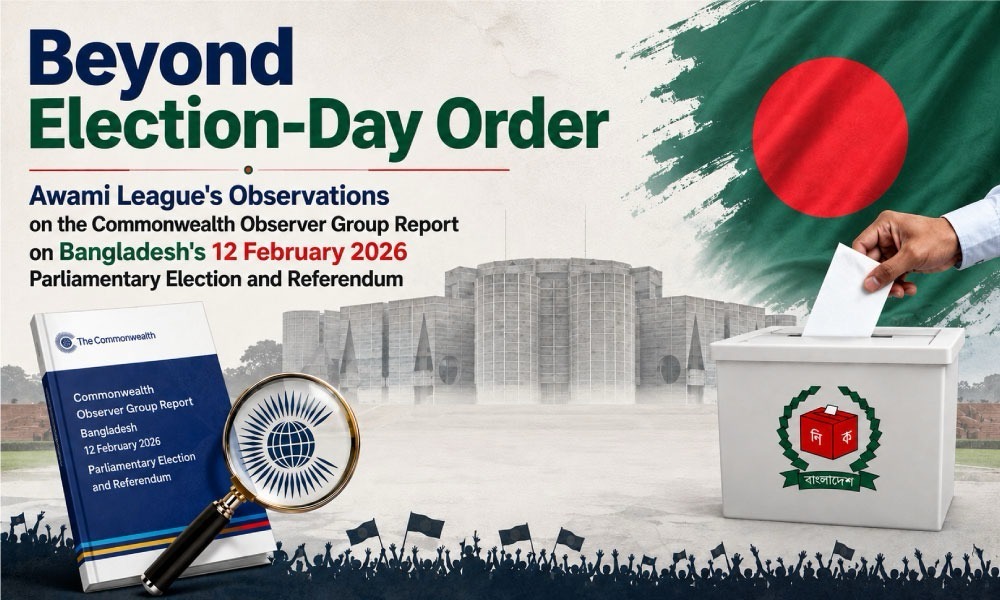
1. Purpose of This Submission:
This submission responds to the Commonwealth Observer Group Report on the Bangladesh Parliamentary Elections and Referendum held on 12 February 2026. The Bangladesh Awami League acknowledges the Commonwealth Secretariat's engagement with Bangladesh at a difficult and consequential moment in the country's political life, and recognises the presence of the Observer Group as part of that wider democratic engagement.
The Awami League values the Commonwealth's long record of supporting constitutional governance, electoral integrity, human rights and inclusive political participation across its member states. It is in that spirit, and with full respect for the Commonwealth's institutional role, that this supplementary submission is placed on record.
The central concern is straightforward. The 12 February election cannot be judged only by asking whether polling-day procedures appeared calm or orderly in selected centres. A democratic election must be assessed across the entire electoral cycle: the legality of the framework, the freedom of political participation, the neutrality of state institutions, the safety of voters and candidates, the credibility of turnout and results, the openness of media and public debate, and the inclusion of all major political forces.
Measured against that broader standard, the 12 February election did not meet the test of democratic legitimacy.
The Awami League was not defeated by voters in a free contest. It was removed from the contest before voters were allowed to decide. Its activities were suspended, its registration was blocked, its grassroots base was placed under pressure, and millions of citizens who identify with the party were denied a meaningful electoral choice. An election held after excluding one of Bangladesh's largest and oldest political parties cannot be treated as a complete expression of the people's will.
This submission therefore asks the Commonwealth Secretariat to preserve the Awami League's record alongside the Observer Group Report, to recognise the democratic concerns raised here, and to support a future political process in Bangladesh grounded in inclusion, constitutional order, neutrality, reconciliation and the restoration of the people's right to choose their representatives freely.
(In response to the email from the Commonwealth Secretariat on the 9th of June, the General Secretary of the Bangladesh Awami League sent a letter to the Commonwealth Secretary General, Hon. Shirley Botchway. Read the letter here.)
2. Executive Summary:
The Commonwealth Observer Group described the 12 February 2026 parliamentary election and referendum as peaceful and orderly. The Awami League respectfully submits that this assessment, even if accurate in relation to procedures observed in particular places on election day, does not address the deeper democratic crisis that surrounded the process.
The election was held under conditions shaped by the forced exclusion of the Awami League, unresolved constitutional questions concerning the interim government and referendum, state-backed campaigning for the referendum's 'Yes' vote, serious concerns over postal voting and ballot secrecy, widespread reports of pre-poll and polling-day irregularities, violence and intimidation, abnormal turnout patterns, disputed referendum figures and the post-election silencing of a major political base.
The Awami League's position is that the election was not simply imperfect. It was structurally compromised.
The party's exclusion was the central democratic defect. The Awami League represents one of Bangladesh's largest political traditions. It was born from the struggle for independence and remains deeply rooted in the country's constitutional and political history. Preventing such a party from contesting did not merely affect one organisation; it denied millions of voters the opportunity to express their political preference through a lawful and recognised party platform. This was not a voluntary boycott. It was imposed exclusion.
The referendum also raises serious concerns. A referendum held alongside a parliamentary election, under a disputed legal framework, with limited public awareness and visible state support for one side, cannot be treated as a normal expression of popular consent. Public resources and government machinery were used in favour of the 'Yes' campaign, while confusing ballot design and delayed publication of referendum results deepened the crisis of trust.
The turnout figures announced by the Election Commission further damaged public confidence. The reported rise from 14.96 percent turnout at 11:00 am to 32.88 percent at 12:00 pm was, on its face, difficult to reconcile with ordinary voting procedures across thousands of polling centres. The final claim of nearly 60 percent turnout sat uneasily beside reports of empty centres, low participation among prisoners and overseas voters, and the wider political reality of the Awami League's peaceful boycott call.
The election environment was also marked by fear. Reports of looted weapons, escaped prisoners, militant releases, high-risk polling stations, the killing of a candidate, attacks on political workers, vote buying, forced voting, fake votes, ballot theft, obstruction of polling agents, pre-stamped ballots and irregular counting cannot be dismissed as isolated noise around an otherwise healthy process. Together, they point to an electoral environment that was deeply compromised.
The period after the election confirmed the danger rather than resolving it. Instead of reconciliation, Bangladesh saw political retribution. Awami League grassroots organisers, supporters, professionals, journalists, teachers and political activists faced legal pressure, arrests, intimidation and silence. Democracy cannot be consolidated by erasing a political tradition that helped shape Bangladesh's independence, constitutional history and development trajectory.
The Awami League therefore respectfully submits that the Commonwealth's assessment should be read within a wider frame. A process may appear calm in selected places and still lack democratic legitimacy. An election without genuine inclusion, lawful competition and equal political rights cannot restore public trust.
This submission calls on the Commonwealth Secretariat to receive and preserve this supplementary record, recognise the exclusion of the Awami League as a central democratic concern, encourage the restoration of full political rights, support dialogue among all major political forces and promote the conditions for a future election that is genuinely free, fair, inclusive, neutral and participatory.
3. Respect for the Commonwealth and the Observer Mandate:
The Awami League acknowledges the Commonwealth Secretariat's engagement with Bangladesh and appreciates the presence of the Commonwealth Observer Group during the 2026 election and referendum. The Commonwealth has a respected history of supporting electoral democracy, peaceful political processes, institutional reform and inclusive governance.
The Awami League's expectations of the Commonwealth are particularly high given the organisation's longstanding record of standing by Bangladesh during many critical moments in our national journey. Following Bangladesh's independence, the Commonwealth extended membership to the newly sovereign nation despite opposition from several member states. In response to that decision, Pakistan withdrew from the Commonwealth. This early recognition reflected the Commonwealth's commitment to the principles of self-determination, democracy and constitutional governance.
Over the years, the Commonwealth has consistently demonstrated its friendship and support for Bangladesh in promoting and safeguarding democracy, constitutional governance and the rule of law. A notable example was witnessed in 1994, when Bangladesh faced a significant democratic and constitutional crisis. At that critical juncture, the Commonwealth played an active and constructive role in facilitating dialogue and understanding between the then-ruling Bangladesh Nationalist Party (BNP) and the opposition Bangladesh Awami League. To assist in resolving the political impasse and fostering a negotiated settlement, the Commonwealth appointed former Australian Governor-General Sir Stephen Ninian as its Special Envoy to Bangladesh.
It is against this historical backdrop that the Awami League approaches the Commonwealth Secretariat today. The party's submission is guided by a genuine belief that the Commonwealth's engagement has often extended beyond election-day observation to the broader defence of democratic inclusion, constitutional order and political reconciliation. It is therefore hoped that the concerns raised in this submission will be considered within that wider tradition of Commonwealth support for democratic governance in Bangladesh.
The Awami League also recognises the limits of any international election observation mission. Observer groups are not courts, investigative agencies or full-cycle auditors. They cannot examine every constituency, every local intimidation incident, every administrative instruction, every online campaign, every postal ballot or every irregularity that may occur before, during and after election day.
For that reason, the conclusions of an observer report must always be understood within the boundaries of what was observed. A report may reasonably describe selected polling-day procedures as orderly. That finding, however, does not settle the larger question of democratic legitimacy. The legitimacy of an election rests on the entire political and legal environment in which it takes place.
The Awami League's concern is not the Commonwealth's presence. The concern is that the phrase 'peaceful and orderly' may be read internationally as validating a process that excluded the country's largest political force and denied millions of citizens meaningful political choice.
This submission is therefore not an attempt to reject the Commonwealth's engagement. It is an effort to complete the record.
4. Election-Day Orderliness Is Not Democratic Legitimacy:
An election can look orderly and still fail the democratic test. Polling stations may open on time. Ballot boxes may be sealed. Voters may stand in line. Officials may complete forms. Observers may see calm in selected centres. None of this can cure a deeper defect: the absence of genuine political competition.
The 12 February election took place after the Awami League had been barred from political activity and prevented from contesting. That exclusion shaped the entire electoral environment before the first vote was cast. Voters were not offered a full democratic choice. They were offered a controlled contest after the removal of a central political alternative.
A credible election requires more than administrative order. It requires freedom of association, freedom of political expression, equal treatment of parties, neutrality of the state, safety for voters and candidates, confidence in the Election Commission, credible dispute resolution, transparent counting and a basic democratic commitment that political opponents must be contested at the ballot box, not removed by administrative action.
The Commonwealth Observer Group itself identified areas requiring attention, including political participation, referendum awareness, women's representation, media risks and the need for a level playing field. These are not secondary issues. They go to the heart of electoral integrity.
The Awami League respectfully submits that the election should not be treated as a successful democratic exercise merely because large-scale violence did not dominate every polling centre on election day. Democracy is not the absence of chaos. It is the presence of genuine choice.
5. Forced Exclusion of the Awami League:
The gravest flaw in the 2026 election was the forced exclusion of the Awami League. The Awami League is not a marginal political group. It is one of Bangladesh's principal political traditions. It led the struggle for independence, helped shape the country's constitutional identity and has commanded a large share of the national vote throughout Bangladesh's electoral history. Its political base reaches across villages, towns, cities, professional communities, youth networks, women's organisations, minority communities and grassroots structures.
The exclusion of such a party cannot be treated as an ordinary administrative decision. It changed the character of the election itself. This was not a voluntary withdrawal from the process. The Awami League did not choose to step away from democratic competition. It was prevented from participating through state action. Its political activities were suspended and its electoral registration was blocked. Its supporters were placed in a position where their political identity could not be lawfully expressed through their party at the ballot box.
There is a clear difference between a party that voluntarily boycotts an election and a party that is forcibly excluded from one. In Bangladesh's past, opposition parties, including the BNP, chose to boycott certain elections. In some instances, they also announced resistance to the electoral process and engaged in violent obstruction. By contrast, the Awami League did not call for violence or for the physical prevention of the 2026 vote. It called for peaceful rejection of a one-sided process from which it had been unlawfully excluded.
The exclusion of the Awami League also meant the exclusion of voters. The Parliamentary Elections and the unconstitutional "Referendum" were conducted in the absence of the Bangladesh Awami League, the largest political party in the country. The banning of the Awami League and its subsequent exclusion from the electoral process fundamentally undermined the inclusive and competitive character that forms the foundation of democratic elections.
Historical electoral data demonstrate the representative strength of the Awami League among the Bangladeshi electorate. In the four parliamentary elections conducted under non-partisan caretaker governments, the Awami League secured an average vote share of approximately 39 percent (38.93 percent), while the Bangladesh Nationalist Party (BNP) received an average of 34.47 percent.
The results were as follows:
• 1991 Election: Awami League 30.08%; BNP 30.81%
• 1996 Election: Awami League 37.49%; BNP 33.62%
• 2001 Election: Awami League 40.13%; BNP 40.97%
• 2008 Election: Awami League 48.04%; BNP 32.50%
These figures demonstrate that the Awami League has consistently represented a substantial segment of the Bangladeshi electorate across different electoral cycles. In these circumstances, an election conducted without the participation of a political party that has repeatedly commanded the support of roughly two-fifths of voters cannot reasonably be regarded as representative of the democratic will of the people. The exclusion of such a major political force inevitably deprived millions of citizens of the opportunity to support their preferred party and significantly diminished the representative character of the electoral process.
Millions of citizens were denied the opportunity to vote for their preferred political party. Many stayed away because the party representing their political identity was absent by force. Others reportedly voted under fear, pressure or local insecurity. Such a process cannot honestly be called participatory.
The central democratic question is not how many parties appeared on the ballot. It is whether the country's major political forces, and the voters who support them, were allowed to participate freely. In this case, they were not.
6. Constitutional and Legal Concerns
The 2026 election and referendum took place in a legal and constitutional environment marked by serious controversy. The interim government carried no direct electoral mandate. Questions were raised regarding the constitutional basis of its formation, the legal effect of its ordinances, the limits of its authority, and the validity of measures adopted without parliamentary approval.
The use of ordinances to alter major electoral arrangements before a national election deserves close scrutiny. Laws affecting political participation, party registration, electoral administration and referendum procedures should be enacted through transparent, accountable and constitutionally sound processes. Where an unelected interim authority undertakes such changes, public confidence in the integrity of the process is inevitably weakened.
The referendum raised an additional and fundamental constitutional concern. The Constitution of Bangladesh does not provide any mechanism for holding a national referendum of this nature. Nor does it confer authority upon the Election Commission to initiate, conduct or supervise a referendum beyond the powers expressly granted to it by the Constitution and the law. As a constitutional body, the Election Commission is bound by the limits of its constitutional mandate and cannot exercise powers that have not been lawfully conferred upon it.
The decision to hold a referendum alongside a national parliamentary election, therefore, raises serious questions regarding constitutional competence, legal authority, and institutional jurisdiction. Constitutional change must be pursued through constitutionally prescribed procedures. It cannot be legitimised through processes that lack a clear constitutional foundation.
Even apart from these jurisdictional concerns, the referendum was conducted in a climate of limited public awareness and deep political division. Citizens were asked to vote on complex constitutional and institutional questions without sufficient time for public education, informed discussion or balanced debate. Rather than serving as a neutral democratic exercise, the referendum became a state-driven political project.
A constitutional referendum cannot be treated as a simple administrative exercise. It must be based upon clear constitutional authority, reflect informed public consent, be free from state pressure, and be conducted through a transparent process that ordinary citizens can understand. The 2026 referendum failed to meet these standards.
The Awami League submits that these constitutional and legal questions remain unresolved and should form part of any serious international assessment of the 2026 election and referendum. The absence of a clear constitutional basis for the referendum, coupled with the exercise of powers beyond constitutionally prescribed limits, raises profound concerns regarding the rule of law, constitutional government and democratic legitimacy.
7. State-Driven Referendum Campaign:
One of the most troubling features of the 2026 process was the role of the state in promoting the referendum's 'Yes' vote. The interim government, including its head, actively promoted support for the referendum. Government officials and public institutions were reportedly mobilised to guide citizens toward one side. Public machinery, public resources, educational institutions, administrative channels and official messaging were used in ways that blurred the line between voter education and partisan campaigning. This was not neutral civic education. It was a state-backed campaign.
The ballot design also raised serious concerns. The use of a tick beside 'Yes' and a cross beside 'No' was widely criticised as psychologically suggestive. A referendum ballot must be neutral. It must not guide voters toward a preferred answer through symbols, design choices or implied moral approval.
The delayed publication of referendum results compared with parliamentary results deepened public suspicion. If both votes were held on the same day and counted within the same administrative framework, the delay in constituency-wise referendum results naturally invited questions. Citizens were left to wonder whether the result was being processed or whether the numbers were being made to fit a desired political narrative.
The Commonwealth Observer Group noted limited public awareness of the referendum's substance. The Awami League submits that the problem was wider: the referendum lacked adequate public understanding, institutional neutrality and result transparency. A referendum conducted in this manner cannot credibly serve as a foundation for constitutional transformation.
8. Turnout Anomalies and Numerical Credibility:
The official turnout figures announced by the Election Commission raised serious doubts about the credibility of the results. The sharpest concern was the reported jump between 11:00 am and 12:00 pm. According to the Commission's own briefings, turnout stood at 14.96 percent at 11:00 am. By noon, it was announced as 32.88 percent. In other words, 17.92 percent of the entire electorate was shown as having voted within a single hour.
Given the size of the electorate, the number of polling centres and the time required for voter identification, ballot issuance, marking, folding and casting, this one-hour surge appeared practically implausible. It suggested a voting speed far beyond ordinary polling realities.
This statistical concern must be read alongside the wider context: empty or thinly attended polling centres in many places, low participation among prisoners and overseas voters, the Awami League's peaceful boycott call, fear among its supporters and public observations that many centres did not show anything close to the turnout later claimed.
The final turnout figure of 59.44 percent therefore requires serious scrutiny. A numerical result that does not match visible civic reality cannot restore public trust. It does the opposite. It creates the impression that votes appeared more confidently in official tables than in polling queues.
The referendum results also raised serious numerical questions, including constituency-level inconsistencies, unusual turnout patterns and reported cases where figures did not align with voter rolls. Even where later corrections were made, public confidence had already been damaged.
The Awami League is not asking the Commonwealth to accept political claims without scrutiny. It is asking the Commonwealth to recognise that numerical anomalies of this scale require independent audit, not quiet acceptance.
9. Security, Violence, and the Climate of Fear:
The election was held in a deeply insecure national environment. After the political upheaval of August 2024, large quantities of firearms and ammunition were reportedly looted from police stations and other facilities. Many of those weapons remained unrecovered. Hundreds of prisoners and accused persons were reported to be at large. A significant number of individuals connected to militant cases were released on bail. Law and order deteriorated across the country, and political violence increased.
This environment directly affected the election. A candidate was shot after the election schedule was announced and later died. Many polling stations were classified as high-risk. Candidates required security protection. Political activists were attacked. Offices were vandalised or burned. Voters, including minority voters and Awami League supporters, reportedly faced threats and intimidation.
Election-related violence was not confined to polling day. In the weeks before the vote, there were reports of clashes, arson, vote-buying, attacks on polling agents and intimidation of candidates and supporters. The night before voting brought further reports of centre occupation, pre-stamped ballots, secret meetings with polling officials, pre-signed result sheets and attempts to influence the outcome before polling even began.
On election day, reports emerged of fake votes, voters discovering that their ballots had already been cast, forced voting for particular symbols, multiple people entering secret booths, ballot paper theft, ballot box theft, attacks on candidates, obstruction of polling agents, clashes, explosions and irregular counting.
Even if observers saw calm in some locations, that cannot erase the wider climate of fear. A voter who reaches a polling centre under threat is not a free voter. A polling station that appears calm after opposition agents have been excluded is not a transparent station. A vote cast in fear is not an expression of democratic will.
10. Postal Voting and Ballot Secrecy Concerns:
The extension of postal voting was presented as an innovation. In principle, enabling overseas citizens and eligible persons in custody to vote can be a positive development. The Awami League does not oppose expanded participation. Its concern is with the way this mechanism was implemented.
The postal voting process raised serious questions about transparency, ballot custody, voter privacy and the possibility of organised control over ballots. Reports emerged of multiple postal ballots being handled by politically affiliated individuals abroad. Political parties themselves raised concerns about flaws in the process.
There were also concerns that ballot papers and voter declaration materials could be linked in a way that compromised secrecy. Ballot secrecy is a fundamental democratic principle. Any process that allows officials, intermediaries or political actors to identify how a citizen voted violates the dignity and freedom of the voter.
Postal voting across jurisdictions requires robust safeguards: independent verification, secure delivery, protection against coercion, separation of identity from vote choice, transparent chain of custody and credible audit mechanisms. In 2026, those safeguards were not demonstrated to the satisfaction of major stakeholders.
The Commonwealth praised the extension of postal voting as an enfranchising mechanism. The Awami League respectfully submits that innovation cannot be judged by intention alone. It must be judged by integrity. A flawed postal voting system may expand participation on paper while weakening trust in practice.
11. Election Commission Neutrality and Administrative Conduct:
The Election Commission was expected to act as the guardian of electoral neutrality. Instead, serious questions arose about its independence, consistency and willingness to enforce the law equally. Concerns were raised over party registration, candidate nomination scrutiny, boundary delimitation, symbol allocation, observer accreditation, enforcement of the code of conduct and the handling of complaints. Independent candidates appeared to face stricter treatment in some cases, while candidates linked to major participating parties were reportedly treated more favourably despite legal or procedural concerns.
The Commission did not act effectively against state-backed referendum campaigning. It did not meaningfully respond to repeated allegations of pre-poll irregularities. It did not suspend or cancel results in constituencies where serious allegations were raised. It moved quickly toward gazette publication and oath-taking despite unresolved complaints from candidates and parties.
An Election Commission must do more than administer procedures. It must command public confidence. When its decisions appear selective, delayed or politically convenient, that confidence collapses.
The Awami League submits that the 2026 election revealed a serious crisis of electoral administration. Future elections in Bangladesh require a commission that is independent not only in law, but also in practice, timing, conduct and public perception.
12. Historical Electoral Reforms and Institutional Strengthening:
It is also important to place the present discussion within the broader historical context of Bangladesh's electoral framework and the institutional reforms undertaken over the past two decades.
Almost all the legal and institutional reforms designed to strengthen electoral integrity, transparency and the independence of the Election Commission were introduced during governments led by Prime Minister Sheikh Hasina. These reforms substantially transformed the operational and institutional capacity of the Election Commission and were intended to ensure that elections could be conducted in a free, fair, transparent and credible manner. According to official records, eighty-two electoral reforms were implemented during this period.
A particularly significant reform was the enactment of the Election Commission Secretariat Act, 2009. Prior to that legislation, the Election Commission Secretariat functioned administratively under the Prime Minister's Office. The 2009 Act established the Secretariat as a separate and independent institution and vested the Election Commission with the legal, administrative, financial and regulatory authority necessary to perform its constitutional responsibilities without requiring executive approval for its day-to-day operations. This represented a major step towards strengthening the Commission's institutional independence.
The electoral framework was further enhanced through the adoption of numerous laws, rules, regulations, guidelines and administrative measures aimed at improving electoral administration and regulatory oversight. During this period, substantial investments were also made in institutional capacity-building, infrastructure development, technological modernisation, voter registration systems and professional training programmes designed to improve the effectiveness, transparency and professionalism of election management.
Further progress was achieved through the enactment of the Chief Election Commissioner and Election Commissioners Appointment Act, 2022. This legislation replaced the previous convention-based appointment process with a statutory mechanism involving a Search Committee composed of holders of constitutionally independent offices and other distinguished neutral persons. The Committee was entrusted with identifying and recommending suitable candidates for appointment as Chief Election Commissioner and Election Commissioners, thereby introducing a more structured, transparent and institutionally grounded selection process.
The enactment of this legislation was also significant because it placed legal constraints upon the exercise of executive discretion in appointments to the Election Commission. Through this parliamentary reform, the Government led by Prime Minister Sheikh Hasina established a statutory process intended to strengthen public confidence in the independence and credibility of the Commission by relinquishing her own constitutional prerogative as Prime Minister in appointing Chief Election Commissioner and other Election Commissioners.
These reforms demonstrate that the Awami League has historically supported the strengthening of democratic institutions and the institutional independence of the Election Commission. The party's present concerns therefore do not arise from opposition to electoral accountability, independent oversight or institutional reform. Rather, they arise from the belief that democratic legitimacy depends not only upon the existence of legal safeguards and independent institutions, but also upon their impartial and effective application in practice, including the meaningful participation of all major political stakeholders in the electoral process.
13. Observer Process and the Question of Credibility:
Election observation plays an important role in protecting democratic integrity. Its credibility, however, depends on transparency, independence, professionalism and the absence of political manipulation. Concerns arose over the recruitment and accreditation of domestic observers, including allegations that large numbers were drawn from obscure or politically connected organisations. Reports also emerged of journalist-observer cards being issued to individuals without genuine journalistic backgrounds. If not properly investigated, such practices risk creating an artificial observation environment designed to legitimise a contested process.
International observers cannot be expected to capture every local irregularity, especially in a country as large and complex as Bangladesh. That is precisely why credible domestic observation matters. If domestic observation is compromised, the wider assessment of election integrity also becomes vulnerable.
The Awami League respectfully urges the Commonwealth to consider whether the observation environment itself was sufficiently transparent and representative to support broad conclusions about public confidence.
14. Media Freedom and Information Control:
The election was held in a media environment marked by both opening and fear. Some outlets may have reported more freely than in previous periods, but that does not mean the media environment was safe or neutral. Attacks on major newspapers, intimidation of journalists, legal uncertainty, digital harassment and the leakage of personal information created conditions in which journalists could not operate without fear.
The restrictions on Awami League activity also affected political reporting. Where the law threatens or discourages coverage of a major political party, media freedom is necessarily restricted. Citizens cannot make informed political choices when the voice of one major political tradition is suppressed, penalised or pushed into informal channels.
The Commonwealth Observer Group noted continuing risks to press freedom and the persistence of a restrictive legal environment. The Awami League submits that these concerns should not be treated as background issues. They form part of the democratic integrity of the election itself.
A free election requires a free public conversation. Bangladesh did not have that in February 2026.
15. Minority Voters, Women, Youth, and Political Inclusion:
The election also raised serious concerns about inclusion. Women's representation remained extremely low. Only a small share of constituency candidates were women, and only seven women were directly elected. This is striking in a country with a long history of women serving at the highest level of government.
Minority voters and candidates faced fear, pressure and insecurity. Reports from several constituencies suggested that minority communities were warned, discouraged or intimidated. Some minority candidates expressed concern for their own safety and for the safety of their voters. A democratic election cannot be inclusive if minority citizens feel unsafe when exercising their political rights.
Youth participation was celebrated in public rhetoric, but real decision-making remained dominated by established or state-favoured political actors. The political energy of young citizens was not translated into a genuinely open democratic field.
The exclusion of the Awami League also displaced women, youth, minorities, professionals and grassroots voters aligned with the party. Their voices were not merely underrepresented. They were pushed out of the political field.
16. Post-Election Repression and the Silencing of a Political Base:
The post-election environment deepened the legitimacy crisis rather than resolving it. Instead of reconciliation, Bangladesh saw further silencing of the Awami League's political base. Local organisers, activists, supporters, professionals, journalists, teachers and citizens associated with the party faced legal pressure, arrests, intimidation and social fear. Many were forced into silence. Others were driven out of public political activity.
This pattern is dangerous for Bangladesh's democratic future. A democracy cannot be built by treating one political tradition as unlawful by executive preference. It cannot stabilise through exclusion. It cannot reconcile by criminalising millions of political identities.
The Awami League remains a mass democratic party. It cannot be erased by bans, suspensions or administrative orders. It was born from the people's struggle and led Bangladesh's independence. Its future, leadership, reform and participation must be determined through its own democratic party procedures and by the will of its supporters, not through externally imposed formulas or state coercion.
Sheikh Hasina's current position reflects that reality: physical absence from Bangladesh does not mean political silence. The Awami League's struggle is framed around the restoration of democratic rights, rule of law, freedom of expression, political participation, minority security and the spirit of the Liberation War. That position remains central to the party's response to the 2026 election.
17. Awami League’s Position:
The Awami League's position can be stated plainly.
I. The 12 February 2026 election was not a genuinely inclusive national election. It was a controlled electoral exercise conducted after the removal of a principal political competitor.
II. The referendum was not a neutral act of constitutional consultation. It was conducted with insufficient public awareness, state-backed promotion of one outcome and serious numerical and procedural questions.
III. The Election Commission did not command sufficient confidence. Its conduct before, during and after the vote raised concerns about impartiality, transparency, complaint handling and result credibility.
IV. The security environment was not conducive to free political participation. Violence, intimidation, looted weapons, escaped prisoners, militant releases and attacks on political actors created fear.
V. The official turnout and result figures require independent scrutiny. Mathematical anomalies and constituency-level inconsistencies cannot be dismissed without audit.
VI. The post-election environment confirms that the process did not produce reconciliation. It deepened political exclusion and repression.
The Awami League did not reject democracy. It rejected a process that denied democracy. The party's demand is not for special privilege. It is for equal political rights, restoration of lawful activity, withdrawal of politically motivated restrictions, release of political prisoners, withdrawal of false cases against professionals and political activists, and a free, fair and inclusive election under a neutral caretaker arrangement in which all major political parties can participate.
18. Requests to the Commonwealth Secretariat and Commonwealth Member States:
In light of the concerns outlined above, the Bangladesh Awami League respectfully requests that the Commonwealth Secretariat and Commonwealth member states:
I. Accept this supplementary submission as part of the institutional record concerning the Bangladesh parliamentary election and referendum held on 12 February 2026.
II. Recognise that election-day orderliness alone cannot establish democratic legitimacy where a major political party has been forcibly excluded from the political process.
III. Acknowledge the exclusion of the Bangladesh Awami League as a central democratic concern that fundamentally affects the credibility, representativeness, inclusiveness and legitimacy of the 2026 election and referendum.
IV. Advocate for the restoration of democratic governance, constitutional order and the rule of law in Bangladesh, consistent with the principles and values of the Commonwealth Charter.
V. Call for the lifting of restrictions on the Bangladesh Awami League and the restoration of its full lawful political activities, together with the protection of the political rights of all citizens and political actors.
VI. Support and encourage meaningful, inclusive national dialogue involving all major political stakeholders, including the Awami League, without precondition, discrimination or coercive exclusion.
VII. Encourage an independent international assessment and review of the 2026 election and referendum process, including concerns relating to turnout anomalies, referendum-result inconsistencies, postal-vote procedures, ballot secrecy, campaign finance practices, state-backed referendum campaigning, complaints-handling mechanisms and alleged human rights violations.
VIII. Support the protection of judicial independence, constitutional institutions and the impartial administration of justice, ensuring that legal processes are free from political influence.
IX. Urge the protection of fundamental freedoms, including freedom of expression, media freedom, press freedom, minority rights and the safety and security of journalists, political activists and supporters.
X. Encourage accountability for human rights violations and support independent mechanisms capable of investigating allegations of abuse and ensuring appropriate remedies.
XI. Affirm that Bangladesh's democratic future cannot be built upon the exclusion or silencing of one of its largest and most significant political traditions, and that democratic legitimacy requires the participation of all major political forces.
XII. Support the creation of conditions for future elections that are genuinely free, fair, inclusive, competitive and internationally credible, conducted under a neutral and trusted framework acceptable to the people of Bangladesh and all major political stakeholders at the earliest possible opportunity.
19. Conclusion:
The Commonwealth Observer Group's report forms part of the record. This submission respectfully asks that the Awami League's record also be preserved.
The 12 February 2026 election may have been presented as peaceful and orderly. But peace without political inclusion is not democratic legitimacy. Order without genuine choice is not representation. A referendum without neutrality is not consent. A turnout figure without public trust is not a mandate.
The people of Bangladesh deserve more than an administratively managed election. They deserve a political process in which every major party can participate, every voter can choose freely, every ballot is counted transparently, every journalist can report without fear, every minority citizen can vote safely and every political tradition can compete under equal law.
The Awami League remains committed to constitutional democracy, peaceful political participation, the spirit of the Liberation War and the people's sovereign right to choose their government. It rejects exclusion, intimidation, manipulated legality and manufactured mandates.
Bangladesh cannot move forward by erasing the Awami League. It can move forward only by restoring political rights, rebuilding public trust and returning the country to a genuinely inclusive democratic path.
The Commonwealth has an important role to play in encouraging that future. This submission is offered in that spirit: firm in principle, respectful in tone and committed to the restoration of democracy in Bangladesh.
ANNEX: ONLINE SOURCES AND SUPPORTING MATERIALS
For the convenience of the Commonwealth Secretariat and for independent verification of the matters referred to in this submission, relevant publicly accessible online materials are provided below. These materials include video recordings, public statements, news reports, and social media content that may assist in understanding the factual background and context of the issues raised.
Electoral Context Amid Allegations of Vote Rigging and Violence – National Media YouTube Video
|
Sl |
Title |
Link |
YouTube Author |
|
01 |
Jamaat alleged vote rigging in 30 constituencies. Jamaat-e-Islami Assistant Secretary General and spokesperson Ehsanul Mahbub Zubair said that incidents of irregularities, vote manipulation, and electoral fraud occurred in various parts of the country during the election. He also alleged that voters were obstructed from casting their ballots and that party polling agents were expelled from many polling stations. According to him, reports of serious irregularities have so far been identified in around 30 constituencies. He claimed that, in addition to vote fraud and manipulation, result sheets contained overwriting, erasures, and alterations. He further stated that these issues were reported to returning officers and other relevant senior officials on election day. Zubair also alleged that while results from some constituencies were announced quickly, the publication of results in several others was intentionally delayed. Referring to a number of constituencies in Dhaka, he said that party representatives had to wait until 5:00 a.m.to obtain the election results. |
@channel24digital
|
|
|
02 |
Jamaat’s Ameer alleged that the election results were altered during vote counting. Jamaat Ameer Shafiqur Rahman has alleged that irregularities and manipulation of election results occurred at various stages of the electoral process. He claimed that, in some cases, the live broadcast of election results was suddenly interrupted, raising suspicions among the public. Shafiqur Rahman further stated that his party possesses documents and information indicating that result sheets from several polling centers were altered through overwriting and corrections. He also alleged that the results in a number of specific constituencies were deliberately changed. According to him, these incidents involved the occupation of polling centers, misuse of administrative authority, and efforts to influence the outcome of the vote through coercive means.
|
|
@channel24digital |
|
03 |
Cocktail explosions in several districts and attacks on candidates have heated up the election environment. Over fifty people were injured across the country in election-related violence involving BNP and Jamaat activists. Violence, attacks, vandalism, and cocktail bomb explosions were reported in various parts of the country during the parliamentary election. In the Munshiganj-3 constituency, 12 cocktail bombs were reportedly detonated. Similar incidents of tension and unrest were also reported in Gopalganj. In Bhola Sadar, ballot papers were allegedly snatched after cocktail bomb explosions. Reports of ballot paper theft and other electoral irregularities also emerged from several polling centers across the country. Meanwhile, Habiba Begum, an independent candidate in the Rajshahi-3 constituency, was reportedly assaulted in front of a polling station. Despite low voter turnout, incidents of cocktail bomb attacks, clashes, and violence were reported nationwide, leaving more than 150 people injured.
|
|
|
|
04 |
Lusterless election in Gopalganj amid an absence of voters. Although voting is taking place in the election, the situation in Gopalganj presents a contrasting picture. The election appears to have lost its usual vibrancyVoter turnout at polling centers is significantly lower compared to previous years. In many places, voter presence is almost nonexistent. At numerous polling stations, there are no polling agents from candidates other than the Sheaf of Paddy symbol. |
|
|
|
05 |
In Gopalganj, ballots were allegedly stamped and signed unlawfully despite the absence of voters at polling centers. Presiding officers at various polling centers in Gopalganj have, on their own initiative, unlawfully affixed seals and signatures on the reverse side of ballot papers in advance. This was done in violation of electoral laws, despite the fact that voter turnout at those centers was either nearly zero or extremely low.Several well-known media outlets in Bangladesh have reported this picture of irregularities in the election. |
|
@EkattorTelevision |
|
06 |
Allegations of fake voting at a polling center in Dohar. Reports of serious irregularities have been found in various polling centres in Dohar, including ballot stuffing, seizure of polling stations, and unauthorized entry into the secret voting booths. A female voter, upon arriving to cast her vote, discovered that her vote had already been cast before she reached the polling centre. It was later learned that several similar incidents had occurred, where voters arrived to find that their votes had already been cast. |
|
|
|
07 |
Fake voting by BNP in Bhaluka, Mymensingh. At a polling centre located at Lohabaari Baradi Government Primary School in Meduari Union under Mymensingh-11 (Bhaluka) constituency, CCTV footage captured an incident where five young men took control of a voting booth and stamped ballot papers. A group entered the Lohabaari Baradi Government Primary School polling centre. Among them, five young men entered a booth and began stamping ballot papers. In a 1 minute and 33 second video, two individuals can be seen stamping ballots, while the other three are folding the ballot papers and placing them into the ballot box. Additionally, three more individuals were also seen at the scene. |
|
|
|
08 |
Allegations of casting fake votes by disguising as women in Sylhet-5 constituency & Moulvibazar. |
|
|
|
09 |
Illegal ballot stamps allegedly made on the order of a Jamaat leader.
Illegal ballot stamps were allegedly made under the instructions of a local leader of Jamaat-e-Islami in Lakshmipur for the purpose of casting fake votes. It is reported that six “voting stamps” were produced unlawfully for this activity. |
|
|
|
10 |
Allegations against a Jamaat leader of distributing money to voters in Tangail.
Allegations have been raised against leaders of Jamaat-e-Islami in the Jagtpura and Mirzapur areas of Bhuiapur Upazila in Tangail for distributing cash among voters.
The incident took place in Jagtpura village under Arjuna Union of Bhuiapur Upazila and in Mirzapur. It is alleged that during campaign activities in support of their candidate, Jamaat leaders were giving money to voters, and local residents recorded the scene on mobile phones. In the circulated video, people can be seen protesting while holding up 500 and 1,000 Taka notes as evidence. |
|
|
|
11 |
Postal ballots came under controversy even before voting began. Ahead of the national parliamentary election, a video related to postal ballots for overseas voters has gone viral on social media. The circulating footage claims that ballot counting or possible manipulation activities were being carried out in a secret location before the voting process officially began. The video shows several individuals in a room collectively counting a large number of postal ballots. An envelope seen in the footage includes the name of Bahrain, a country in the Middle East, as part of the address. In one part of the video, a person is heard saying, “Take whatever is here. We don’t need them. Don’t record the video. Don’t post it on Facebook.” In another segment, a different voice is heard saying, “If multiple people record videos, it will spread on Facebook. Then it will damage the image. Voting through postal ballots for expatriates in Bahrain may be stopped.” |
|
|
|
12 |
A voter alleged that upon arriving to vote, they found the vote had already been cast, along with reports of malfunctioning CCTV cameras. Several voters have alleged that their votes had already been cast before they arrived at the polling station. At the Banshpura Government Primary School polling center, multiple irregularities have been reported. One male voter said that when he went to cast his vote, the presiding officer informed him that his vote had already been cast by someone else. Similarly, a female voter reported a comparable experience. She said that upon arriving to vote, she found that her vote had already been cast. When she informed the presiding officer, she was marked with indelible ink despite not casting her vote, which created the impression that she had already voted. The voter claims that she did not actually vote.
|
|
|
|
13 |
A series of clashes and incidents of violence marked the national election. Reports of ongoing clashes, violence, and irregularities have started emerging one after another. In Gopalganj, the situation appears to be the opposite of normal voting trends, with most polling centres remaining largely empty of voters. Meanwhile, a cocktail explosion occurred at a polling center in Gopalganj, injuring three people, including a teenage girl and two Ansar members. The incident took place around 9:30 a.m. at the Reshma International School polling center in the city. Additionally, independent MP Rumeen Farhana alleged that the administration is harassing her supporters and that police have detained some of her campaign workers.
|
|
|
|
14 |
Post-election attacks and vandalism reported in several districts, allegedly involving BNP and Jamaat activists. Following the announcement of the national parliamentary election results, incidents of violence, attacks, and vandalism were reported in various districts across the country. Clashes and unrest were reported in multiple areas, including Jhenaidah, Meherpur, Patuakhali, Kishoreganj, Munshiganj, Faridpur, and Bagerhat, among several other districts. |
|
|
|
15 |
Money was allegedly recovered from the election vehicle of BNP candidate Annie. Ahead of the 13th National Parliamentary Election, during the election campaign activities of BNP parliamentary candidate for Lakshmipur-3 (Sadar), Shahid Uddin Chowdhury Anee, the army set up a search checkpoint at Jhumur Mor in Lakshmipur town on 11 February 2026. In the evening, a search was conducted on a vehicle used by Anee’s personal assistant (PS) and his relative Badru Alam Shyamol at the checkpoint. During the search, Tk 1.5 million intended for polling agents was reportedly recovered from the vehicle.
|
|
|
|
16 |
A fake voter was caught red-handed in Patuakhali. In Patuakhali, two individuals were caught red-handed on charges of attempting to cast fake votes through fraudulent means. The arrest took place at the Khapupara Nesaruddin Kamil Madrasah polling centre in Kalapara municipal town. |
|
|
|
17 |
Boycott of the by-election over allegations of vote rigging and fake voting. |
|
Allegations of Widespread Electoral Irregularities and Inflated Turnout Raise Questions Over Bangladesh’s 13th Parliamentary Election
|
SL |
Title & Description |
Link |
|
01 |
No voters, yet ballots filled. No people, yet results prepared.
Constituency: Kurigram-1, polling center no. 171. |
https://www.bdvortex.com/1044/ |
|
02 |
Beyond the Ballot: Allegations, Irregularities, and the Credibility of the 13th National Election Transparency International Bangladesh (TIB) has raised serious concerns about the credibility of Bangladesh’s 13th National Parliamentary Election, citing widespread irregularities in its post-election observations. According to TIB, voters were obstructed in 46.4 percent of polling centers, while allegations of ballot stuffing emerged in 21.4 percent and pre-stamped ballots in 14.3 percent. Reports also included voter coercion, booth capturing, exclusion of opposition polling agents, and administrative inaction. Restrictions on journalists and mobile networks further limited transparency. |
https://www.bdvortex.com/1040/ |
|
03 |
NCP convener Nahid Reveals Vote Engineering Secrets After Talks Collapse Political tensions have intensified following allegations by National citizen party convener Nahid Islam regarding vote engineering after reported talks with BNP Chairman Tarique Rahman failed over the July Charter. Speaking after taking oath as a Member of Parliament, Nahid claimed large-scale electoral manipulation and questioned the neutrality of former interim government figures. Reports suggest BNP declined to join the Constitutional Reform Council after unsuccessful negotiations, deepening divisions among major political forces. Analysts warn that disagreements over constitutional reforms, referendum outcomes, and council participation could trigger legal disputes, political instability, and uncertainty surrounding Bangladesh’s ongoing reform process. |
https://www.bdperspectives.com/3034/nahid/ |
|
04 |
The Death of Democracy in Dhaka: Muhammad Yunus and the Farce of February 12 Election A commentary titled The Death of Democracy in Dhaka sharply criticizes the February 12, 2026 election in Bangladesh, alleging that the vote was neither free nor representative. The document claims the election was tightly controlled by the interim administration led by Muhammad Yunus and describes the process as a managed exercise rather than a genuine democratic contest. It argues that a significant portion of the electorate was effectively disenfranchised and questions the independence of electoral institutions. The report concludes that the election reflects deeper concerns about political participation, legitimacy, and democratic governance in Bangladesh.
|
https://www.bdperspectives.com/wp-content/uploads/2026/02/The_Death_of_Democracy_in_Dhaka.pdf |
|
04 |
Bangladesh's February 12, 2026 Election: A Staged Spectacle Under Yunus's Watch A commentary on Bangladesh’s February 12, 2026 election alleges that the vote was a tightly controlled political exercise rather than a genuine democratic contest. The report claims that the interim administration led by Muhammad Yunus oversaw an election marked by low public participation despite official turnout figures of 59.4 percent. According to the commentary, independent observers and local reports suggested turnout may have been significantly lower, raising questions about the credibility of the process. The article argues that the election served to formalize a pre-determined political outcome, sparking debate over democratic legitimacy and public representation. |
https://www.bdperspectives.com/wp-content/uploads/2026/02/Bangladeshs-February-12-2026-Election.pdf |
|
05 |
Bangladesh’s February Election Faces Mounting Questions Over Fairness and Neutrality As Bangladesh prepared for its February 12, 2026 national election, growing debate emerged over the fairness and neutrality of the electoral process. The vote, the first since the political upheaval of August 2024, was organized under the interim administration led by Muhammad Yunus, which came to power promising democratic reforms. While supporters viewed the election as a step toward restoring constitutional governance, critics raised concerns about transparency, administrative impartiality, and legal legitimacy. |
https://www.bdperspectives.com/wp-content/uploads/2026/02/Bangladeshs-February-Election.pdf |
|
06 |
Referendum State Bias And The Illegal Yunus Government In any democratic system, a referendum is an expression of direct popular sovereignty. The stateʼs obligation is to act as a neutral administrator—ensuring security, fairness, and free expression—while refraining from influencing the outcome. In present-day Bangladesh, however, this foundational principle has been gravely violated. An illegal and constitutionally questionable Yunus government has transformed the referendum into a partisan political instrument, undermining the Constitution, eroding judicial independence, and placing the democratic framework of the state in existential danger. |
https://www.bdperspectives.com/wp-content/uploads/2026/02/Referendum-State-Bias-And-The-Illegal-Yunus-Government.pdf |
|
07 |
A report critical of Bangladesh’s February 2026 parliamentary election argues that the process faces serious questions over its democratic legitimacy. The report alleges that the election is being conducted without a clear constitutional framework, creating uncertainty about its legal basis. It further claims that the exclusion of major political actors and large segments of the electorate has weakened the representative nature of the vote. Concerns over political violence, candidate intimidation, and alleged institutional bias have also been highlighted. The report warns that international recognition or observation of the election could lend credibility to a process that critics believe falls short of accepted democratic standards. |
https://www.bdperspectives.com/2945/a-failed-democratic-exercise/ |
|
08 |
Bangladesh’s Election Commission reported that 127.7 million voters were registered for the 13th National Parliamentary Election and referendum, with an overall referendum turnout of 60.26 percent. Official results show 48.07 million voters supported the proposal (“Yes”), while 22.57 million voted against it (“No”). An additional 7.4 million ballots were declared invalid or rejected. However, controversy has emerged over significant discrepancies in the Commission’s statistics. Reports indicate that in some constituencies, the number of votes cast exceeded the number of registered voters, with turnout rates reportedly reaching as high as 244 percent, raising concerns about the accuracy and credibility of the results. |
https://www.tbsnews.net/bangla/bangladesh/news-details-454071 |
Vote Count Discrepancies and Polling Irregularities Raise Election Concerns in Bangladesh:
X Content
|
Sl |
Title & Description |
Link |
|
01 |
EC Vote Count Discrepancies Spark Transparency Concerns Official Bangladesh Election Commission data from 208 constituencies reveals significant differences between parliamentary election and referendum vote totals. Of the constituencies reviewed, 139 recorded more votes in the parliamentary election, 60 reported higher referendum turnout, and 9 showed identical figures in both polls. In several constituencies, including Cumilla-10 and Sirajganj-4, the discrepancies involved thousands of votes. Election officials have suggested possible counting or administrative errors, but complete nationwide data has yet to be released. The inconsistencies have raised fresh questions about transparency, vote management, and the overall integrity of the electoral process. Video Collection: Maasranga Television |
|
|
02 |
Video Alleging Polling Irregularities Sparks Concerns Over Election Integrity A video circulating online from Bangladesh’s February 12, 2026 election shows ballot boxes reportedly left unattended inside a polling station, with no presiding officer or polling agents visible. The footage has raised questions about ballot security and oversight procedures during the voting process. Election authorities have maintained that the election was conducted peacefully and in accordance with legal requirements. However, the video has revived earlier allegations of irregularities, including booth capturing and pre-stamped ballots. While officials defend the process, the incident has fueled ongoing debate over transparency, supervision, and public trust in the electoral system. |
|
|
03 |
Naogaon-1 Polling Centre Reported 836 “Extra Votes,” Sparks Election Integrity Questions A results sheet from polling center No. 45 in Naogaon-1 constituency has gone viral online after it reportedly showed 3,414 votes cast despite only 2,578 registered voters. The document, said to be Form-16 from Nurpur Government Primary School, indicates 836 more votes than eligible voters. Individual candidate totals also appear inconsistent, with combined figures exceeding the voter count. The sheet further shows mathematical discrepancies in the final tally. |
|
|
04 |
Turnout Dispute Erupts Over Bangladesh’s February 2026 Election Bangladesh’s February 12, 2026 election under the interim administration led by Muhammad Yunus has come under scrutiny amid conflicting turnout figures. While the Election Commission reported a voter turnout of 59.4 percent, independent accounts cited significantly lower participation, estimated between 10 and 13 percent, with reports of largely empty polling stations. |
|
|
05 |
Bangladesh 2026 Election: Turnout Discrepancies Fuel Debate Over Credibility Bangladesh’s 13th parliamentary election and constitutional referendum, held on 12 February 2026, has sparked debate over its credibility despite the Election Commission reporting a 59.4 percent turnout and describing the vote as peaceful. Questions emerged after Rajshahi-4 initially recorded an unusually high 244 percent turnout before being revised to just over 72 percent, which officials attributed to technical errors. Similar concerns were reported in other constituencies, along with a high number of rejected ballots in the referendum. |
|
|
06 |
TIB Report Flags Irregularities in 40% of Seats, Raises Election Integrity Concerns A new assessment by Transparency International Bangladesh (TIB) has raised questions over the credibility of Bangladesh’s recent national election, reporting irregularities in around 40 percent of parliamentary seats. According to the findings, candidates in 28.6 percent of those seats formally lodged complaints, suggesting disputes directly from participants in the electoral race. |
|
|
07 |
Sharp Turnout Surge Reported Within Hours Raises Questions Over Election Data Bangladesh’s Election Commission reported fluctuating voter turnout figures during the national election, initially estimating participation at around 14–15 percent by mid-morning, with several polling stations appearing largely empty. However, by midday, the Commission stated that turnout had risen to 32.88 percent nationwide based on data from multiple centres. The rapid increase within a short period has sparked public discussion and scrutiny over the consistency and methodology of turnout reporting. |
|
|
08 |
Allegation of Pre-Cast Vote in Chattogram Raises Concerns Over Polling Integrity A voter from Halishahar in Chattogram has alleged irregularities during the national election, claiming that their vote had already been cast before they arrived at the polling station. According to the account, officials later allowed the individual to vote again after adjusting the records. |
|
|
09 |
Allegation of Pre-Stamped Ballots Raises Questions Over Voting Fairness Allegations have emerged from a polling station during Bangladesh’s national election claiming that voters were issued pre-stamped ballots marked with a specific symbol. According to a reported account, when a voter requested a fresh ballot, a presiding officer allegedly stated that all ballots were already marked. |
|
|
10 |
No Voters, Yet Seals and Signatures Ready - Ballots “Already Voted” in Shibpur, Narsingdi Allegations of serious irregularities have emerged from a nearly voter-less polling centre in Shibpur, Narsingdi. Witnesses claim ballot papers were signed and sealed even before |
https://x.com/bdperspectives/status/2022404923229618537?s=20 |
|
11 |
Allegation of Pre-Cast Votes in Nilphamari-2 Sparks Election Integrity Concerns Voters in Nilphamari-2 have alleged serious irregularities during Bangladesh’s national election, claiming they arrived at polling stations only to find their votes had already been cast. According to these accounts, some voters were informed that ballots had been pre-marked or recorded in advance. |
|
|
12 |
18.56% in One Hour — A Mathematical Miracle or Manipulation? Official figures show turnout rising from 14.32% at 11:00am to 32.88% by 12:00pm — an increase of 18.56% in just one hour. With 127.7 million registered voters, that jump equals roughly 23.7 million votes cast in 60 minutes. |
|
|
13 |
Pre-Stamped Ballots for the Sheaf of Paddy in Cumilla – 10 constituency Fresh allegations have surfaced from Cumilla-10, where ballot papers were reportedly stamped in advance with the BNP’s electoral symbol — the sheaf of paddy. Critics claim this is part of a broader pattern of polling-centre takeovers and ballot manipulation. |
|
|
14 |
Children Casting Proxy Votes? Serious Allegations from Kushtia |
|
|
15 |
Allegations of Ballot Snatching Reported in Chandpur-3 Allegations have emerged from Chandpur-3 constituency during Bangladesh’s national election, claiming that activists from the Bangladesh Nationalist Party (BNP) took control of several polling centres shortly before voting ended and stamped ballot papers with their party symbol. |
|
|
16 |
At Day’s End, Bangladesh Witnessed Yunus’s “Best Election” in History In Valuka, Mymensingh, reports allege that after a quiet day with low voter presence, ballot stamping intensified later in the afternoon — raising fresh questions about the credibility of the process. |
|
|
17 |
Results at Night, Voting in the Morning - Yunus’s “Late Night Election” In Barguna, result sheets reportedly had signatures before voting even began. Critics call this a staged “Laylatul Election,” where polling centers are seized, ballots are stuffed, and outcomes are finalized under the cover of darkness. |
|
|
18 |
Allegations of ‘Night Voting’ in Jatrabari In Jatrabari, reports claim that ballot papers at Shaheed Zia Girls’ School were stamped overnight in favor of Jamaat-backed candidates. |
|
|
19 |
23 Signed Result Sheets Seized in Jhenaidah-4 a Day Before Polling In the Jhenaidah-4 constituency — covering Kaliganj and part of Sadar — 23 result sheets reportedly signed by agents of the “Dari-Palla” (Scales) symbol were seized at the Salimunnessa polling centre. According to local reports, the centre’s presiding officer was Jesmin Ara, an assistant engineer with the Department of Public Health Engineering. It has been alleged that the result sheets were signed in her presence prior to polling day.
|
|
|
20 |
Blank Result Sheet Signed Before Voting Begins: Allegations Raise Fresh Questions Over Electoral Integrity Under Bangladesh’s electoral rules, presiding officers are required to sign official result sheets only after voting has concluded and ballots have been counted in accordance with established procedures. |
|
Election-Related Violence, Electoral Irregularities, Nighttime Voting, Attacks, and Allegations:
Facebook Content
|
Sl |
Title |
Link |
|
01 |
Fake voting by BNP in Bhaluka, Mymensingh. CCTV footage from a polling centre at Lohabaari Baradi Government Primary School in Meduari Union, Mymensingh-11 (Bhaluka), reportedly shows a group of young men taking control of a voting booth and stamping ballot papers. The 1-minute-33-second video appears to show some individuals marking ballots while others fold and place them into the ballot box, with additional people present at the scene. |
|
|
02 |
There is no Awami League in this election; accordingly, at least 30% of the country's people are not participating: Independent candidate Rumin Farhana. |
|
|
03 |
Jamaat leader detained in Narayanganj while buying votes. Allegations have been raised against a Jamaat-e-Islami worker in Narayanganj-3 constituency for distributing money among voters. In the Darikandi area of Sanmandi Union under Sonargaon Upazila, locals claim that Tk 20,000 was found in the possession of a Jamaat worker named Asaduzzaman (55), and that the money was being distributed among voters. |
|
|
04 |
Upon arriving at the polling centre, voters discovered that their votes had already been cast by someone else. |
|
|
05 |
Voting was completed before Tahajjud in most centers of Matiranga Upazila in Khagrachhari. Allegations have been raised that voting in most polling centres in Matiranga Upazila of Khagrachhari was completed before the early morning hours (Tahajjud time). It has been claimed that the majority of votes were cast even before voting officially began. This was reportedly shown in video footage as well. |
|
|
06 |
Bangladesh witnessed vote theft in a voter less election. “In an election without voters, Bangladesh witnessed vote theft,” said Mo. Tarek Rahman, Member Secretary of Amjanatar Dal, expressing disappointment over the election and alleging vote fraud. |
|
|
07 |
Voters are unwilling to vote, so a Jamaat leader was chased while trying to take people to polling centers by offering money. |
|
|
08 |
Rangpur-4 erupts over Akhtar Hossain's allegations of vote rigging; locals take to the streets in protest. |
|
|
09 |
BNP committed vote rigging in every constituency. candidate Rumeen Farhana. |
|
|
10 |
One of the worst elections in the country's history, where the presiding officer of a polling center is being taken away. The incident occurred at around 11:30 p.m. at Moishashi Government Primary School in Balaganj Upazila. |
|
|
11 |
Ballots stamped with the Jamaat symbol! Surely they are stamping ballots to establish justice and fairness! voters at the center. |
|
|
12 |
In front of the presiding officer, a voter is stamping the ballot for NCP's Hannan Masud's "Shapla Koli" symbol. The presiding officer himself is casting votes in the referendum. |
|
|
13 |
In the voter less election, Jamaat agents are mass-stamping ballotpapers. |
|
|
14 |
Instead of carrying out security duties, police are searching for voters in the market. Even after announcements over loudspeakers, no voters are being found, and the polling centers remain empty. |
|
|
15 |
Arranged election: ballot papers already signed at a polling center in Shibpur, Narsingdi. |
|
|
16 |
Mass signatures on ballot papers! In Thakurgaon-1 constituency, signatures were allegedly placed on ballot papers in bulk during the national parliamentary election. It has been claimed that even in the absence of voters at the polling center, the presiding officer had already signed the ballot papers in advance. |
|
|
17 |
The people of the entire country have boycotted this election. An election without the Awami League is like curry without salt. At Uttara High School polling center, a voter said that one of the main reasons for the relatively low voter turnout was that a large portion of supporters of the Awami League, one of the country's major political parties, were not participating in the election. According to him, the absence of the Awami League from the electoral contest had a noticeable impact on voter turnout. He also noted that in previous elections, long queues of voters were commonly seen at this polling center, but that was not the case this time. |
|
|
18 |
Voting had already been completed in Debidwar, Cumilla. At the Sujat Ali Government College polling center in Debidwar, a voter reportedly arrived and discovered that his vote had already been cast before his arrival. |
|
|
19 |
In Monirampur Upazila of Jessore district, a voter named Mozammel Hossain Pranto, who is listed as voter number 1 at the Bahadurpur High School polling center, reportedly found that his name had already been marked as voted upon entering the polling station. Mr. Pranto said he asked the election official, “Who cast my vote?” and was told, “Your vote has already been cast.” He further stated that when he questioned again, the response was that someone else had already voted on his behalf. |



This work is copyrighted and authorized by the Bangladesh Awami League. You may download, display, print and re-produce this material in unaltered form only (retaining this notice)for your personal, non-commercial use or use within your organization.
