36128
Published on July 10, 2026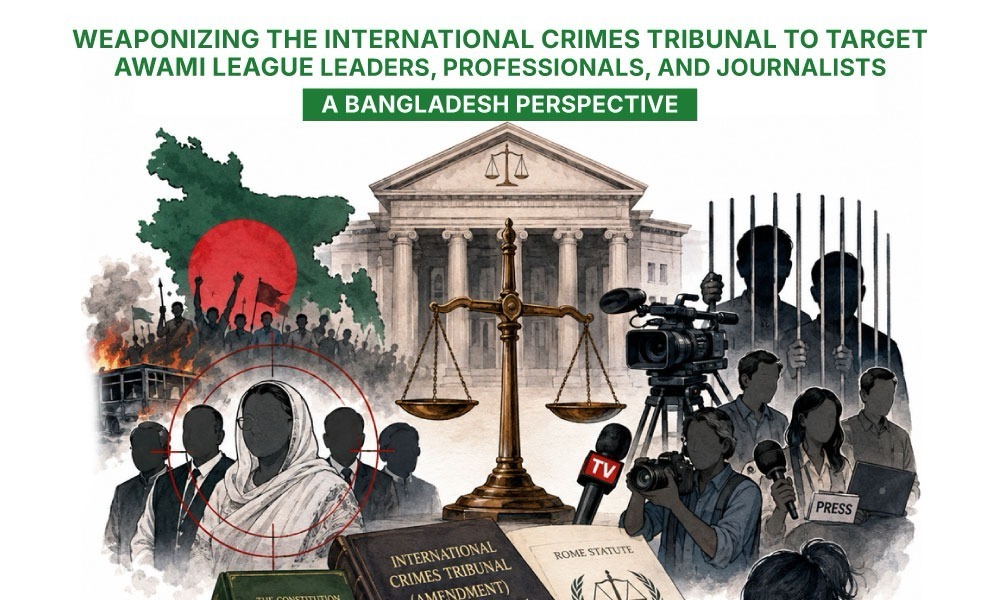
The International Crimes Tribunal of Bangladesh was established under the International Crimes (Tribunals) Act, 1973, with the formal objective of prosecuting individuals responsible for genocide, crimes against humanity, and war crimes committed during the Bangladesh Liberation War of 1971. The Pakistan Army, along with local collaborators including the Razakar militia, Al-Badr militia, and Al-Shams militia, carried out mass atrocities during this period, and the demand for accountability had remained unresolved for decades.
When the tribunal was formally activated in 2009 under the Awami League government led by Sheikh Hasina, it was welcomed by the United Nations, which offered technical assistance, and endorsed by the European Union, which encouraged Bangladesh to ensure proceedings conformed to international standards of due process. At its inception, the tribunal was widely regarded as a genuine attempt at transitional justice, reconciling historical trauma with the rule of law.
The war crime fact-finding committee tasked to investigate and find evidence completed its report in 2008, identifying 1,600 suspects. Prior to the formation of the ICT, the United Nations Development Programme offered assistance in 2009 on the tribunal's formation. The first indictments were issued in 2010. By 2012, nine leaders of Jamaat-e-Islami and two leaders of the Bangladesh Nationalist Party (BNP), along with others, had been indicted as suspects in war crimes. By February 2024, ICT-1 had rendered judgment in 44 cases and ICT-2 in 11 cases. Of the 55 adjudicated cases, 30 involved allegations of genocide, with 21 leading to convictions. The tribunals were noted for concluding cases in a reasonable timeframe, despite limited resources compared to international criminal tribunals.
Since the political transition following the July–August 2024 uprising and the departure of the Awami League government, critics have increasingly alleged that the ICT is being transformed from a mechanism of justice into a tool of political retribution.
According to these critics, the tribunal's mandate has expanded beyond its intended purpose and is now being used to pursue a broad range of individuals associated with the former ruling party, including senior political leaders, grassroots activists, professionals, journalists, and ordinary citizens. They argue that the growing use of crimes-against-humanity allegations against political opponents risks undermining public confidence in the rule of law and the credibility of transitional justice in Bangladesh.
One of the primary concerns raised by observers is the widening scope of investigations. Initially designed to address the most serious international crimes, the tribunal is now handling a large number of cases linked to the political unrest and violence surrounding the events of 2024.
Critics argue that the distinction between individual criminal responsibility and political affiliation is becoming blurred. The concern is that membership in, support for, or association with the Awami League is increasingly treated as grounds for suspicion, even where direct evidence of involvement in crimes remains contested.
Such perceptions are particularly significant in a deeply polarized political environment where legal proceedings are often viewed through a partisan lens.
The International Crimes Tribunal was established in 2009 under the International Crimes (Tribunals) Act (ICTA) 1973. The Act was an attempt by a newly independent nation to affirm its commitment to ending impunity and ensuring justice for the atrocities of 1971. The tribunal’s primary focus was to investigate and prosecute individuals accused of genocide, war crimes, crimes against humanity, and crimes against peace, particularly the then Pakistan Army and their local auxiliary forces.
On November 24th, 2024, Bangladesh enacted significant amendments to the ICTA, applying them retroactively from January 6th, 2009, to expand the tribunal’s jurisdiction. In addition, on January 6th, 2009, the Awami League formed a government under the leadership of Sheikh Hasina. One of the most notable changes is the extension of the tribunal’s reach beyond Bangladesh’s borders, empowering it to prosecute crimes committed by Bangladeshi citizens abroad and by foreign nationals for offences committed at least partly within Bangladesh. However, the law still requires some nexus to Bangladeshi territory for foreign nationals, as clarified in Section 1(4)(b). Article 7 of the Rome Statute, which Bangladesh has ratified.
In Article 7, sub-Article (1) of the Constitution of the People’s Republic of Bangladesh said: “All powers in the republic belong to the people, and their exercise on behalf of the people shall be effected only under, and by the authority of the constitution”. And Article 26 sub-Article (2) said “no such laws shall be promulgated that are inconsistent with the constitution and the fundamental rights within”
It is stated that the constitutional structure of Bangladesh vests legislative authority in Parliament, while the power of promulgating ordinances is provided only as an exceptional and temporary measure under Article 93 of the Constitution. Under the said provision, the President may promulgate an ordinance when Parliament is not in session or stands dissolved and when circumstances exist which render immediate action necessary. Article 93(1) clearly states that no such Ordinances can be promulgated that is inconsistent with any provision of the Constitution.
After the dissolution of parliament on 24 November 2024, the President promulgated Ordinance No. XIV of 2024 titled the International Crimes Tribunal (Amendment) Ordinance, 2024. Through the said ordinance, numerous provisions of the International Crimes (Tribunals) Act, 1973 were amended, replaced or inserted, including provisions of both substantive and procedural nature.
The President himself, in a widely circulated interview with the Daily Kaler Kantho on 23.02.2026, stated that he was not part of governmental discussions and that numerous political and constitutional developments occurred without his participation or consultation.
Article 93 of the Constitution clearly indicates that the President cannot promulgate an ordinance containing provisions which Parliament itself would not be competent to enact under the Constitution. The retrospective criminal provisions of the impugned ordinance violate Articles 26 and 27 of the Constitution; the President does not have the authority to promulgate such provisions through an Ordinance.
The most visible aspect of the tribunal's current activities has been the prosecution of senior Awami League figures, including former Prime Minister Sheikh Hasina and other high-ranking officials. Supporters of these prosecutions argue that accountability for alleged abuses committed during the 2024 protests is essential for justice and national reconciliation.
Critics, however, contend that the proceedings risk appearing selective because they focus overwhelmingly on one political camp. They question whether comparable scrutiny is being applied to all actors accused of violence during the country's turbulent political transition.
The perception of selective justice can be damaging because accountability mechanisms derive legitimacy not only from convictions but also from public confidence in their impartiality.
Awami League and its companions, party leaders, were charged in the International Crimes Tribunal (ICT). The ICT is handling over 27 cases lodged over crimes against humanity during the uprising, with more than 205 total individuals named as accused. Further trials and investigations into other political leaders are ongoing. We assumed that the International Crimes Tribunal (ICT) will continue under the present government; maximum Awami League leaders and activists will be charged under the ICT Act. The trial is being conducted by targeting one party.
State-appointed defence lawyer Md Amir Hossain, representing Mahbubul Alam Hanif and three others, told the International Crimes Tribunal (ICT) that the accused should not face trial merely because they belong to the Awami League.
Another major concern involves the broader social impact of tribunal-related investigations. Many Awami League activists, local leaders, and supporters claim that they face legal uncertainty due to complaints and investigations connected to political violence.
Critics argue that when large numbers of individuals become subjects of investigations primarily because of political association, a climate of fear may emerge. In such circumstances, citizens may become reluctant to engage in political activity, public debate, or civic participation.
This concern extends beyond party politics and touches upon fundamental democratic principles, including freedom of association and political participation.
Shahriar Kabir is one of the famous journalists and human rights activists. He is the president of Ekattorer Ghatak Dalal Nirmul Committee and also the president of Forum of Secular Bangladesh. His only crime was to advocate for the prosecution of war criminals. After the government's departure, he was arrested at midnight on 17 September 2024 without showing any reason. Further, Kabir will be brought before the International Crimes Tribunals on 12 January 2025; he has been charged with crimes against humanity. To date, he has been detained in custody without showing legal grounds.
AHM Shamsuddin Chowdhury Manik, a retired justice of Bangladesh, was arrested on August 23, 2024. In July 2024, Manik participated as a guest in the talk show To the Point on Channel i. During the discussion, he became agitated with the host, Dipti Chowdhury, and repeatedly expressed his anger towards her throughout the program. Before leaving the studio after the show, he referred to Chowdhury as a 'child of a RAZAKAR'. For that reason, he was arrested, and he was detained in custody and also charged with crimes against humanity.
Perhaps the most controversial development has been the inclusion of journalists and media figures in tribunal-related proceedings. Press freedom advocates argue that prosecuting journalists under crimes-against-humanity frameworks creates a dangerous precedent.
The concern is not that journalists should enjoy immunity from criminal law. Rather, critics argue that media professionals should only face prosecution where there is compelling evidence of direct participation in criminal conduct. If journalistic activity, editorial decisions, or perceived political sympathies become grounds for prosecution, the result may be widespread self-censorship and a weakening of independent media.
Many observers believe that a democracy requires journalists to be free from political pressure regardless of which party is in power.
A total of 102 journalists from various media outlets have expressed concern over what they describe as a biased and opaque trial process at the International Crimes Tribunal (ICT).
The journalists said the recent situation surrounding the ICT — including statements from political actors, inconsistencies in trial proceedings, lack of transparency, and visible political influence — has raised serious questions about the impartiality of the court.
They noted that if the judiciary cannot operate independently, democracy, human rights, and the rule of law all come under threat.
Farzana Rupa, a prominent presenter at Ekkator TV, along with Mozammel Babu, managing director and founder, both journalists, have already spent over 21 months in pre-charge detention without bail on separate murder charges relating to July 2024 cases. Till now, no evidence has been presented by prosecutors to show their criminal involvement in these murder cases, and their detention for these offences has already been widely classified by human rights organisations. New arrests relate to events eleven years earlier, on 5 May 2013, when security forces moved to disperse thousands of Hefazat-e-Islam supporters – an ultra-conservative Islamist organization. On the question of Babu’s arrest, the chief prosecutor said: "He was present there all night long," and that whilst other TV stations had been prevented from broadcasting that night, "his live programme continued. And he was concealing the killings.” Only live telecast they were charged with crimes against humanity.
International human rights organisations have also strongly condemned the arrests of the two journalists. “Editorial decisions on covering a contested political incident are not crimes against humanity, and using an international criminal law framework to punish journalists circumvents the basic protections guaranteed to the press under Bangladesh’s own constitution while also violating international human rights conventions,” said Kunāl Majumder, the Asia-Pacific Program Coordinator of the Campaign for Press Freedom. “Bangladeshi authorities must stop weaponizing the International Crimes Tribunal to target journalists and immediately release Farzana Rupa and Mozammel Babu.”
Smriti Singh, South Asia Regional Director of Amnesty International, added to the criticism: “Farzana Rupa and Mozammel Haque [Babu], who are already in detention, now face vague new charges relating to a story that was aired more than a decade ago. Their arrest in a case related to crimes against humanity is an affront to fundamental principles of press freedom and sets a dangerous precedent that threatens the right of all journalists to report without fear of retaliation.”
The broader debate ultimately revolves around due process and judicial independence. Critics argue that the legitimacy of any tribunal depends upon transparent procedures, equal treatment under the law, access to legal representation, disclosure of evidence, and the presumption of innocence.
When political actors publicly comment on ongoing cases, when proceedings appear rushed, or when outcomes seem predetermined, confidence in judicial neutrality may be weakened. Even where legitimate accountability efforts are underway, perceptions of political influence can undermine public trust.
The most directly documented evidence of corruption within the ICT came through a joint investigation conducted by British journalist David Bergman, working with Netra News and Prothom Alo, published on 10 March 2026. The investigation, based on verified audio recordings of WhatsApp conversations, revealed that ICT prosecutor Saimum Reza Talukder had repeatedly solicited bribes from the family of ABM Fazle Karim Chowdhury, a five-term Awami League Member of Parliament detained on charges of crimes against humanity.
“If ultimately, we could get him out – I mentioned then a fairly large amount. I mentioned one crore.” – ICT Prosecutor Saimum Reza Talukder, in an audio recording verified by Netra News and Prothom Alo (March 2026)
However, on 23 February 2026, the same day Tajul Islam was himself removed from his position, Mahmud launched a series of public allegations on social media. He accused Islam and fellow prosecutor Gazi Monawar Hossain Tamim of corruption and irregular conduct, specifically questioning the handling of certain accused police officers in cases and alleging that meetings had been held with the relatives of accused individuals. Most strikingly, Mahmud alleged that the chief prosecutor’s office had effectively become a “money-making tool.”
“The wife of a former police sub-inspector, one of the accused in the Ashulia killings during the July mass uprising, entered a prosecutor’s chamber with a heavy bag. The accused was later turned into a prosecution witness in exchange for money and was eventually acquitted.” – ICT Prosecutor BM Sultan Mahmud, Facebook post, 23 February 2026
Adding a further layer of concern, prosecutor Tanvir Hassan Zoha stated during a preliminary review that hard drives in the tribunal’s CCTV system had been added and removed. This finding was reported to the same fact-finding committee examining the corruption allegations against prosecutors. If substantiated, the tampering of tribunal surveillance systems represents a critical threat to the integrity of the entire evidentiary record maintained by the institution.
New Age Bangladesh reported on 4 April 2026 that the ICT’s current chief prosecutor, Aminul Islam, confirmed that a fact-finding committee had been formed to investigate these allegations, including the specific incident involving a heavy bag carried to a prosecutor’s office and the alleged conversion of an accused individual into a paid state witness.
The long-term implications extend beyond individual cases. If large segments of society perceive the tribunal as a mechanism for eliminating political rivals, national polarization may deepen. Rather than promoting reconciliation, legal proceedings could become another arena for political conflict.
Bangladesh's democratic future depends not only on accountability for past abuses but also on ensuring that justice is administered fairly, transparently, and without regard to political affiliation. Any perception that the law is being used selectively risks weakening public faith in both democratic institutions and the justice system itself.
The debate surrounding the International Crimes Tribunal reflects a larger struggle over accountability, justice, and political power in Bangladesh. Supporters view the tribunal as a necessary mechanism to address serious allegations arising from past abuses. Critics view it as an increasingly politicized institution being used against Awami League leaders, supporters, civilians, and journalists.
Regardless of one's political position, the credibility of the tribunal will ultimately depend on its ability to demonstrate impartiality, respect due process, and ensure that justice is guided by evidence rather than political considerations. Only through transparent and independent judicial processes can Bangladesh achieve both accountability and democratic stability.
Writer: Aslam Mia, Advocate, Supreme Court of Bangladesh






This work is copyrighted and authorized by the Bangladesh Awami League. You may download, display, print and re-produce this material in unaltered form only (retaining this notice)for your personal, non-commercial use or use within your organization.
