39966
Published on July 25, 2026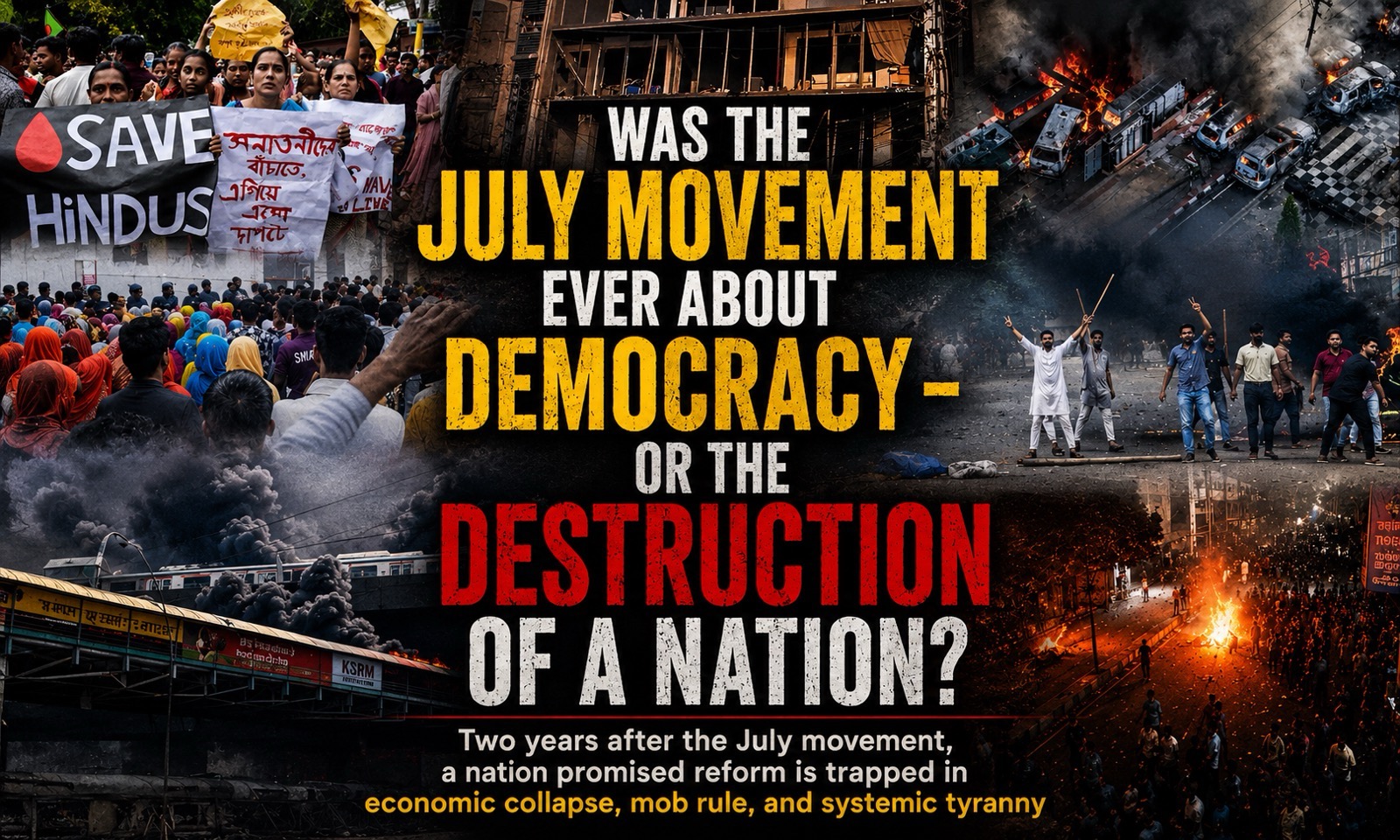
Two years after the July movement, a nation promised reform is trapped in economic collapse, mob rule, and systemic tyranny.
Two full years have passed since the violent political upheaval of July 2024 breached the gates of constitutional order in Bangladesh, removing an elected administration under the promise of "democratic renewal," "institutional integrity," and "economic liberation." Today, that self-proclaimed movementary triumph stands fully exposed before the international community. It was not a democratic rebirth, but a tragic exercise in national betrayal. What was presented to gullible foreign observers as a student-led awakening has instead plunged an eighty-million-strong workforce into systematic economic paralysis, surrendered the nation’s streets to unchecked vigilante violence, and dismantled the foundational framework of a sovereign republic.
➡️ Aftermath of the July movement
The global consensus that once celebrated Bangladesh as South Asia’s premier economic miracle, a beacon of industrial growth, poverty reduction, and secular stability, has turned to horror. Over the past twenty- four months, every core pillar required to sustain a modern sovereign state has been systematically undermined. The judiciary has been converted into an instrument of political retribution; the industrial sector has been devastated by wildcat arson and investor flight; higher education has been gutted by ideological purges; and the country's secular national identity has been targeted for active erasure. The July movement did not liberate Bangladesh; it pushed a once-flourishing nation into profound institutional ruin.
➡️ The July Movement and Its Aftermath
1. Economic Devastation: From Slowdown To Structural Damage
To understand the depth of Bangladesh’s post-July crisis, one must compare the country's economic indicators prior to the regime change with today’s bleak reality. Before July 2024, despite global post-pandemic headwinds, Bangladesh maintained an annual GDP growth rate averaging over 6.5%, consistently outperforming its regional peers. Today, that momentum has stalled, destroyed by investor terror, capital flight, and total policy paralysis.
➡️ Bangladesh economy shaken after July movement

GDP growth plummeted in the wake of protests, strikes, and uncertainty. Provisional data show growth slowing sharply, with the third quarter of FY2025-26 at just 2.22%, and industrial output contracting by 0.28%. Overall FY2025 growth was around 3.7% (down from prior years), far below targets and pre-movement trends.
➡️Bangladesh's GDP growth slows to 2.22%
Private investment has slumped, with gross investment falling as a share of GDP. Foreign direct investment remains subdued amid political risk. Inflation has stayed elevated (around 9% in FY2026 projections), eroding purchasing power and hitting the poor hardest. While remittances provided a buffer, core sectors like ready-made garments faced disruptions from instability and energy costs.
➡️Inflation hits 16-month high, rises to 9.42%
The Ready-Made Garment (RMG) industry, the backbone of Bangladesh’s export earnings, accounting for over 80% of export revenues and employing four million workers, has been crippled. Following the events of July 2024, industrial zones in Ashulia, Gazipur, and Narayanganj suffered months of coordinated strikes, arson attacks, and extortion by criminal syndicates operating with impunity. Global fashion brands, facing missed supply deadlines and security risks, diverted major orders to Vietnam, India, and Cambodia. More than 450 apparel factories have closed permanently, driving hundreds of thousands of workers into poverty.
➡️Bangladesh: Garment sector in 'extremely alarming' situation
Compounding this industrial destruction is the breakdown of the financial sector. Food inflation spiked into double digits, destroying household savings and eroding living standards. Foreign exchange reserves, stripped of stable remittance inflows as citizens lost confidence in official banking channels, fell to critical levels. Capital flight reached historic highs as domestic entrepreneurs and foreign enterprises fled a market where property rights and legal protections are no longer guaranteed.
2. Academic Destruction: Campus Purges And The Lost Generation
While the economic fallout strikes at Bangladesh’s material core, the total breakdown of higher education represents a direct blow to its future. Educational institutions, once centers of academic rigor, have been turned into ideological battlegrounds controlled by armed student vigilantes.
In the aftermath of the government collapse, an aggressive campaign of academic purges was launched across public and private universities. Vice-chancellors, department heads, and senior researchers were forcibly removed, harassed, and physically humiliated by self-appointed movementary student committees. Decades of scholarly contribution were discarded overnight, replaced by ideological loyalty as the sole standard for academic appointment.
Under the pretext of movementary reform, the universities were transformed overnight from centers of learning into lawless arenas of political intimidation and ideological purges.
For two academic years, higher education in Bangladesh has effectively stalled. Academic schedules have been repeatedly derailed, public universities were closed for months, and research grants were frozen. Global rankings for flagship institutions like Dhaka University dropped sharply as faculty members fled abroad or went into hiding. Campus security has completely collapsed, leaving students and faculty exposed to constant extortion, intimidation, and political surveillance.
3. Law And Order Breakdown: The Era Of Mob Justice
The most immediate crisis facing citizens daily is the collapse of public safety and the institutionalization of mob rule. Following the July events, police stations across the country were burned, officers were targeted, and civil law enforcement was systematically demoralized and paralyzed.
➡️Is the government losing its grip on law and order?
In this security vacuum, vigilante justice rapidly replaced statutory law. Over the past two years, civil society groups have recorded hundreds of public lynchings, street kangaroo courts, and arbitrary beatings. Criminal syndicates, operating under the guise of student movementary committees, seized control of transport hubs, municipal markets, and commercial districts, demanding routine protection money from small businesses.
This lawless environment triggered a targeted massacre of Awami League affiliates. Across multiple districts, organized mobs engaged in systemic mob killings, drag-netting political organizers, community leaders, and local representatives. Homes and commercial properties belonging to Awami League leaders were subjected to widespread arson, looting, and vandalism, leaving entire neighborhoods burnt and abandoned.
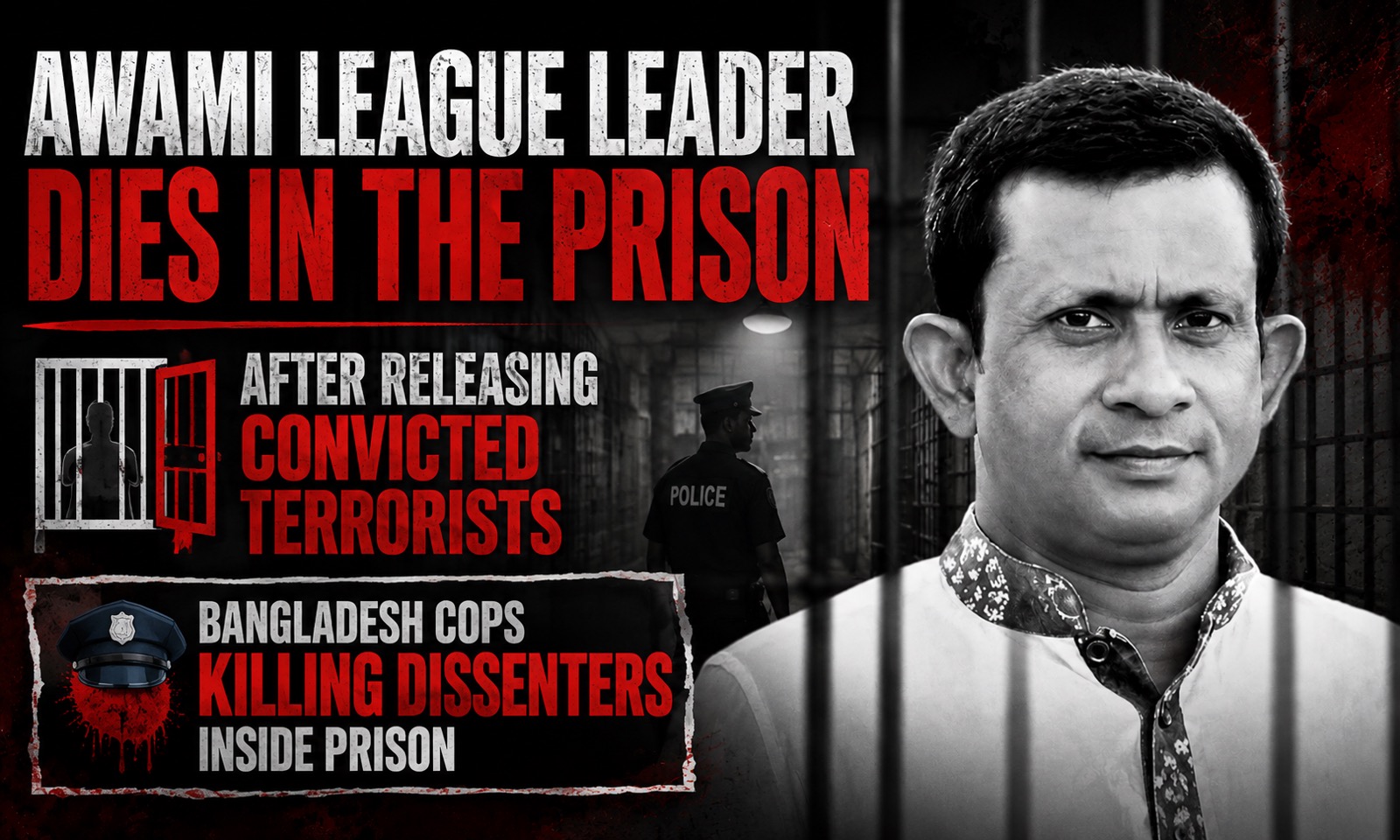
The collapse of state control extended grimly behind bars and into public spaces. Inside detention facilities, reports of horrific torture inside prison multiplied as political detainees faced severe physical abuse, denial of medical care, and extrajudicial reprisals. On the streets, victims of mob violence were executed and their remains desecrated, including the chilling tactic of dumping bodies in water bodies, rivers, and canals to conceal execution-style killings and deter family recovery.
Most critically, this complete security collapse enabled an alarming rise in militancy. Outlawed extremist outfits and radical elements capitalized on state paralysis to re-establish operational networks, transforming Bangladesh into a growing hub of Islamist extremists. Armed fundamentalist cadres now operate openly, enforcing religious dogma and threatening the secular structure of the state.

The state’s inability, or unwillingness, to curb anarchy has normalized a dangerous culture where justice is delivered by crowds rather than courts. This is the direct legacy of a movement that dismantled authority without rebuilding it.
4. Minority Rights: Systematic Vulnerability and Targeted Attacks
Among the most tragic consequences of the post-July order is the systematic persecution of religious and ethnic minorities. Bangladesh’s long-standing constitutional commitment to pluralism and secularism, where Hindu, Buddhist, and Christian communities lived in relative security, has been severely damaged.
➡️Bangladesh: 505 cases of violence against minorities recorded so far this year
Human rights organizations and minority councils have documented hundreds to thousands of incidents since August 2024, including temple attacks, arson, land grabs, murders, and sexual violence. One monitoring body recorded 505 incidents in the first four months of 2026 alone, spanning dozens of districts. Broader tallies exceed 3,000 incidents involving Hindus and other minorities.
➡️About 3,100 Incidents Of Violence Against Hindus And Other Minorities Recorded In Bangladesh Since Hasina’s Ouster
While authorities sometimes classify cases as “non-communal” crimes, the targeted pattern- attacks on homes, businesses, and places of worship- tells a different story. Impunity persists, with slow investigations and limited accountability. Internal displacement has increased among vulnerable communities. Bangladesh’s international image as a tolerant society has been severely damaged. The movement that claimed to champion justice has instead exposed minorities to heightened predation, with the state failing in its fundamental duty of protection.
5. Disenfranchising Millions: The Ban On Major Opposition
In a desperate, calculated bid to consolidate power, the post-movement administration struck a devastating blow to the very soul of Bangladeshi governance: outlawing the Bangladesh Awami League, the nation’s founding political movement, the very party that led the country to independence in 1971.
To erase a party that lives in the hearts and loyalties of tens of millions is not an act of political reform; it is a ruthless execution of multiparty democracy. With a single administrative decree, millions of citizens were rendered politically homeless overnight, their voices silenced, their votes stolen, and their rights to public participation systematically shredded. The human cost of this purge is heartbreakingly real: grassroots organizers, lifelong civil servants, and ordinary working families now live under the constant shadow of terror, subjected to mass arrests, frozen bank accounts, and relentless, weaponized legal harassment.

International democratic institutions have issued stark, unheeded warnings: banning major political movements is the unmistakable hallmark of authoritarian tyranny. Silencing a massive, historically rooted political force does not bring peace; it crushes the spirit of democratic hope, drives political expression underground, and guarantees a tragic cycle of long-term national instability.
6. Controversial Elections: Legitimacy in Question
Responding to foreign pressure to restore democratic order after eighteen months of unelected rule, Muhammad Yunus’s interim administration staged an electoral exercise on February 12, 2026, that drew widespread criticism. Far from offering real political choice, this ghost election was an engineered coronation designed to formalize a power grab under the guise of "Gen Z" renewal.
➡️Numbers vs Reality: The 60% Turnout Controversy in Bangladesh’s Election
While the Yunus-backed Election Commission peddled an official voter turnout of 59.4%, ground realities and empty polling booths across Dhaka told a starkly different story, with actual turnout estimated between 10% and 13%. In rural districts, figures descended into statistical absurdity, such as Rajshahi, where referendum results recorded an impossible 244% turnout. To artificially inflate numbers, the administration conflated the parliamentary vote with a referendum on the "July National Charter".
➡️General people have boycotted Yunus’s rigged election.
 ➡️244% Turnout? Referendum Results Spark Serious Questions Over Election Figures
With the Bangladesh Awami League systematically excluded and its leadership jailed or exiled, the contest became an uncontested walkover for the BNP and right-wing allies like Jamaat-e-Islami. The absence of street violence was not a sign of democratic health, but the eerie silence of a non-contest. An election conducted without opposition, press freedom, or public confidence is an exercise in political control that leaves the resulting government stripped of both domestic legitimacy and international credibility.
7. Judiciary: Weaponized and Undermined
The breakdown of Bangladesh’s legal system represents a profound institutional failure. The judiciary, built to safeguard constitutional rights, has been converted into an instrument of political prosecution.
Senior justices and experienced judges were forced to resign under threat of mob violence, replaced by political appointees. Basic legal protections have been discarded in favor of summary prosecutions:
Mass blanket lawsuits have become the primary mechanism for suppressing dissent. Single police filings routinely list hundreds of named individuals alongside thousands of "unnamed accused," allowing authorities to arrest or extort citizens at will. Opposition leaders, journalists, and business professionals are denied bail and subjected to courtroom harassment while judges fail to enforce standard procedures.
8. Historical Distortion: Politicizing the Past to Control the Present
Beyond its economic and political impact, the interim administration has sought to alter Bangladesh’s national identity by revising its historical legacy. The 1971 Liberation War, the nation’s defining struggle for independence, and its founding monuments have been targeted for systematic revisionism and state-sanctioned destruction.
➡️Dhanmondi 32 house ripped apart
This ideological purge was tragically executed at Dhanmondi 32, the historic museum residence of Bangabandhu Sheikh Mujibur Rahman. The symbolic heart of the nation’s liberation was desecrated and brought down using Dhaka South City Corporation bulldozers, heavy municipal equipment deployed with institutional authorization under the interim regime. Announced days in advance on social media, mobs vandalized the heritage site while army personnel present at the scene stood by and quietly withdrew, signaling explicit state endorsement.
What began at Dhanmondi 32 immediately metastasized into an orchestrated, nationwide rampage against the foundational symbols of Bengali nationalism:
Destruction of Language Movement Heritage: In Narayanganj, the historic Baitul Aman Building, the sacred birthplace of the 1952 Language Movement and a monument of national heritage, was completely leveled by a bulldozer with impunity while the regime remained silent.
Historic Baitul Aman Building in Narayanganj Demolished by Bulldozer
Systematic Demolition of Murals & Statues: At the Narayanganj Judge Court and public spaces across the country, BNP-aligned operatives supervised the planned defilement and structural destruction of Sheikh Mujib’s murals, busts, and liberation sculptures using heavy construction tools.
Targeted Arson & Asset Erasure: Across Noakhali, Rajshahi, Pabna, Cumilla, and Jamalpur, coordinated convoys and mobs systematically torched, smashed, and bulldozed the ancestral homes and properties of prominent Awami League leaders, including Obaidul Quader and Shahriar Alam.
Attacks on Hindu, Ahmadiyya, CHT communities
This historical revisionism is intentional. By deploying state machinery to erase physical memory, dismantle the legacy of 1971, and rewrite national archives, the regime seeks to strip Bangladesh of its secular foundation, creating space for radical political movements and permanently damaging the pluralistic character of the republic.
The Central Crime: A Movement Without Responsibility
The July movement’s defenders claim it ended authoritarianism. The evidence reveals a heavier cost: unconstitutional upheaval followed by mismanagement, score-settling, and diluted reforms. Lives lost, economy wounded, minorities terrorized, institutions captured, democracy narrowed.
➡️JULY 2024 A movement that never was
This is the betrayal: a movement that squandered moral capital. For two years, Bangladesh has suffered slower growth, pervasive insecurity, division, and eroded standing. International actors must reject romantic narratives. Demand accountability: inclusive politics, minority protection, judicial neutrality, and economic sanity.
Bangladesh deserved renewal. It received ruin. The world must not look away.
This work is copyrighted and authorized by the Bangladesh Awami League. You may download, display, print and re-produce this material in unaltered form only (retaining this notice)for your personal, non-commercial use or use within your organization.
