29611
Published on August 4, 2026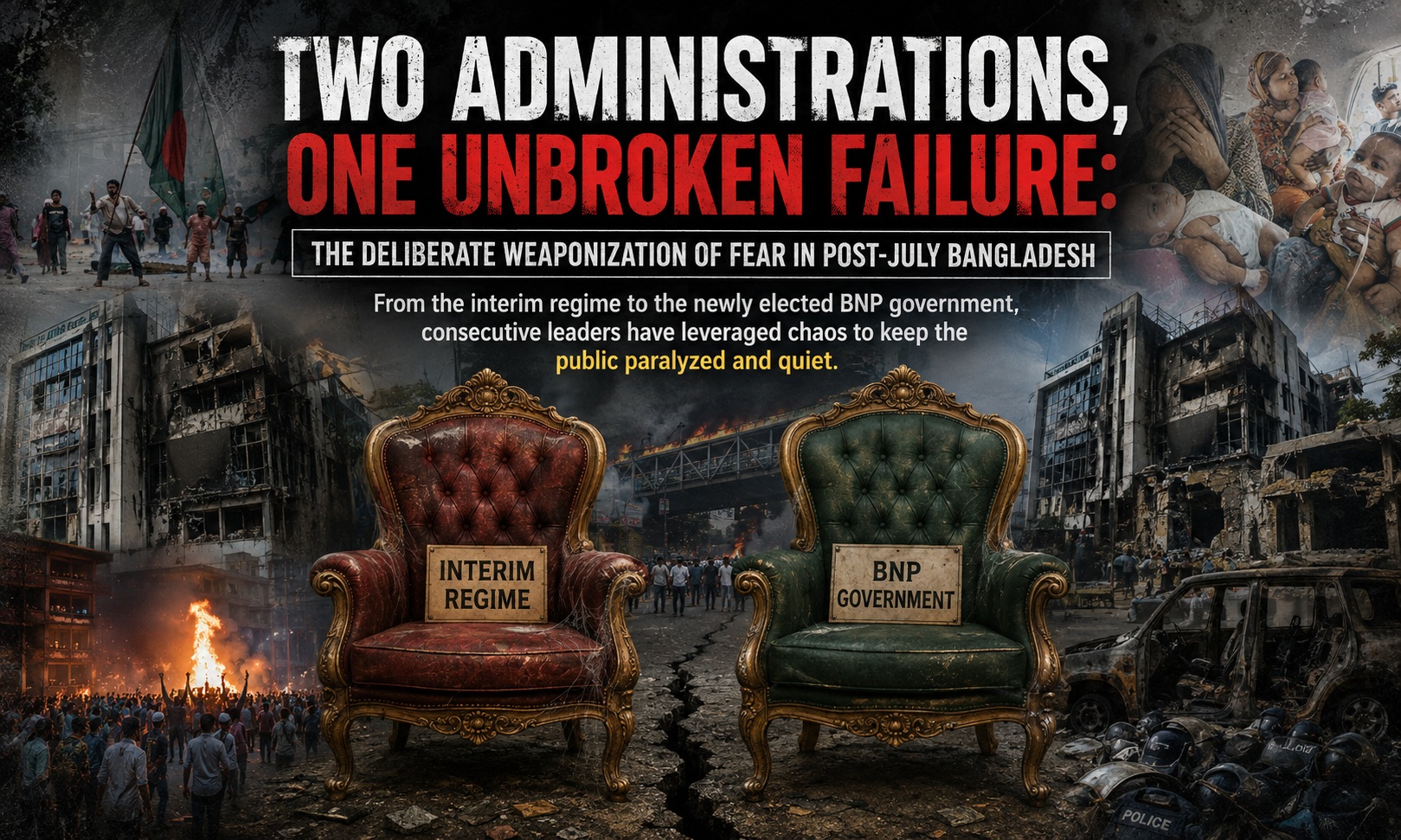
From the interim regime to the newly elected BNP government, consecutive leaders have leveraged chaos to keep the public paralyzed and quiet.
Two years after the so-called July Movement, Bangladesh is now trapped in state failure. Citizens were promised institutional reform, civil liberties, and strict adherence to the rule of law. Instead, they got a dangerous security vacuum, systemic violence, and state institutions weaponized for political consolidation.
Country’s law and order situation fragile, alarming
From the technocratic misrule of the interim administration to the governance of the elected BNP administration, neither regime stabilized the nation. Instead, both leveraged public insecurity to justify extraordinary powers while allowing vigilantes, criminal networks, and partisan mobs to police society.
Is the government losing its grip on law and order?
Mob justice has become the defining feature of post-July Bangladesh. Street-level vigilantes have effectively replaced formal jurisprudence across major urban centers, including Dhaka and Chittagong. Human rights monitoring bodies, including Ain o Salish Kendra (ASK) and Transparency International Bangladesh (TIB), confirm that over 200 individuals have been brutally killed in public lynchings since August 2024, with hundreds more severely injured.
ASK: 197 killed in mob violence in 2025, Dhaka tops list
33 killed by mobs in three months
This vigilante violence extends directly into academic institutions. Dozens of university professors and school teachers have been forced to resign, publicly humiliated, or physically assaulted by politicized student factions. Rather than protecting educators, successive authorities acquiesced to street mobs, dismantling academic independence.

This is not spontaneous chaos. It is the predictable result of a security vacuum that both governments refused to fill.
Political violence has surged under the new order. Odhikar recorded 41 deaths and 970 injuries in political clashes between April and June 2026. BNP internal conflicts alone produced four deaths and 400 injuries in that period, frequently tied to disputes over extortion, territorial control, and local nominations. HRSS data for the first six months of 2026 shows 56 political killings and 5,246 injured in 830 incidents.
Extortion networks linked to ruling-party actors have reasserted control over markets, transport hubs, and businesses. Transparency International Bangladesh’s assessment of the BNP’s first 100 days confirmed that mob violence and organised criminal activity continued unabated despite official tough talk.
The national security apparatus remains functionally paralyzed. During the chaos of the July movement, thousands of military-grade firearms and hundreds of thousands of rounds of live ammunition were looted from police arsenals. Two years later, the vast majority of these weapons remain in the hands of violent gangs, political enforcers, and organized crime syndicates. Violent crime, ranging from highway robberies to daylight carjackings, has reached historic highs.
Instead of tackling real crime, law enforcement agencies have been deployed as tools of arbitrary political persecution. Operation Devil Hunt and subsequent campaigns under the interim government produced thousands of arrests of alleged political opponents, many under the Anti-Terrorism Act or Special Powers Act, often with hundreds of unnamed suspects listed. HRSS recorded 23,121 arrests in the first half of 2026, the overwhelming majority of perceived political adversaries.
Extrajudicial practices also have not disappeared. Odhikar documented at least 40 extrajudicial killings by security forces between August 2024 and September 2025,19 by gunfire, 14 by torture, and seven by beating in custody.
61 custodial deaths across Bangladesh in first 6 months of 2026: ASK
40 extrajudicial killings during interim govt
This culture of fatal custodial abuse has only escalated under the subsequent political handover. According to documentation compiled by Ain o Salish Kendra (ASK), at least 61 prisoners and four people in direct police custody died in the first six months of 2026 alone. Victims, including political detainees, are routinely taken into custody in good health only to suffer severe fatal beatings, delayed medical intervention, or unexplained deaths behind closed doors. Far from ending under the newly elected BNP administration, custodial torture and suspicious deaths remain routine instruments of state-sanctioned terror.
The post-July security vacuum has turned Bangladesh’s most vulnerable into open targets. Religious minorities, women, and children now face systematic terror, property seizure, and sexual violence while state institutions offer neither protection nor justice.
Violence Against Women, Attacks On Minorities And Mob Violence Surge In Bangladesh
Systemic Sectarian Violence
The Bangladesh Hindu Buddhist Christian Unity Council documented more than 2,000 attacks on minority homes, businesses, and places of worship between August 2024 and June 2026. In 2025 alone, it recorded 522 communal attacks, 66 deaths, 95 assaults on temples and churches, and 28 cases of sexual violence against minority women and girls. The first half of 2026 brought another 257 sectarian incidents, including murders and organised land grabs.
BHBCUC claims 257 communal violence incidents, 44 deaths in six months
The interim government dismissed these as “political, not communal.” The BNP government that followed has shown no greater urgency. Temples continue to be vandalised, families driven from their land, and killers walk free.
383 journos faced harassment, attacks in six months: HRSS
Epidemic of Sexual Violence
Crimes against women and minors have exploded. Bangladesh Mahila Parishad recorded 786 rapes and gang-rapes in 2025, a 52 percent jump from the previous year, with 543 of the victims under 18. Human Rights Support Society logged 828 rape cases the same year, 57 percent of them children.
The trend accelerated in 2026. Ain o Salish Kendra reported 118 girls raped and 17 murdered after assault in just the first four months. Child-rights group Shishurai Shob counted 86 children killed and 336 sexually abused between January and June. Neighbours, relatives, and teachers feature repeatedly among the perpetrators.
At least 86 children killed, 336 sexually abused in first half of the year
Near-Zero Accountability
A joint Supreme Court–BRAC study of cases disposed in early 2025 found a conviction rate of only 3 percent for violence against women and children. Perpetrators act with near-total impunity. Police inaction and judicial delay have become the norm.
Both the interim administration and the elected BNP government have treated this cascade of attacks as an inconvenience rather than a crisis. Targeted killings, temple burnings, forced displacement, and the rape of children continue because neither government has chosen to stop them.
Across every category- mob killings, political assassinations, rape, minority attacks, land grabbing, assaults on teachers and journalists- the pattern is identical: weak investigation, delayed justice, and political interference. Both the interim and BNP governments have preferred selective crackdowns on opponents over systemic reform of the police, prosecution, and courts. Insecurity has become a tool of governance rather than a problem to be solved.
Two years after the July Movement, Bangladesh has not gained safety, justice, or the rule of law. It has gained fear. Murders, muggings, abductions, and open extortion dominate daily life. Women and children face heightened sexual violence. Minorities live under constant threat. Political actors settle scores with impunity while ordinary citizens retreat indoors after dark.
The international community can no longer hide behind diplomatic platitudes or pretend that Bangladesh is undergoing a healthy "political transition." The evidence is overwhelming. Bangladesh has exchanged centralized authoritarian rule for decentralized mob anarchy and state-sanctioned extortion.
Foreign governments, international human rights bodies, and trade partners must hold the governing authorities in Dhaka accountable for this breakdown. If the international community continues to turn a blind eye to this human rights disaster, it will be complicit in the complete collapse of a nation of 170 million people.



This work is copyrighted and authorized by the Bangladesh Awami League. You may download, display, print and re-produce this material in unaltered form only (retaining this notice)for your personal, non-commercial use or use within your organization.
