18078
Published on September 4, 2026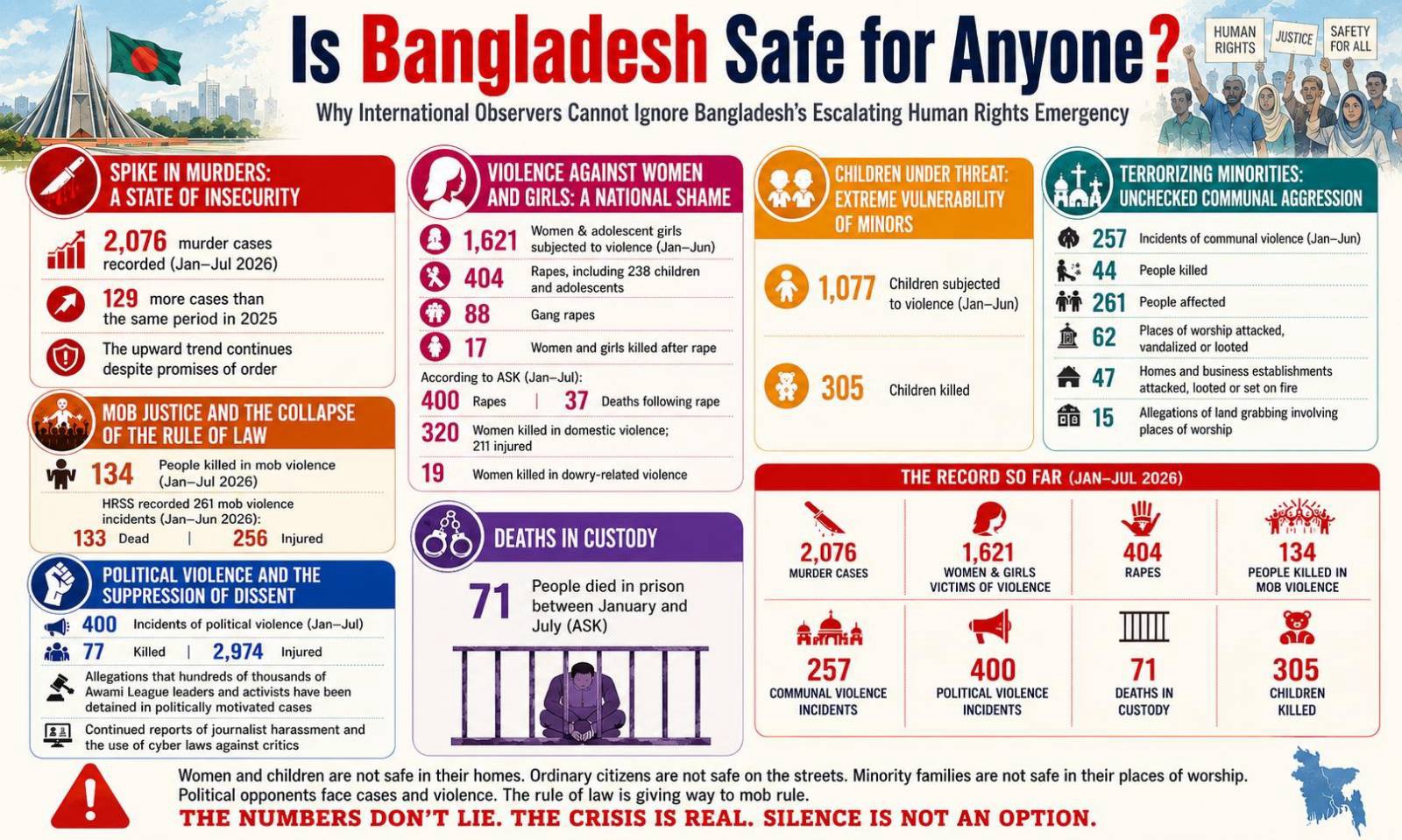
Why International Observers Cannot Ignore Bangladesh’s Escalating Human Rights Emergency
Eight months into office, the BNP-led government has delivered not stability but a cascade of violence that has left ordinary Bangladeshis more insecure than before. Murder, rape, attacks on minorities, mob killings, and deaths in custody have become routine features of daily life. What was promised as a return to democratic norms has instead dissolved into systemic lawlessness, state-sanctioned political retribution, and unchecked violence across the country.
Citizens are no longer asking whether the government can protect them. They are asking how much longer they must endure this level of failure. The gap between campaign rhetoric and daily reality has never been clearer.
The most fundamental duty of any government is to prevent people from being killed. On that measure the BNP has already failed. Far from restoring calm, the first seven months alone saw a measurable rise in lethal violence, with the trend continuing into August.
Horrific murders one after another across the country
2,076 murder cases recorded from January to July
129 more cases than the same period in 2025
The upward trend continues despite campaign promises of restored order
These are not abstract statistics. They represent families destroyed, communities living with constant fear, and a state apparatus that has proven unable to reverse the bloodshed.
Women and adolescent girls have paid a particularly heavy price under the administration's security vacuum. Sexual violence and domestic abuse have continued at alarming levels, with little evidence of effective intervention or deterrence from the authorities.
400 women raped in first 7 months of 2026, 37 killed after rape: ASK
1,621 women and adolescent girls subjected to violence (HRSS, January–June)
404 rapes, including 238 children and adolescents
88 gang rapes
17 women and girls killed after rape
According to ASK (January–July): 400 rapes and 37 deaths following rape
320 women killed in domestic violence; 211 injured
19 women killed in dowry-related violence
In August alone (HRSS): 249 women and girls subjected to violence, including 79 rapes (46 under 18) and 18 gang-rapes; 49 women killed in domestic violence
1,621 women and children victims of abuse in 6 months: Report
When nearly four hundred women are raped in seven months, and dozens are murdered afterward, the claim of effective governance collapses. The failure to protect half the population is not a side issue. It is a core indictment of the government’s capacity and will.
The next generation is not spared either. Families no longer feel their children are safe even inside their own homes or neighborhoods. The scale of violence against the youngest citizens reveals a profound breakdown in social protection.
1,077 children subjected to violence in the first six months
305 children killed
In August alone (HRSS): 282 children faced abuse, including 77 fatalities
A government that cannot protect children has forfeited any claim to competence or moral authority. Parents are left to confront the reality that the state offers them little more than statistics after the fact.
Religious minorities have faced a sustained wave of attacks. Temples, homes, and businesses have been targeted with little evidence of decisive state response. The pattern suggests both indifference and incapacity.
257 incidents of communal violence in the first six months
44 people killed
261 people affected
62 places of worship attacked, vandalized or looted
47 homes and business establishments attacked, looted or set on fire
Allegations of land grabbing involving 15 places of worship
These incidents have deepened a climate of insecurity among minority communities. When places of worship are repeatedly attacked, and land is seized without consequence, the message is unmistakable: equal protection under the law does not apply.
When citizens decide the courts cannot deliver justice, they take matters into their own hands. The result has been a surge in mob killings that the government has failed to contain — and the killings continued at a high rate in August.
134 people killed in mob violence from January to July
HRSS recorded 261 mob violence incidents in the first six months: 133 dead, 256 injured
In August alone (HRSS): 28 killed and 62 injured in 53 incidents of mob violence and lynching
This is not spontaneous disorder. It is the predictable outcome of a government that has failed to enforce the law and allowed public confidence in the justice system to evaporate. Every mob killing is a public declaration that the formal institutions of the state no longer command respect.
Political space has narrowed sharply. Opposition voices, particularly those associated with the previous government, face cases, arrests and violence. The atmosphere of selective justice is unmistakable.
400 incidents of political violence from January to July
77 killed and 2,974 injured
In August alone (HRSS): 70 incidents, 7 killed and 536 injured
Allegations that hundreds of thousands of Awami League leaders and activists have been detained in politically motivated cases
Continued reports of journalist harassment and the use of cyber laws against critics
A government that governs through selective prosecution and street violence cannot claim democratic legitimacy. The right to dissent is being treated as a threat rather than a democratic necessity.
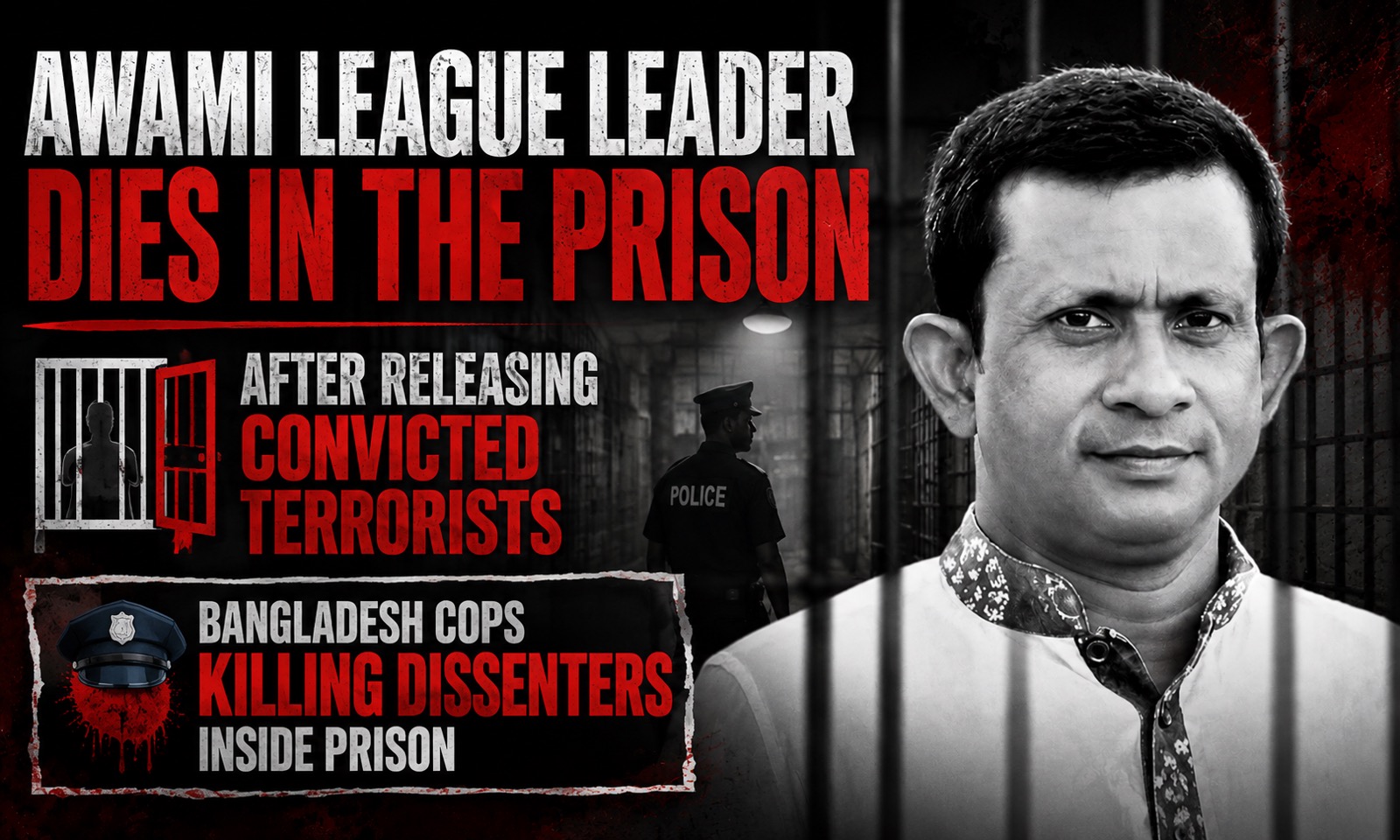
Even those already in the hands of the state are not safe. Prison deaths raise serious questions about medical care, oversight, and accountability inside the system.
71 people died in prison between January and July (ASK)
In August alone (HRSS): 6 more deaths in prison custody
Deaths in custody demand transparent investigation. The absence of credible accountability only deepens public distrust and fuels the perception that the state itself has become a source of danger.
The first eight months can be summarized in a single, damning picture:
2,076 murder cases (Jan–Jul)
400+ rapes and 37+ deaths after rape (ASK, Jan–Jul)
1,621 women and girls subjected to violence (HRSS, first six months) + 249 more in August
1,077 children subjected to violence and 305 killed (first six months) + 77 child deaths in August alone
257 communal violence incidents and 44 deaths (first six months)
At least 162 mob violence deaths (134 + 28 in August)
At least 84 political violence deaths (77 + 7 in August)
At least 77 prison deaths (71 + 6 in August)
These are not the statistics of a government consolidating power and restoring order. They are the statistics of a government that has lost its grip.
Women and children are not safe in their homes. Ordinary citizens are not safe on the streets. Minority families are not safe in their places of worship. Political opponents face cases and violence. The rule of law is giving way to mob rule.
The BNP came to power promising change. What Bangladesh has received instead is a measurable and continuing deterioration in the most basic human rights. The numbers are public. The failure is measurable. The urgency is real.
International observers, human rights organizations and governments that claim to care about democratic standards and citizen security can no longer look away. The evidence is already on the record. The longer the silence continues, the deeper the crisis will become.



This work is copyrighted and authorized by the Bangladesh Awami League. You may download, display, print and re-produce this material in unaltered form only (retaining this notice)for your personal, non-commercial use or use within your organization.
