4119
Published on September 24, 2026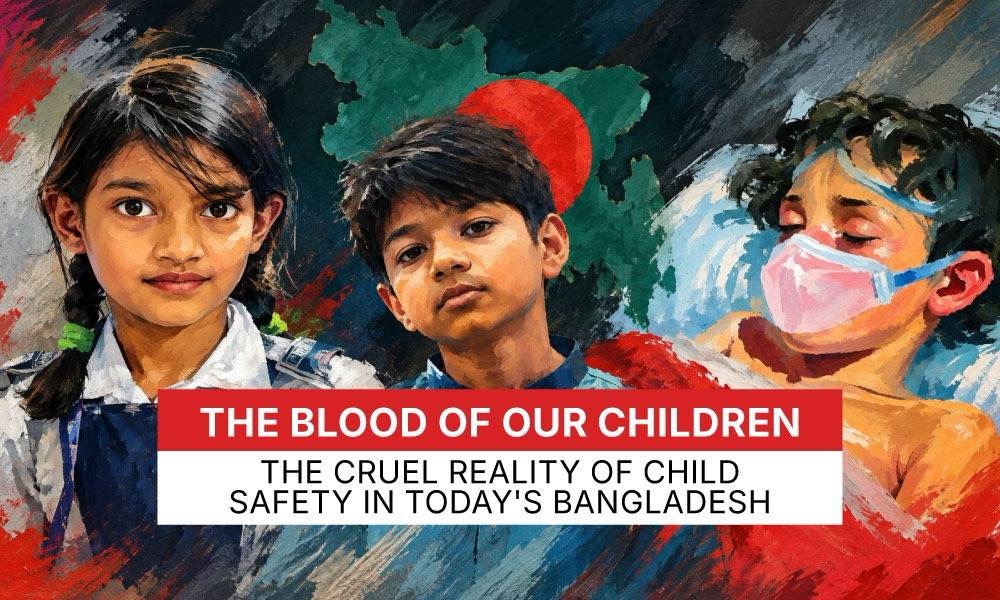
One Oprotim, one Ramisa, or one Asiya alone cannot capture the horrifying reality of child killings in Bangladesh.
Under the new BNP government, Bangladesh’s children are not safe anywhere.
Not in classrooms.
Not in madrasas.
Not on playgrounds.
Not even inside their own homes.
Since this administration took power, a relentless stream of missing-child reports has ended in rape, torture, and murder. The numbers are not abstract. They are dead children. Shattered families. A nation that watches its future generation being slaughtered while the state looks the other way.
155 Children Killed in Eight Months, More Than 2,000 Still Missing

Bodies of 36 missing children recovered in eight months
According to human rights organization Ain o Salish Kendra (ASK) and official police data, 155 children were killed between January and August 2026 alone. Of these, 36 were reported missing before their bodies were recovered, often dumped in ponds, buried under floors, or left in bushes after sexual violence.
ASK Expresses Concern Over Recent Cases of Missing Children Found Dead
Police Headquarters data for the first seven months of the year show 15,717 children reported missing. Authorities claim 13,679 were later found or returned. That still leaves more than 2,000 children unaccounted for. Every week brings another body. Every month the tally of the dead rises.
These are not isolated crimes. They form a pattern of state failure.

Police figures confirm the scale of disappearances: roughly 74 children reported missing every single day in the first seven months of 2026. The recovery rate of 87 percent is repeatedly cited by officials as success. It is not. When more than 2,000 children remain missing, and 36 bodies of previously missing children are recovered in eight months, the system is broken. The “golden hours” after a child vanishes, the critical window for rescue, are routinely wasted. Families file general diaries. Searches drag. Bodies surface days later, decomposed, often showing signs of sexual assault
The failure to enforce basic law and order under the current administration has allowed crime to reach into the spaces where children should feel most secure. Recent cases show that no environment in the country is currently safe:
1. Hospitals and Public Facilities
In September 2026, seven-month-old Mohammad Rakib Islam was stolen directly from Bed No. 11 inside the pediatric ward of Cox's Bazar District Sadar Hospital. Security cameras captured a woman walking out of the government facility with the sick baby in her arms before taking an auto-rickshaw. If a government hospital cannot protect a sick infant, public trust in state institutions completely breaks down.
2. Playgrounds and Neighborhood Streets
In Cumilla, 13-year-old Ishiat Shahriar Apratim went out to play and never came home. His body was found days later. In Pabna, a 10-year-old girl went to a local shop, was abducted, and was later found dead in a pond inside a plastic bag after being sexually assaulted.
From disappearance to recovery of body: FIR details Apratim’s Missing Case
3. Neighboring Homes and Family Spaces
In Madarganj, Jamalpur, a 7-year-old girl was tricked into visiting a classmate's home, where she was assaulted by her classmate’s father, killed, and buried under the dirt floor. In Bagerhat, 9-year-old Rafi Akon went missing from his village, only for his body to be spotted in a nearby canal two days later.
Accused Says Koli Was Killed 15 Minutes After Rape
Other highlighted cases include:
In Pabna, 10-year-old Kamrunnahar Kali went missing. Seven days later, her body was pulled from a ditch in a sack. Investigators say a local shopkeeper raped and strangled her. Public rage led to attacks on the accused’s house.
In Brahmanbaria’s Nabiganj, 7-year-old Mim disappeared after saying she was going to her grandmother’s. Two days later, her semi-decomposed body was recovered from bushes beside a pond.
Half-decomposed body of child, missing for 2 days, recovered in Brahmanbaria

Earlier in the year, the Pallabi case in Dhaka shocked the capital: an 8-year-old girl was raped and murdered by a neighbour; her dismembered body was found in his flat. A special tribunal delivered death sentences in record time. The speed of that one trial only highlighted the lethargy in hundreds of others. Similar cases in Mymensingh, Rangpur, Faridpur and Sitakunda followed the same script: lure, sexual violence, murder, delayed recovery.
Rights groups and independent monitors note that in the majority of these killings the perpetrator was known to the victim. Neighbours. Relatives. Acquaintances. The state’s response has been reactive, fragmented, and insufficient. MUN Alert, the national missing-child notification system launched earlier, has not slowed the deaths. Police statements emphasize recoveries while families bury children.
This crisis is not just about a rise in crime; it is about a lack of accountability. International organizations, including UNICEF, have warned about Bangladesh’s failing child protection systems and called for an end to the culture of impunity. Experts point to three main reasons why this breakdown is happening under the BNP government:
1. Focus Shift in Policing: Local police forces are often directed toward political priorities rather than community policing and basic crime prevention. This leaves neighborhoods without proper protection.
2. Slow Emergency Response: Despite more than 15,000 missing child reports in seven months, police missing-person systems remain slow and fragmented. With over 2,000 children still unrecovered, families are left searching on social media without real support from the state.
3. Lack of Swift Consequences: Criminals, frequently neighbors, local influential figures, or acquaintances, know that legal delays and police inaction will likely protect them. When crimes against children go unpunished, predators become bolder.
The BNP administration came to power promising order and security after years of turmoil. Instead, Bangladesh under its rule has produced a documented surge in violence against the most vulnerable. When children are killed after leaving school, after attending madrasa classes, while playing in village yards, or inside the houses of people they trust, the claim of effective governance collapses.
What exactly is the government doing? Special tribunals exist on paper. Laws against child repression are on the statute books. Yet conviction rates remain low, investigations drag, and the daily average of missing-child reports stays alarmingly high. Public anger occasionally boils over into attacks on accused homes, a symptom of lost faith in official justice. Political statements about “active police” and high recovery percentages do not restore the dead. They do not answer the parents who still wait for children who will never come home.
This is not merely a crime wave. It is a governance failure with generational consequences. A state that cannot keep its children alive in schools, homes, and playgrounds has forfeited the most basic claim to legitimacy. International media and human-rights bodies should treat these figures as a red flag. The numbers are public. The bodies are real. The pattern is established.
Bangladesh’s children are dying under the BNP’s watch. The question is no longer whether the crisis exists. The question is how long the government will be allowed to fail them.








This work is copyrighted and authorized by the Bangladesh Awami League. You may download, display, print and re-produce this material in unaltered form only (retaining this notice)for your personal, non-commercial use or use within your organization.
