71
Published on October 17, 2026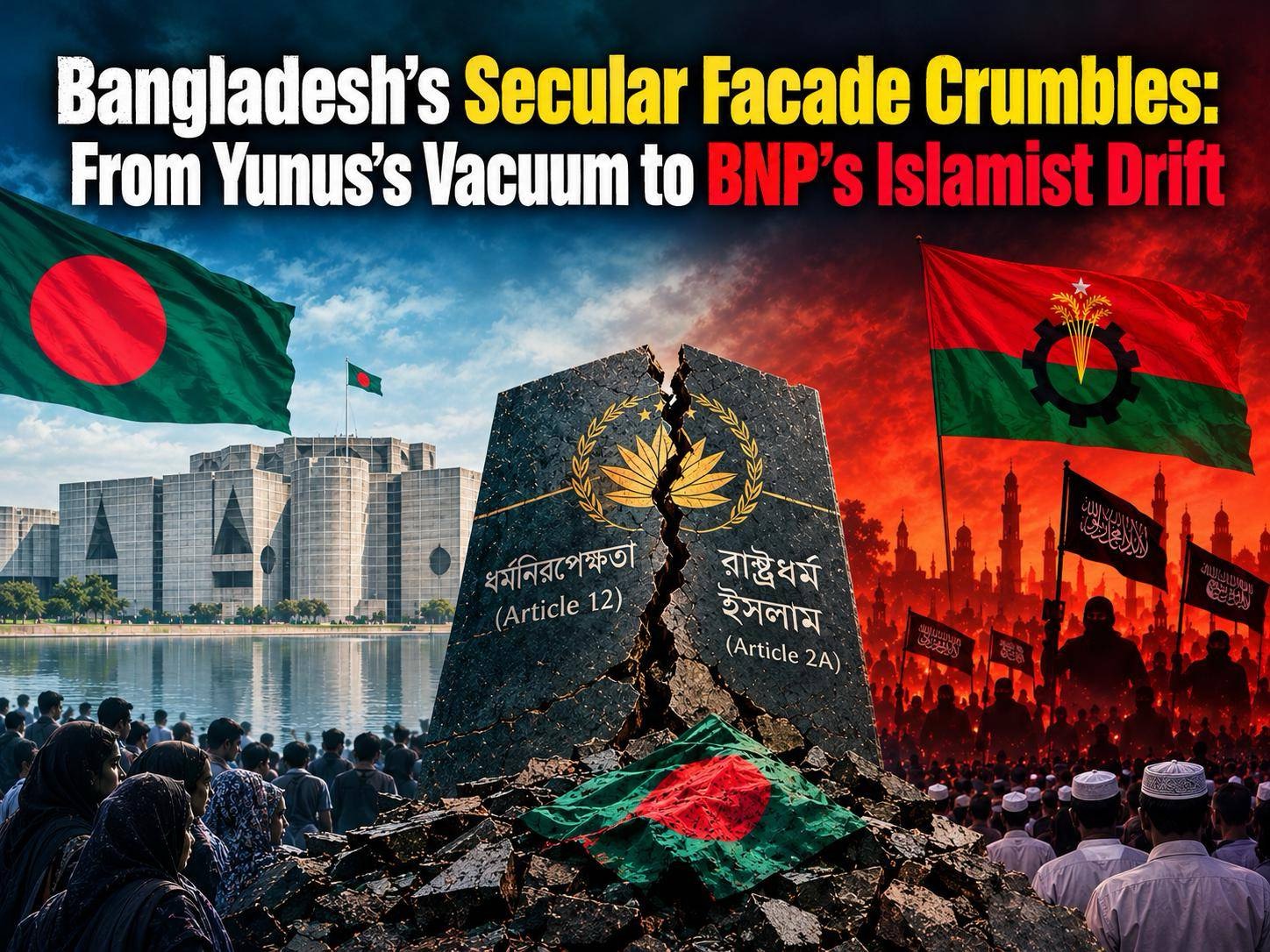
The Yunus-led interim government failed to turn promises of democratic renewal into lasting protection for minorities. Now, the BNP government must prove that religious identity will never matter more than equal citizenship.
For decades, international observers lauded Bangladesh as a rare triumph: a Muslim-majority democracy founded on secular principles. But beneath this diplomatic veneer lies a schizoid constitution and a political class that traded national security for short-term political survival. Today, as radical networks like Islamic State Khorasan (ISK) and Al-Qaeda in the Indian Subcontinent (AQIS) rebuild inside the country’s borders, the West must confront a stark reality: Bangladesh’s governance model is collapsing into a breeding ground for global jihad.
Bangladesh’s Evolving Security Crisis: The Rise of Religious Extremism Amid Political Transition
The tragedy of Bangladesh is not merely the resurgence of extremist networks; it is the cynical paralysis of the interim administration led by Dr. Muhammad Yunus and the dangerous opportunism of the newly elected Bangladesh Nationalist Party (BNP) government. Both have sacrificed national stability to appease hardline Islamist factions, leaving a nuclear-adjacent region exposed to systemic risk.
Thousands join Hefazat's grand rally
Bangladesh's constitutional framework contains an apparent contradiction. While Article 12 purports to guarantee secularism and religious freedom, Article 2A explicitly designates Islam as the state religion. This structural hypocrisy left the door wide open for political weaponization.

Both provisions remain part of the constitutional framework. Their coexistence raises an important question: how can the state give one religion official status while ensuring that every citizen feels equally represented?
Bangladesh does not need to choose between Islam and democracy. It needs to ensure that the recognition of Islam never becomes a justification for unequal citizenship.
Does Removing Secularism Mean Turning Bangladesh Toward a Jamaat-Oriented State?
When Muhammad Yunus took charge of the interim government in August 2024, the situation changed quickly. The ban on Jamaat-e-Islami was lifted. Key radical figures were released. Security institutions that had previously disrupted extremist networks were weakened and politicized. What followed was a power vacuum that hardline groups moved to fill.

Human Rights Watch's World Report 2026, citing Bangladeshi human-rights organisation Ain o Salish Kendra, reported that at least 124 people were killed in mob attacks between June and August 2025. The report also raised concerns about attacks on minorities and pressure from religious hardliners.
Hindus in Muslim-majority Bangladesh rally to demand protection from attacks
The numbers for Hindus are especially stark. Between August 2024 and mid-2026, more than 3,200 attacks were recorded. Temples were vandalized, homes burned, and businesses looted. Groups that had been tightly controlled under the previous government suddenly operated in the open. Hizb ut-Tahrir held public marches calling for a caliphate. Reports surfaced of Islamic State Bengal networks running bomb-making operations out of madrasas near Dhaka. Black flags and images of Osama bin Laden appeared at rallies.
Yunus’s administration spoke about democratic reform, yet it failed to push back effectively against the forces that reject democratic pluralism. Proposals to improve women’s rights ran into strong street pressure from Hefazat-e-Islam. Cultural events were disrupted. Minority communities reported a sharp rise in insecurity. The interim period did not create Bangladesh’s Islamist currents, but it removed many of the barriers that had previously contained them. By the time elections were held in February 2026, the political atmosphere had already shifted.
Jamaat genie out of bottle: How Yunus has failed to tame radicalism in Bangladesh
If the interim government created the security vacuum, the newly elected BNP government has actively institutionalized it. Returning to power in alliance with radical elements, the BNP leadership has reverted to its historically dangerous playbook, normalizing extremist networks rather than purging them from state structures:
Mainstreaming Militancy: Individuals associated with proscribed terror cells are being integrated into local governance structures and political coalitions under the pretext of democratic inclusion.
Transnational Conduit: Intelligence reports confirm that transnational radical groups, including ISIS affiliates and Rohingya militant factions, are leveraging porous southeastern borders and lawless refugee camps to run recruitment drives and illegal arms trafficking networks funded by foreign entities.
Dismantling Counter-Terrorism Infrastructure: Specialized police units, including the Counter Terrorism and Transnational Crime (CTTC) unit, have been systematically purged or deprioritized, neutering Bangladesh's intelligence apparatus.
Bangladesh's Political Transition and the Challenge of Extremism
The human cost is already visible. Hindu communities, once around 9 percent of the population, live with growing fear. Women face tighter social controls. Space for secular cultural life is shrinking. Extremist ideas that were once limited to the margins have become more visible and, in some circles, more acceptable.
The December 2025 explosion at a madrasa in Keraniganj, linked to Islamic State Bengal, served as a concrete warning. It showed that the infrastructure of radical networks is being rebuilt while politicians debate constitutional language.
Keraniganj madrasa blast: Al Amin’s militant links under investigation
For the wider region and the international community, the stakes are high. A Bangladesh that drifts toward majoritarian Islamism becomes less stable, less reliable on counterterrorism, and a greater source of concern for its neighbors, especially India. What was once presented as a success story of Muslim-majority democracy risks becoming an example of how democratic openings can be captured by religious identity politics.
Both the Yunus interim government and the current BNP administration share responsibility for this trajectory. One created the opening and released the constraints. The other has chosen not to close it. Talk of “pluralism” and “reform” cannot hide the direction of travel.
Bangladesh does not have to choose between faith and democracy. It does have to decide whether the state will protect equal rights for all citizens or gradually become a vehicle for majoritarian religious assertion. At present, the second path is gaining ground. The window to change course is still open, but it is narrowing. International observers who once viewed Bangladesh as a moderate success story should look more carefully at what is actually happening. The paradox is no longer abstract. It is unfolding in real time.



This work is copyrighted and authorized by the Bangladesh Awami League. You may download, display, print and re-produce this material in unaltered form only (retaining this notice)for your personal, non-commercial use or use within your organization.
