81
Published on November 19, 2026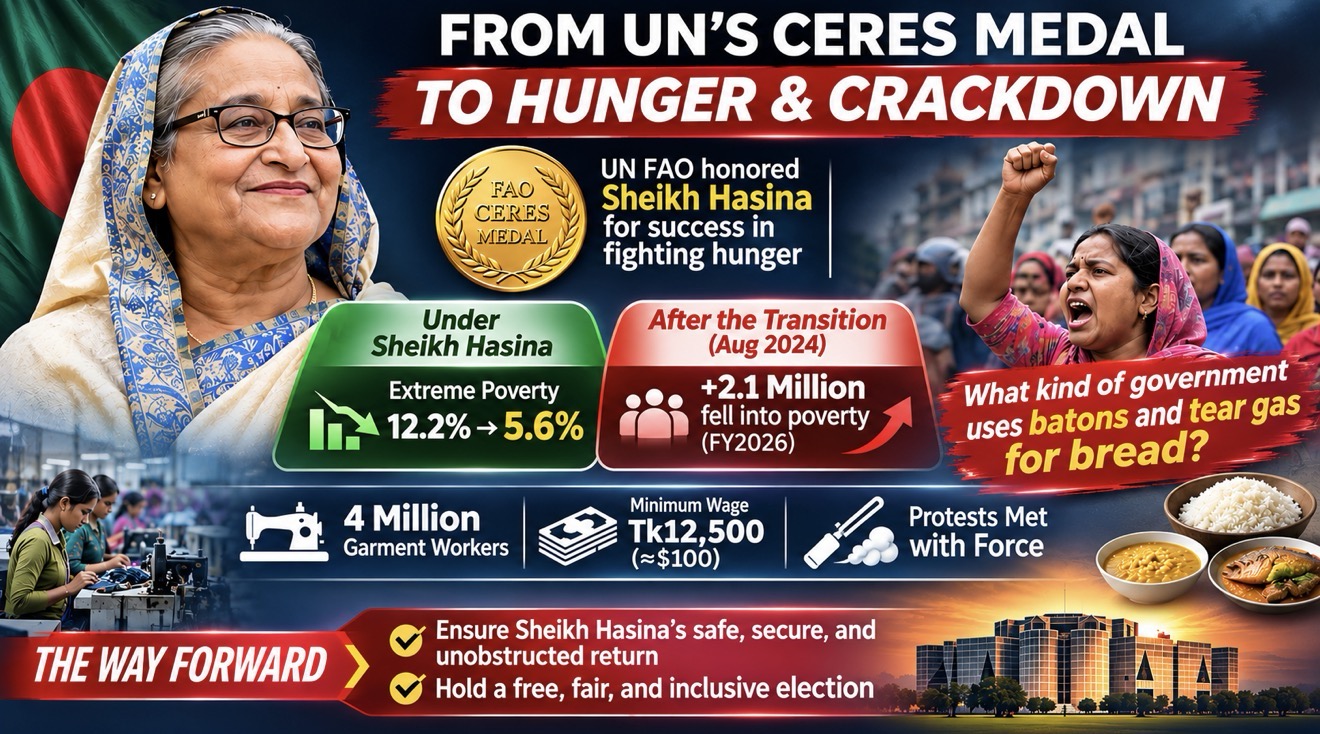
In 1999, the United Nations Food and Agriculture Organization (FAO) awarded Prime Minister Sheikh Hasina the prestigious Ceres Medal in recognition of her contributions to agricultural development, food security and the fight against hunger. It was an international acknowledgment of Bangladesh’s commitment to improving the lives of its people.
Under her leadership, Bangladesh made remarkable progress in poverty reduction, food security and socioeconomic development. Millions of families moved out of poverty, rural livelihoods improved, and access to basic necessities expanded. Yet, barely two years after the political upheaval of August 2024, the country is confronting a deeply troubling reversal: rising economic insecurity, declining purchasing power and growing unrest among workers struggling to survive.
Between 2010 and 2022, Bangladesh achieved substantial poverty reduction under Sheikh Hasina’s government.
34 million people escaped poverty, marking a significant improvement in living standards.
Extreme poverty declined from 12.2% to 5.6%.
Moderate poverty fell from 37.1% to 18.7%.
These were not merely statistical achievements. They represented millions of families gaining better access to food, housing, education, healthcare and economic opportunities. Bangladesh’s development trajectory demonstrated that sustained investment, agricultural advancement and targeted social programmes could deliver meaningful improvements in people's lives.
The international recognition Sheikh Hasina received was rooted in these broader development efforts.
The economic outlook since the August 2024 political transition has become increasingly concerning. The latest poverty and inflation figures point to mounting pressure on ordinary households.
2.1 million additional people were estimated to have fallen into poverty in FY2026.
Inflation averaged 8.7% in FY2026, continuing to undermine household purchasing power.
Approximately 62 million people remain economically vulnerable, at risk of slipping into poverty.
Although these figures reflect different poverty measures and reference periods, their implications are difficult to ignore. Years of progress in reducing poverty have been followed by renewed economic insecurity, leaving millions of Bangladeshis struggling to cope with rising living costs.
For ordinary families, the crisis is not an abstract economic debate. It is the daily struggle to afford rice, lentils, cooking oil, vegetables, fish and other essentials. When food prices rise faster than incomes, even families previously considered economically secure can find themselves pushed towards poverty.
The authorities governing since August 2024 cannot simply blame inherited problems or global economic pressures. They must account for their economic management, policy decisions and failure to adequately protect vulnerable households.
Perhaps nowhere is the deterioration in living conditions more visible than in Bangladesh’s garment sector.
More than four million workers sustain an industry that remains one of the country's principal sources of export earnings. Yet the minimum monthly wage stands at just Tk12,500, leaving workers struggling to meet even their most basic needs amid persistent inflation.
Their demands are neither unreasonable nor radical. They want wages that can provide adequate food, decent housing, healthcare, education for their children and a life with basic human dignity.
Instead of treating these grievances as legitimate concerns requiring urgent dialogue and policy intervention, authorities have faced allegations of using batons, tear gas and intimidation against protesting workers.
What kind of government responds to workers demanding enough money to feed their families with batons and tear gas?
Workers who help generate billions in export earnings should not have to risk injury simply to demand a living wage. Their right to peaceful assembly, collective bargaining and freedom of expression must be respected.
The contrast is particularly striking. A country whose former prime minister received international recognition for her contribution to the fight against hunger is now witnessing workers being confronted with force while demanding the means to put food on their tables.
The broader political consequences of the August 2024 transition cannot be separated from Bangladesh's economic and institutional challenges.
Development requires political stability, accountable institutions, public confidence and an inclusive democratic framework. The exclusion of a major political force such as the Awami League from the electoral process raises serious questions about political pluralism and the legitimacy of any claim to democratic representation.
Bangladesh cannot build a sustainable future through political exclusion, intimidation or the suppression of dissent. Nor can economic hardship be addressed by treating legitimate public grievances as threats to those in power.
The people deserve accountable governance, not political persecution; meaningful economic opportunities, not empty promises; and the protection of their fundamental rights, not violence when they demand them.
Bangladesh urgently needs a political and economic course correction. This requires more than rhetoric. It demands concrete commitments:
Guarantee Sheikh Hasina’s safe return: Her security, constitutional rights and freedom of political participation must be protected, without arbitrary obstruction or politically motivated persecution.
Restore inclusive democracy: Hold a free, fair and credible national election in which all major political parties, including the Awami League, can participate without discrimination or intimidation.
Protect workers’ rights: End the use of excessive force against peaceful labour protests and establish meaningful dialogue to ensure fair wages, workplace safety and economic security.
Address the cost-of-living crisis: Take effective measures to control inflation, strengthen purchasing power, protect vulnerable households and expand employment opportunities.
Restore accountable governance: Strengthen democratic institutions, the rule of law and fundamental freedoms so that economic development benefits the wider population.
The contrast between Bangladesh in 1999 and Bangladesh today should serve as a warning.
The Ceres Medal recognised a commitment to fighting hunger. The poverty reduction achieved between 2010 and 2022 demonstrated what sustained development efforts could accomplish. But economic insecurity, rising living costs and the violent suppression of workers' grievances threaten to undermine that progress.
A nation cannot claim development while millions struggle to afford food. It cannot claim democracy while a major political constituency is excluded. And it cannot claim to protect workers while those demanding a living wage face batons and tear gas.
Bangladesh deserves better than a return to hunger, repression and political exclusion.
Ensure Sheikh Hasina’s safe and unobstructed return. Restore inclusive democracy. Protect workers' rights. Make economic security a national priority. End hunger.



This work is copyrighted and authorized by the Bangladesh Awami League. You may download, display, print and re-produce this material in unaltered form only (retaining this notice)for your personal, non-commercial use or use within your organization.
