1011
Published on November 25, 2026
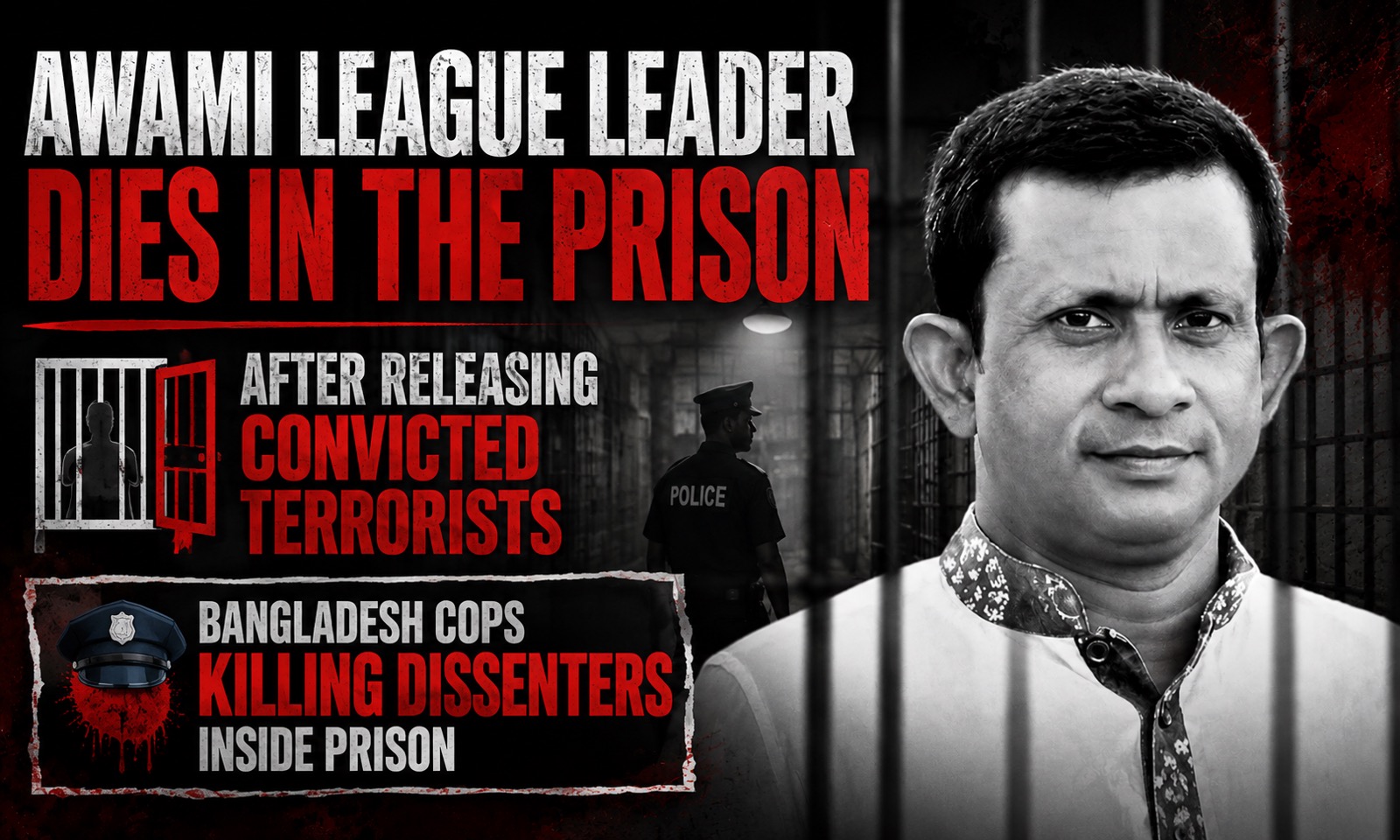
On 31 August, Nurul Islam, General Secretary of Ward No. 7 of the Awami League in Mirsharai Municipality, secured bail in a case. A month earlier, on 31 July, he had been sent to prison under the Anti-Terrorism Act. The moment he stepped through the prison gate with his bail papers in hand, police arrested him again in another case and took him back inside. At noon on 2 September, he died.
The prison superintendent said that he had suffered chest pain during prayer. His wife, Rokeya Akter, said that the shock of being arrested again on the very day he secured bail had broken him emotionally. This man, who worked in marketing at a private hospital, has now left behind two young children without a father.
This is not an isolated incident. On 23 July, Bablu Mia died in Sirajganj District Jail. He had been brought to prison a month earlier in connection with a political case. On 3 November, Zakir Hossain Nabab, Organising Secretary of the Bogura District Awami League, died in Naogaon District Jail. He had been detained since last year in an explosives case. Ranjit Ghosh of Kishoreganj secured bail on Sunday and was supposed to be released on Monday. But he died before his release.
His family confirms that despite informing the authorities about his illness, he received no medical treatment. Prison authorities, however, say he was taken to hospital. In the first six months of the government, ASK recorded 61 deaths in custody and 66 political killings. Not all the victims belonged to the Awami League, but the state is responsible for the life of every person in its custody. The longer the detention and the further justice is delayed, the heavier that responsibility becomes.
To understand how these arrests are being generated, it is important to remember a finding by Human Rights Watch (HRW). More than 8,400 people have been named as accused in just ten murder cases, most of them without even being individually identified. When thousands of unnamed people are listed as accused in a case, the door remains open for anyone to be picked up at any time. The November arrest figures are coming through precisely that door.
Within 24 hours on 16–17 November, 526 people were detained in Dhaka, including 50 members of the Awami League and Chhatra League. Within 24 hours on 19 November, another 537 people were arrested, including 107 Awami League members. The following day, the figure was 124. MZamin has counted at least 828 arrests in the capital alone since 1 November.
Former State Minister, freedom fighter and retired Lieutenant Colonel Nazrul Islam Hiru was arrested in connection with an attempted murder case filed over an incident in Vatara on 19 July 2024, in which Sheikh Hasina is also named as an accused. Former Education Minister Nurul Islam Nahid was picked up from a house in Uttara at 2:20 a.m. The following day, a court sent him to prison.
Even before his arrest, local BNP leaders and activists had gathered outside the house. It is difficult to accept as mere coincidence the timing of the arrests of senior leaders in cases dating back to July, a year and a half ago, during the very week the Awami League announced a lockdown.
Now let us turn to mob violence, because the boundary between the law and the mob has almost disappeared.
The Home Minister, upon taking office in February, said that mob violence would not be tolerated. On 27 August, he declared a zero-tolerance policy in Parliament. In February itself, the High Court had asked the government why its failure to prevent mob violence should not be declared unlawful.
According to ASK’s figures, at least 154 people were beaten to death during the first eight months, from January to August. By November, the reality behind that zero-tolerance policy had become apparent.
At Barishal University, Chhatra Dal leaders and activists beat five university officers and employees over allegations of their links to the Awami League, dragged them away and took them into the proctor’s office. One Chhatra Dal leader publicly declared that their programme would continue until Awami League collaborators were “eliminated”.
In Rupsha, Khulna, local people seized Monir Master, a headteacher and General Secretary of an Awami League ward unit, from his own business establishment and handed him over to the police. Police say there are three cases against him.
This pattern deserves attention: first, people are beaten; then the crowd detains them and hands them over to the police; finally, the police pursue cases against them. The mob has now become an extension of the arrest machinery, while the state serves as its final repository.
The language used to legitimise this mob has come from the very top of the administration. On 11 November, the Home Minister told Parliament that just as the Nazis could never return to Germany, the “fascist Awami forces” would never be allowed to return to Bangladesh.
After comparing an entire political party—which includes teachers, shopkeepers, salaried employees and rural Union Parishad members—to the Nazis, the phrase “fascist collaborators” was bound to circulate on the streets like a licence to attack people.
In Monirampur, Jashore, three government employees conducting a survey for the Family Card programme had their tablets seized, and one was beaten and injured, with the same label being used against them.
How this licence has entered the language of administration in educational institutions was demonstrated by Human Rights Watch on 3 November. More than 400 teachers across 22 universities are under investigation. At Dhaka University, 44 teachers have been asked to stop working, while 25 have had their teaching activities restricted.
Professor Purba Islam of the Agricultural University was suspended over allegations that she chanted slogans during a procession. Yet the video of the incident reviewed by the organisation does not show her chanting any slogans.
Another professor, Yahia Khandaker, was suspended over allegations of taking a “pro-Hasina position on campus”, even though he was in Dhaka with his family at the time. The High Court has stayed his suspension, but the government is appealing the decision.
Here, accusations come before evidence, and punishment comes before due legal process.
The clearest example of all this is Kalia in Narail.
On 18 November, two BNP-linked leaders were killed. Police themselves confirmed that two people had already been detained in connection with the incident. In other words, the suspects were in state custody, the courts were functioning, and the path to justice was open.
Yet, from 4 p.m. on 20 November until midnight, houses were set on fire in Bendar Char and surrounding areas. The homes of former MP Kabirul Haque Mukti, a former mayor and ordinary party activists were targeted.
Now consider the figures relating to the damage. The Superintendent of Police told Prothom Alo that three to four houses were affected. The Officer-in-Charge of the police station said 15 to 20, some of which were abandoned houses already damaged after 5 August. The Fire Service said more than 50 residential structures across 20 to 25 houses had been affected. Victims said at least 60 houses were targeted.
A press release from Police Headquarters also stated that BNP and affiliated organisation leaders and activists had gathered there alongside relatives of the deceased. Later, there was another attempt to dismiss the reports as rumours.
Before calling an incident a “rumour”, when the accounts of the damage given by officials of the same government range from three to twenty houses, they should have first reconciled their own figures.
Representatives of the Hindu community have also confirmed the incident of this widespread communal attack. The attack on the home of Krishna Pada Ghosh, a Hindu Awami League leader in Ghoshpara, was also part of this violence.
The geography of these arson attacks points to a clear pattern.
On the night of 17 November, in “protest” against an attack on a police station in Gopalganj and the burning of a BNP MP’s house, a procession in Cumilla headed towards the Awami League’s South District Office and the home of former MP Bahar Uddin Bahar.
The media directly described the incident as “counter-fire”. Bahar and his daughter, a former mayor, were outside the country. Nobody was present in the house or office.
In response to a crime committed in Gopalganj, petrol was poured into the ground floor of an empty house in Cumilla.
The following day, in Sirajganj, the same Awami League office and the home of the same former MP, Habibe Millat Munna, were set on fire. This was the second such attack. Local residents said they had seen several Chhatra Dal members at the scene.
In Sitakunda, the personal assistant of a former MP reported an attack on the former MP’s house, alleging that the caretaker had been tied to a tree and beaten.
Police say some of the videos circulating on social media are old.
In Kalapara, Patuakhali, local BNP leaders and activists have been accused of vandalising and looting the homes of 12 leaders, including former State Minister Mohibbur Rahman.
If a case is filed over a crime in Gopalganj, it should be tried in a court in Gopalganj. If that crime becomes an excuse to spread attacks from house to house against Awami League leaders across the country, that is what can be called a system of “collective punishment”!
If we remember that the legal basis of this entire structure was supposed to be “temporary”, the responsibility of the current BNP government becomes even clearer.
In May 2025, the activities of the Awami League were banned until the completion of the tribunal’s trials. At the time, UN High Commissioner for Human Rights Volker Türk warned that this would not ensure accountability, would restrict rights, and that the trials could take years.
On 8 April 2026, the new Parliament approved the Anti-Terrorism (Amendment) Ordinance, thereby maintaining the ban.
The government that pledged in its own election manifesto to fully respect international human rights law now has a Home Minister who tells Parliament in November that law enforcement agencies have never done anything that amounts to a human rights violation.
Human Rights Watch says the exact opposite: the BNP-Jamaat alliance has once again brought back its old methods of repression, even though it should have turned that page. But it has not.
On 15 August, in front of Dhanmondi 32, a rickshaw driver was recording a video on his mobile phone when he was beaten. Another man was distributing singaras; he too was brutally beaten. Someone had said “Joy Bangla” and met the same fate.
Two of them were detained by the police. We do not know whether any of these three individuals had cases filed against them. There was no need to find out, because on that day, they had only one identity.
References
1. Death of an Awami League leader detained in Chattogram Jail (Prothom Alo, Nurul Islam) https://www.prothomalo.com/bangladesh/district/c672z7jtnv
2. Death of an Awami League leader in prison (Bangla Tribune, information about his admission to prison on 31 July) https://www.banglatribune.com/country/chitagong/966347/
3. Awami League leader dies after falling ill in Sirajganj Jail (Desh Rupantor, Bablu Mia) https://www.deshrupantor.com/706548/
4. Awami League leader dies after falling ill in prison (Bangla Tribune, Zakir Hossain Nabab) https://www.banglatribune.com/country/rajshahi/978511/
5. Awami League leader dies in prison the day after securing bail (Times of Bangla, Ranjit Ghosh) https://bangla.tob.news/%E0%A6%9C%E0%A6%BE%E0%A6%AE%E0%A6%BF%E0%A6%A8-%E0%A6%AA%E0%A6%BE%E0%A6%93%E0%A7%9F%E0%A6%BE%E0%A6%B0-%E0%A6%AA%E0%A6%B0%E0%A6%A6%E0%A6%BF%E0%A6%A8-%E0%A6%95%E0%A6%BE%E0%A6%B0%E0%A6%BE%E0%A6%97/
6. Political violence shadows Bangladesh’s new government (Arab News) https://arabnews.com/node/2650594/world
7. Bangladesh: New Crackdown Under Anti-Terrorism Law (Human Rights Watch) https://www.hrw.org/news/2025/10/08/bangladesh-new-crackdown-under-anti-terrorism-law
8. 526 arrested in a single day, including Awami League and Chhatra League leaders and activists (bdnews24 Bangla) https://bangla.bdnews24.com/bangladesh/yg2gkujrl4
9. ‘107 Awami League members’ among 537 arrested in Dhaka (bdnews24) https://bdnews24.com/bangladesh/ipn3hfpzwn
10. More than a thousand Awami League leaders and activists, including ministers and MPs, arrested in the capital (Manabzamin) https://www.mzamin.com/article/62751
11. Bangladesh arrests freedom fighter and former minister amid escalating crackdown on Awami League leaders (IANS) https://ianslive.in/bangladesh-freedom-fighter-and-former-minister-arrested-amid-escalating-crackdown-on-awami-league-leaders–20261118154444
12. Police detain ex-minister, Awami League leader Nahid from Uttara home (The Financial Express) https://thefinancialexpress.com.bd/national/police-detain-ex-minister-awami-league-leader-nahid-from-uttara-home
13. 107 Awami League-linked activists arrested in Dhaka crackdown (Dhaka Tribune) https://www.dhakatribune.com/bangladesh/425200/107-awami-league-linked-activists-arrested-in
14. Beyond protest: Mob violence and the struggle for institutional response in Bangladesh (Global Voices) https://globalvoices.org/2026/09/27/beyond-protest-mob-violence-and-the-struggle-for-institutional-response-in-bangladesh/
15. Chhatra Dal hands over five university officers and employees to police (Risingbd) https://www.risingbd.com/campus/news/671837
16. Violence in nine districts: Homes of dozens attacked and set on fire in Narail (Ajker Patrika; also covering Monir Master in Khulna and incidents in Kalapara and Narail) https://www.ajkerpatrika.com/bangladesh/narail/ajpmwjt2rtrug
17. Family Card survey worker beaten and tablet seized after being labelled a ‘fascist collaborator’ (Ajker Patrika) https://www.ajkerpatrika.com/bangladesh/jashore/ajp79mocpg8sk
18. ‘Fascist Awami League Forces Will Never Be Allowed to Return’: Home Minister Tells Parliament (Prothom Alo English) https://en.prothomalo.com/bangladesh/politics/6xq5i6l2su
19. Bangladesh: Academics Allegedly Targeted for Supporting Hasina (Human Rights Watch) https://www.hrw.org/news/2026/11/03/bangladesh-academics-allegedly-targeted-for-supporting-hasina
20. 20–30 homes of activities-banned Awami League leaders and activists attacked, set on fire in Narail (Prothom Alo English) https://en.prothomalo.com/bangladesh/politics/r2ss3xs64o
21. Police dismiss reports of attacks on Hindu homes in Narail as rumours (The Business Standard) https://www.tbsnews.net/bangladesh/police-dismiss-reports-attacks-hindu-homes-narail-rumours-1609461
22. Police, Hindu leaders reject communal attack claims in Narail (Dhaka Tribune) https://www.dhakatribune.com/bangladesh/nation/425363/narail-hindu-leaders-reject-communal-attack-claims
23. Awami League office and former MP Bahar’s house set on fire in Cumilla (Jugantor) https://www.jugantor.com/country-news/1186069
24. Former MP Bahar’s house and Awami League office set on fire (Bhorer Kagoj) https://www.bhorerkagoj.net/chittagong/803719
25. Awami League office and former MP’s house set on fire in Sirajganj (Ajker Patrika) https://www.ajkerpatrika.com/bangladesh/sirajganj/ajpg5nwqvrchq
26. Former Awami League MP’s house vandalised and set on fire in Chattogram (Sitakunda) (Barta Bazar) https://bartabazar.com/news/382138/
27. Bangladesh: Interim government bans Awami League activities under anti-terror law (International IDEA Democracy Tracker) https://www.idea.int/democracytracker/report/bangladesh/may-2025?pid=8061
28. Bangladesh arrests 10 leaders and activists of the Awami League and its affiliated organisations (ANI; 8 April ordinance) https://aninews.in/news/world/asia/bangladesh-arrests-10-leaders-and-activists-of-the-awami-league-and-its-affiliate-organisations20260622195304/
29. Three beaten, two detained over ‘Joy Bangla’ slogan, video recording and singara distribution at Dhanmondi 32 (Prothom Alo English) https://en.prothomalo.com/bangladesh/city/7jerb8alux









This work is copyrighted and authorized by the Bangladesh Awami League. You may download, display, print and re-produce this material in unaltered form only (retaining this notice)for your personal, non-commercial use or use within your organization.
